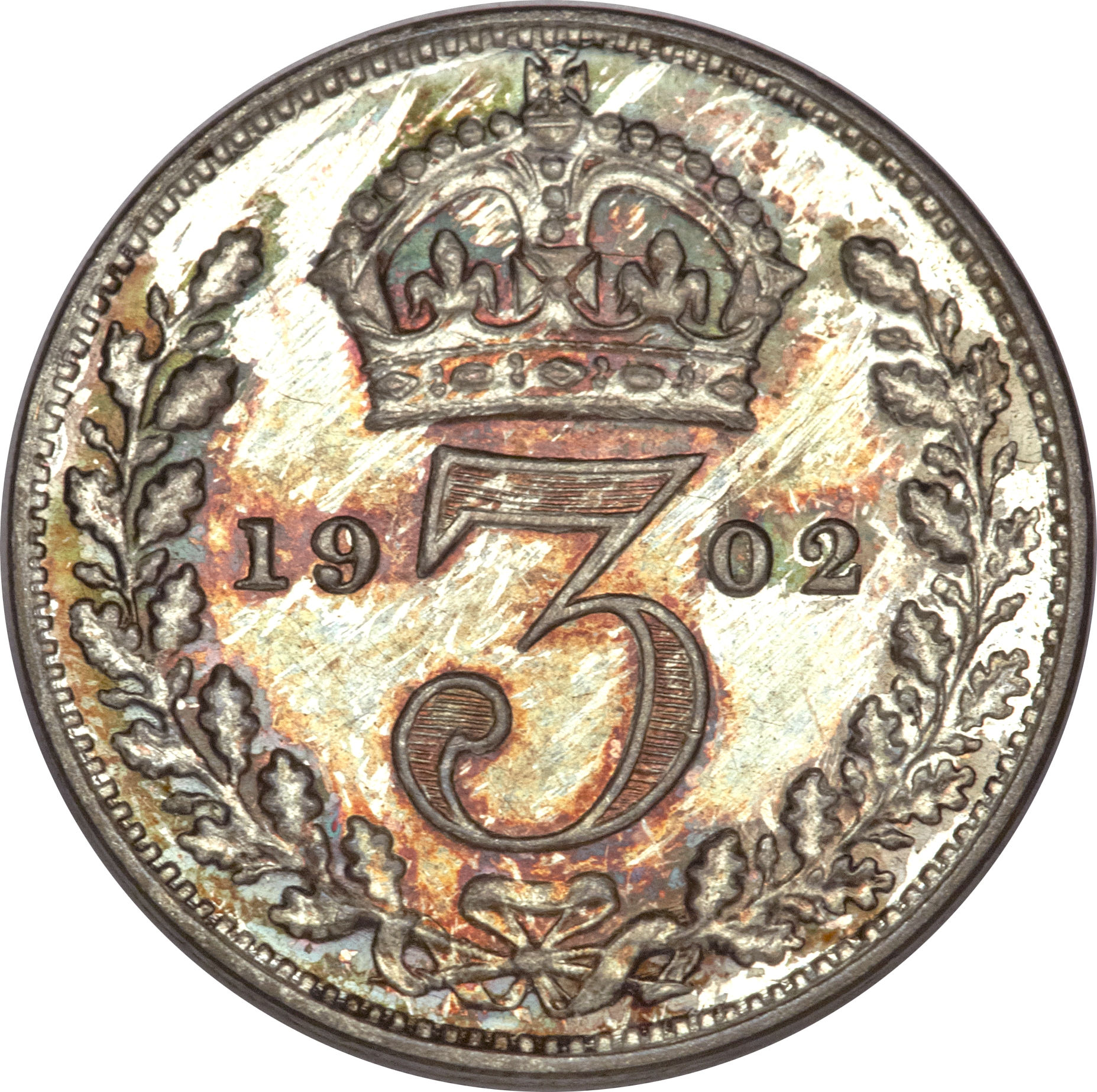
Very Rare: fewer than 100,000 minted.
1 Penny - Edward VII Maundy issues (1902–1910)
| Country | United Kingdom |
| Year | 1902–1910 |
| Denomination | 1 Penny |
| Mintage | 21,000 |
| Mint | Royal Mint · Llantrisant |
| Series | Maundy Money |
| Circulation | Non-circulating |
| Composition | Silver (.925) (925/1000 fine) |
| Weight | 0.470g · 0.0140 t oz |
| Diameter | 11.0mm |
| Shape | Round |
| Orientation | Medal alignment ↑↑ |
| Obv. artist | George William de Saulles |
| Rev. artist | Jean Baptiste Merlen |
| Grade scale | UK (EF/UNC) |
Uncrowned portrait of King Edward VII right, legend around.
Crowned denomination dividing date within oak wreath.
Find this on eBay
Affiliate1 Penny - Edward VII Maundy issues price history
Daily limit reachedAbout the 1902 1 Penny - Edward VII Maundy issues
The 1902 1 Penny - Edward VII Maundy issues is a collector 1 penny coin issued from 1902 to 1910 in the Maundy Money series, struck in 92.5% silver. It weighs 0.47g and measures 11mm across. Reverse design: Crowned denomination dividing date within oak wreath.
A mintage of 21,000 is recorded for one date of this type; figures for each year are not held.
Common questions
How much is the 1902 1 Penny - Edward VII Maundy issues worth?
No verified sale of the 1902 1 Penny - Edward VII Maundy issues has been logged on MyCoinage yet.
Is an Edward VII Maundy penny legal tender?
Yes, technically. Maundy money remains legal tender, and Wikipedia notes that at decimalisation all Maundy pieces, old and new, were deemed to be in new pence, so an Edward VII Maundy penny now has a face value of 1p. They do not circulate because of their silver content and collector value.
Why are 1909 and 1910 Maundy pennies scarcer?
Until 1908 Maundy sets could be ordered through banks. From 1909 distribution was restricted to the recipients and certain officials, and Tony Clayton says Edward VII himself gave that instruction. CoinVarieties gives 2,948 Maundy pennies for 1909 against 18,000 for 1908.
Who designed the Edward VII Maundy penny?
The Royal Mint credits the King's portrait to George William de Saulles. The reverse, a crowned figure 1 in an oak wreath, is Jean Baptiste Merlen's design of 1822, with the crown revised by Leonard Charles Wyon in 1888.
What is the 1902 matt proof Maundy penny?
In 1902 the Maundy pieces were included in the matt proof sets issued to mark the new reign, alongside the larger silver and the gold. These have a sandblasted finish that CoinVarieties notes is easily disturbed. Ordinary 1902 Maundy pennies were also struck for the ceremony.
How do I identify the 1902 1 Penny - Edward VII Maundy issues?
Check the weight 0.47g and diameter 11mm and the metal (92.5% silver) against the specification table on this page. The reverse design is described above.
History and design
The penny is the smallest of the four silver coins given out at the Royal Maundy service on the day before Good Friday. Edward VII's Maundy pennies were struck in every year of the reign. The Royal Mint's own listing for 1907 explains that the four denominations struck that year would make up 8,760 complete sets, which shows that the four values were never struck in exactly equal numbers.
In the CoinVarieties figures the penny was usually the most plentiful of the four. CoinVarieties, quoting the Krause catalogue, gives 21,000 for 1902 and 18,000 for 1908. The numbers fell sharply after 1908: until then Maundy sets could be bought through banks, but from 1909 they were reserved for the recipients and those involved in the ceremony, and the 1909 figure drops to 2,948.
The obverse carries George William de Saulles's bare head of Edward VII, the portrait the Royal Mint credits on its Maundy set pages. The reverse is a crowned figure 1 within an oak wreath, a design introduced by Jean Baptiste Merlen in 1822 and given a new crown by Leonard Charles Wyon in 1888.
The coin is struck in sterling silver, 92.5 percent fine. Maundy pieces kept that standard until the reduction to 0.500 silver that Wikipedia dates to 1921.
Collecting notes
Maundy pennies are usually collected in sets of four, often in their original dated cases or purses. The 1909 and 1910 dates are the harder ones because of the restricted distribution. 1902 also exists as a matt proof from the coronation-year proof sets, distinguishable by its dull sandblasted surface. Wear is unusual: Tony Clayton notes that Maundy coins after 1820 rarely turn up below very fine. The Edward VII Maundy twopence is the next value up.
Sources
The history, design, varieties and collecting notes on this page are drawn from these sources. Prices come from recorded sales, not from them.
- 1909 Edward VII Maundy Set, The Royal Mint (read 10 Oct 2026)
- Maundy money, Wikipedia (read 10 Oct 2026)
- Maundy Money, Tony Clayton, Coins of the UK (read 10 Oct 2026)
- Great Britain 1902, 1904, 1905, 1908 and 1909 penny KM-795 (pages read one by one), CoinVarieties (read 10 Oct 2026)
- Edward VII Silver Maundy Set 1907, The Royal Mint (read 10 Oct 2026)
More from Maundy Money