1 Penny - George III Pattern (1797)
Circulating version: 1797 1 Farthing - George III Pattern
| Country | United Kingdom |
| Year | 1797 |
| Denomination | 1 Penny |
| Mint | Royal Mint · Llantrisant |
| Circulation | Non-circulating |
| Demonetised | Yes |
| Composition | Gold |
| Weight | 39.110g |
| Diameter | 36.0mm |
| Thickness | 2.50mm |
| Shape | Round |
| Edge | Plain |
| Orientation | Coin alignment ↑↓ |
| Obv. artist | Conrad Heinrich Küchler |
| Rev. artist | Conrad Heinrich Küchler |
| Grade scale | UK (EF/UNC) |
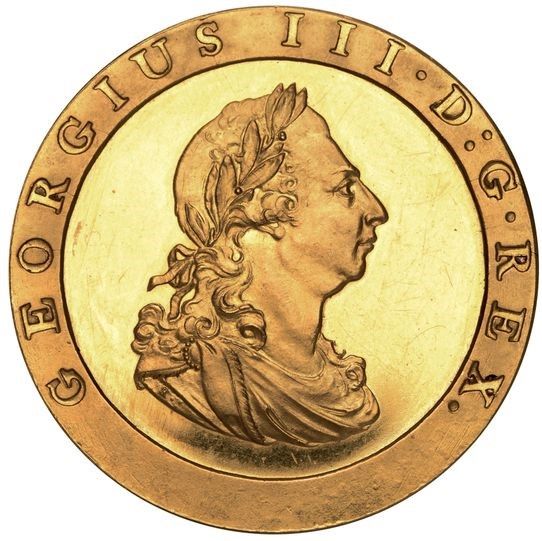
Laureate and draped bust of King George III right, legend around on raised rim.
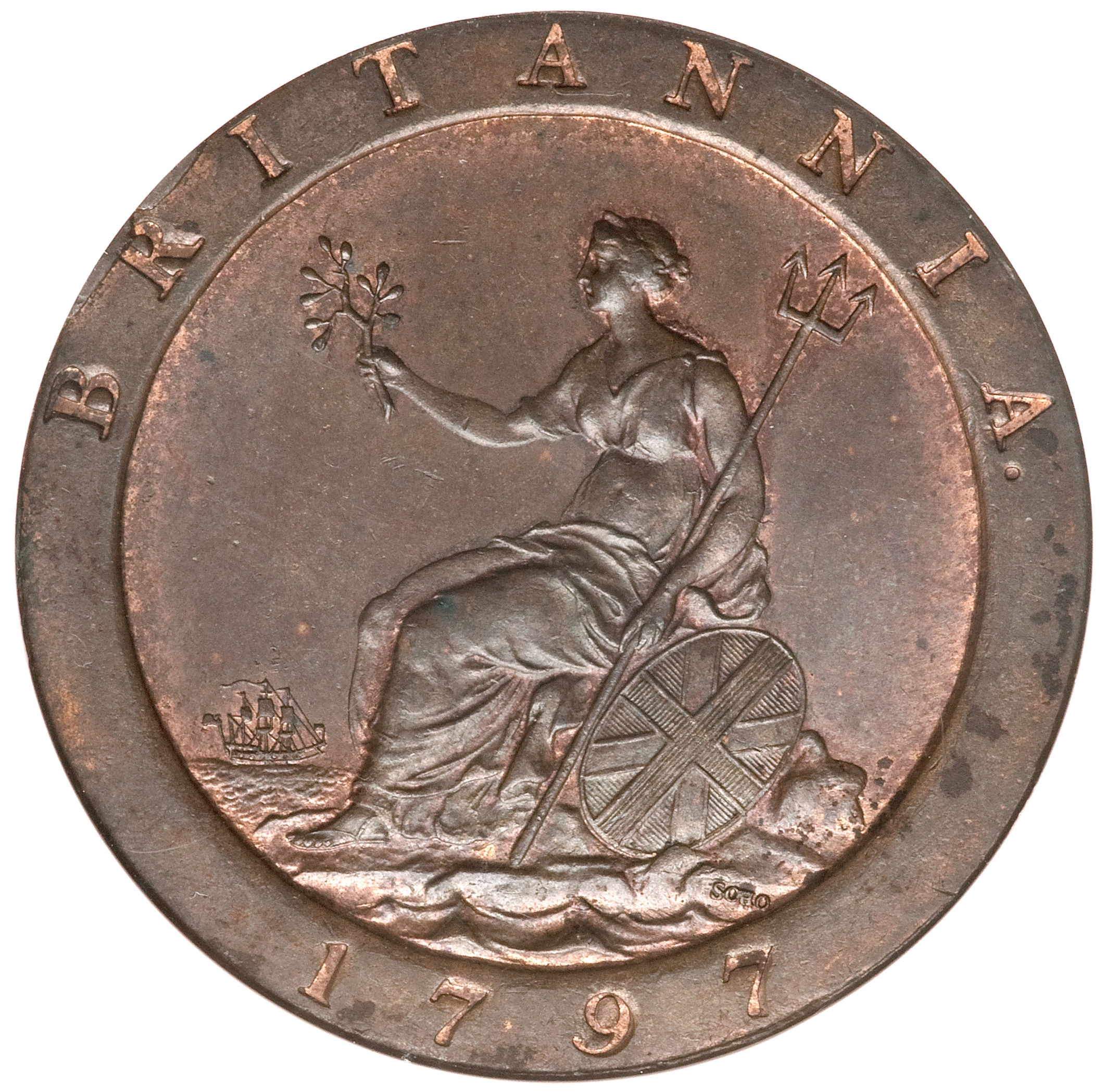
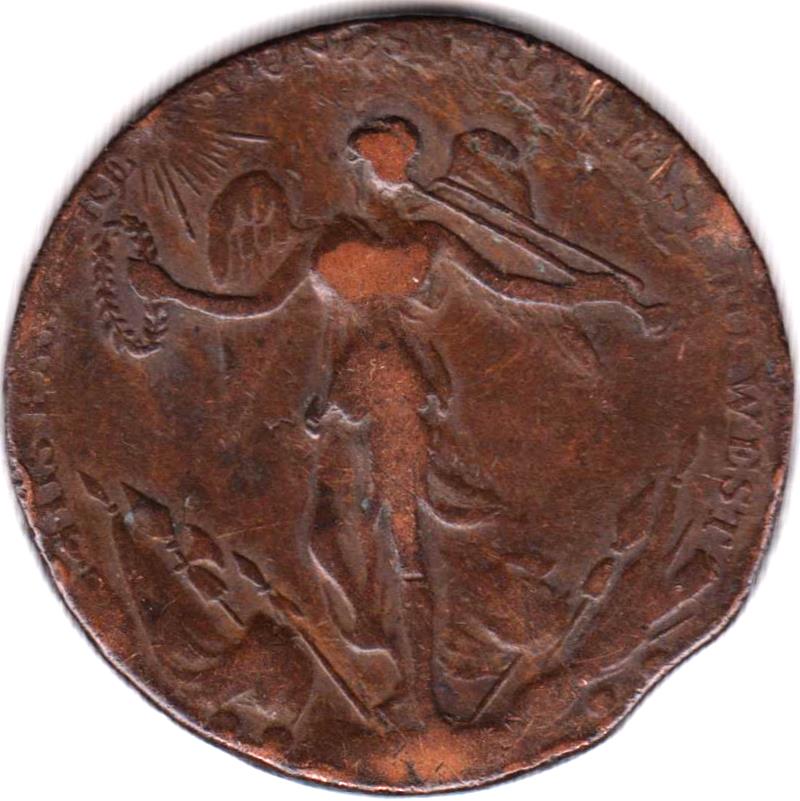
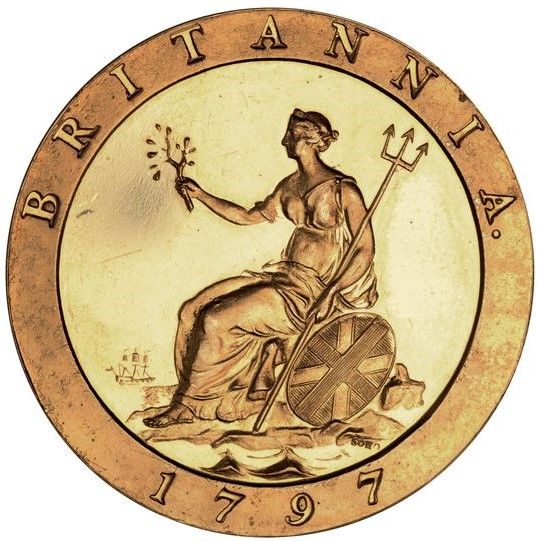
Seated figure of Britannia left, with trident and shield in left hand, olive branch in right, sea behind with ship to left, legend above and date below on raised rim.
Find this on eBay
Affiliate1 Penny - George III Pattern price history
Daily limit reachedAbout the 1797 1 Penny - George III Pattern
The 1797 1 Penny - George III Pattern is a collector 1 penny coin, struck in gold. It weighs 39.11g and measures 36mm across. Reverse design: Seated figure of Britannia left, with trident and shield in left hand, olive branch in right, sea behind with ship to left, legend above and date below on raised rim.
It is no longer legal tender, so its value is to collectors only.
Common questions
How much is the 1797 1 Penny - George III Pattern worth?
No verified sale of the 1797 1 Penny - George III Pattern has been logged on MyCoinage yet. Its gold content is worth up to £3,767 at today's spot price, which puts a floor under its value.
Is there a gold 1797 cartwheel penny?
Yes, but only as a special striking. Baldwin's records just two late Soho cartwheel pennies in gold: its own example of 26.92 g on a thin 2 mm flan, and the Murdoch specimen sold at Sotheby's in 1904. Later gold pieces struck by W. J. Taylor from Soho dies also exist.
Was the gold cartwheel penny ever money?
No. The circulating 1797 penny was struck in copper and weighed one ounce. Gold strikings were made from the same Soho dies for presentation or for collectors, and Baldwin's suggests the two late Soho gold pieces were probably presentation pieces or made for a special occasion.
What is the difference between a late Soho piece and a Taylor restrike?
Late Soho pieces were struck at Boulton's Soho Mint after the main issue. Restrikes were made by the London dealer William Joseph Taylor, who bought Soho dies when the mint's equipment was sold off, restored them and struck pieces for collectors in several metals.
How is the 1797 1 Penny - George III Pattern different from the circulating coin?
This is a collector version of the 1797 1 Farthing - George III Pattern, not the coin found in change. It is struck in gold rather than copper.
How do I identify the 1797 1 Penny - George III Pattern?
Check the weight 39.11g and diameter 36mm and the metal (gold) against the specification table on this page. The reverse design is described above.
History and design
In 1797 Matthew Boulton's Soho Mint in Birmingham began striking Britain's first copper pennies, the one-ounce cartwheels. Alongside the currency coins, Soho struck special pieces from the same or closely related dies: proofs and patterns in copper, bronzed copper, silver and gold. The Royal Mint Museum holds 1797 pattern pennies in silver, bronzed copper and copper, many from the collection of Sarah Sophia Banks, whom Boulton supplied with new and unusual Soho pieces.
The gold strikings are the rarest. Baldwin's records only two late Soho cartwheel pennies in gold: one it offered, weighing 26.92 g on a thin 2 mm flan with a plain edge, and the Murdoch specimen sold at Sotheby's in March 1904. Baldwin's suggests both were made as presentation pieces or for some special occasion. Neither was ever money.
The design is Conrad Heinrich Küchler's, as on the circulating penny. The obverse shows George III laureate and draped, facing right, with GEORGIUS III D G REX sunk into a raised rim and the initial K on the drapery. The reverse has Britannia seated left with olive branch, trident and shield, a three-masted ship at sea, SOHO below the shield and BRITANNIA with the date on the rim.
Baldwin's notes that on its gold piece the dies are aligned with the reverse inverted, as on the currency coins, and that most of the olive leaves on Britannia's branch are detached from the stem, a feature of that reverse die.
Collecting notes
Gold cartwheel pennies come from two different sources. Late Soho pieces were struck at Boulton's mint. Restrikes were made by the London dealer William Joseph Taylor, who bought many Soho dies when the mint's equipment was sold by Fuller and Horsey in 1850, restored them and struck pieces for collectors. Tony Clayton believes that the later strikings can chiefly be told by marks from die corrosion.
Any gold example should be checked for weight, flan thickness, die details and provenance against the published references. For the copper coin that circulated, see the cartwheel penny.
Sources
The history, design, varieties and collecting notes on this page are drawn from these sources. Prices come from recorded sales, not from them.
- Penny, Royal Mint Museum (read 12 Oct 2026)
- George III (1760-1820), Proof Penny, 1797. Struck in Gold, Highest Rarity, Baldwin's (read 12 Oct 2026)
- George III pattern penny, 1797 (RMM 1097), The Royal Mint Museum, via Museum Data Service (read 12 Oct 2026)
- George III, Restrike Silver Pattern Penny, 1797, by W J Taylor (auction 23006, lot 172), Spink (read 12 Oct 2026)
- George III pattern penny, 1797, silver (RMM 1095) and bronzed copper (RMM 1096), The Royal Mint Museum, via Museum Data Service (read 12 Oct 2026)
- The Penny, Tony Clayton, Coins of the UK (read 12 Oct 2026)
More 1 Penny coins from nearby years