Uncommon: fewer than 10,000,000 minted.
1 Penny - George III 2nd Issue 'Cartwheel' (1797)
"Cartwheel penny"
| Country | United Kingdom |
| Year | 1797 |
| Denomination | 1 Penny |
| Mintage | 8,601,600 |
| Mint | Royal Mint · Llantrisant |
| Circulation | Circulating |
| Demonetised | 1869 |
| Composition | Copper |
| Weight | 28.350g |
| Diameter | 36.0mm |
| Thickness | 3.00mm |
| Shape | Round |
| Edge | Plain |
| Orientation | Coin alignment ↑↓ |
| Obv. artist | Conrad Heinrich Küchler |
| Rev. artist | Conrad Heinrich Küchler |
| Grade scale | UK (EF/UNC) |
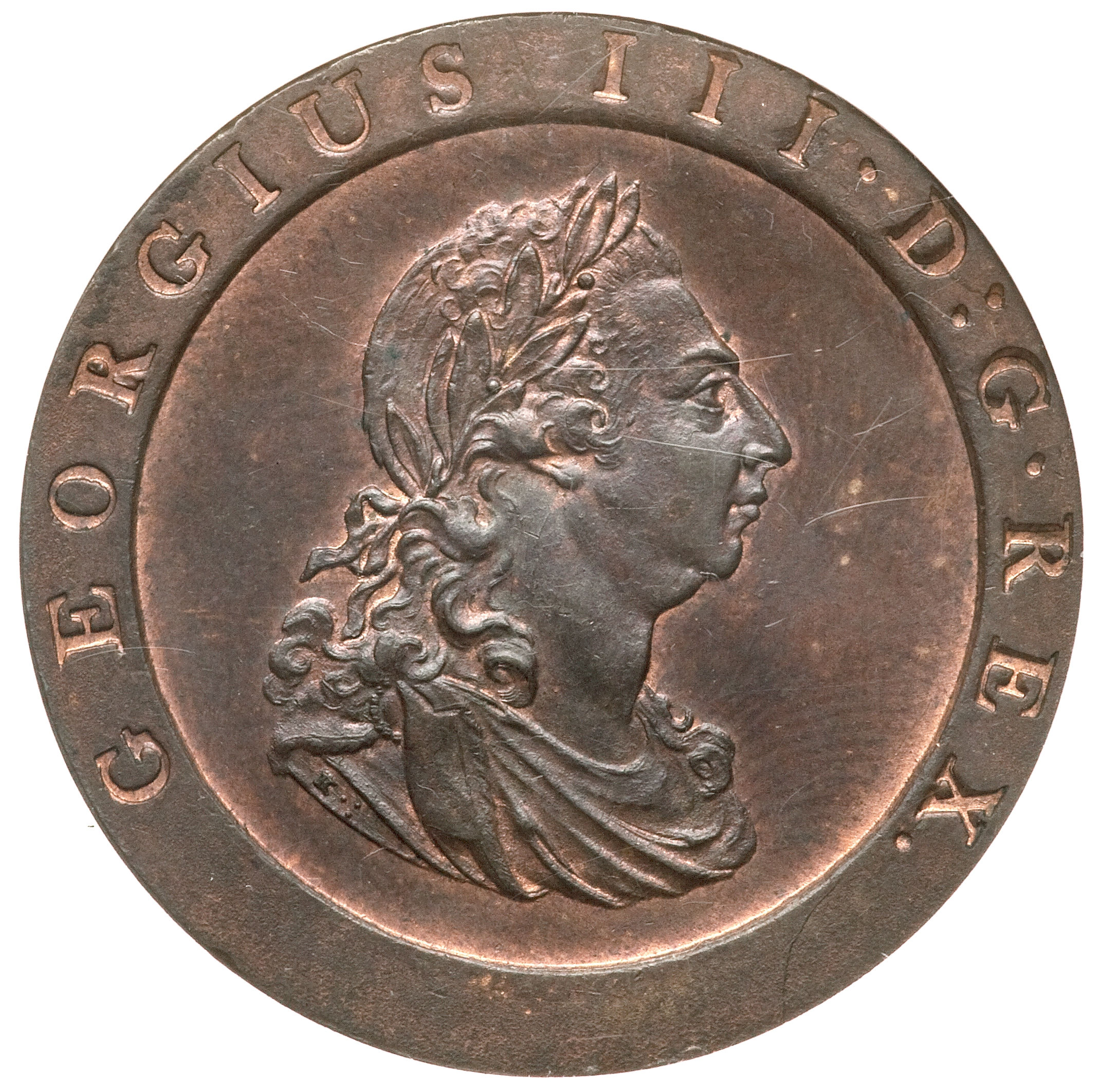
Laureate and draped bust of King George III right, legend around on raised rim.
GEORGIUS III.D:G.REX
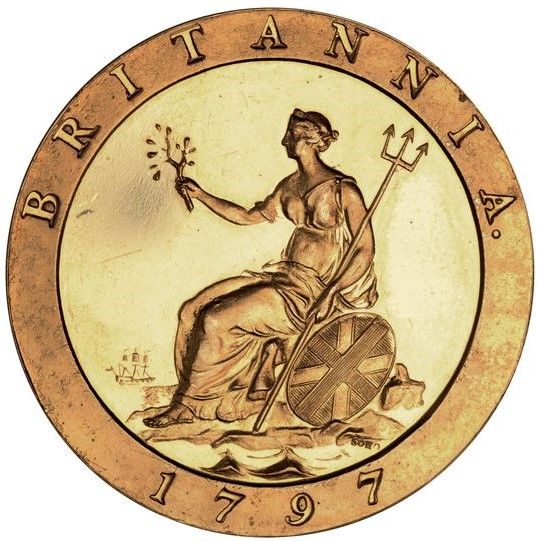
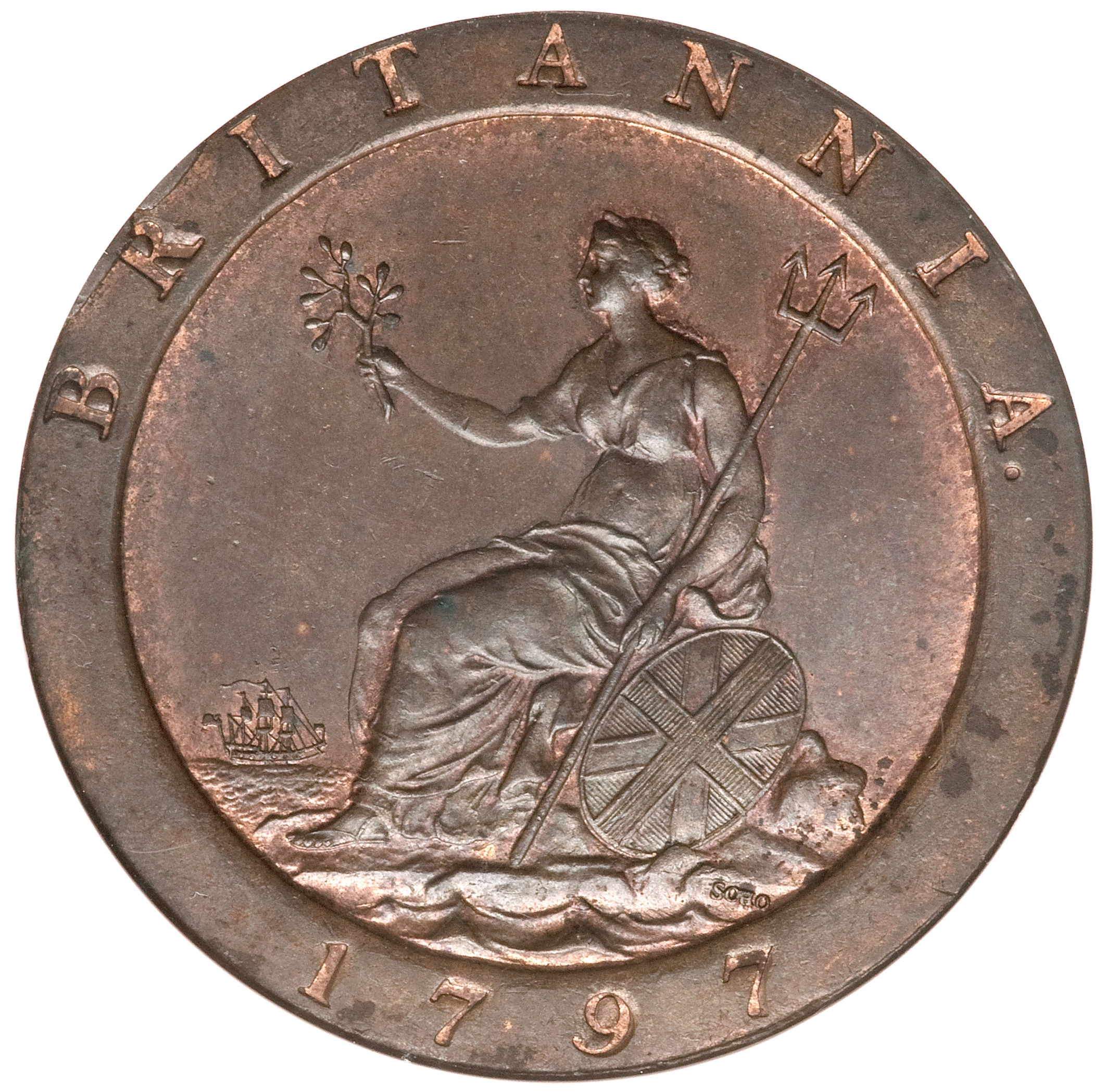
Seated figure of Britannia left, with trident and shield in left hand, olive branch in raised right hand, shield bearing Union flag resting on left, sea behind with ship on left,
BRITANNIA 1797
'Cartwheel' 1p market value
Find this on eBay
Affiliate'Cartwheel' 1p price history
Daily limit reached'Cartwheel' 1p value by grade
Realised auction prices · ⭐ Pro Expand rows for individual sale records| Grade | Latest | Median | 30d Δ | All-time range | Sales (1yr) | Total sales | Last sale | |
|---|---|---|---|---|---|---|---|---|
| EF | £90.00 🔒 | £90.00 (1) | – | £90.00 – £90.00 | 0 | 1 | 06-06-2004 | |
|
Loading…
|
||||||||
| VF | £36.98 🔒 | £36.98 (1) | – | £25.00 – £36.98 | 0 | 2 | 13-03-2024 | |
|
Loading…
|
||||||||
About the 1797 1 Penny - George III 2nd Issue – 'Cartwheel'
The 1797 1 Penny - George III 2nd Issue – 'Cartwheel' is a circulating 1 penny coin, struck in copper. It weighs 28.35g and measures 36mm across. Reverse design: Seated figure of Britannia left, with trident and shield in left hand, olive branch in raised right hand, shield bearing Union flag resting on left, sea behind with ship on left,.
8,601,600 were struck. It is no longer legal tender (withdrawn 1869), so its value is to collectors only.
Common questions
How much is the 1797 1 Penny - George III 2nd Issue – 'Cartwheel' worth?
Verified sold prices for the 1797 1 Penny - George III 2nd Issue – 'Cartwheel' run from £36.98 to £90.00 across 2 grades, taking the median for each grade. Condition makes the difference, so check the grade table above before pricing one.
How many 1797 cartwheel pennies were made?
Nearly 44 million. The Royal Mint Museum gives approximately 44,000,000, and Wikipedia and Coin Hunter give 43,969,204. All carry the date 1797, although Wikipedia records that striking at Soho went on until 1799.
Why is it called the cartwheel penny?
Because of its size and its broad raised rim, with the lettering sunk into the rim rather than raised. The coin weighs one ounce and measures about 36 millimetres, so it looks like a small wheel. The twopence of the same year shares the design.
Is a 1797 cartwheel penny rare?
No. The Royal Mint Museum calls the penny a very common piece, since nearly 44 million were issued. Worn and battered examples are plentiful; well preserved ones with sharp detail on the rim lettering and Britannia are much harder to find.
Who made the cartwheel penny?
It was struck by Matthew Boulton at his steam-powered Soho Mint in Birmingham, not by the Royal Mint. Both sides were engraved by the German Conrad Heinrich Küchler, whose initial K is on the drapery at the base of the King's bust.
Is the cartwheel penny still legal tender?
No. Tony Clayton records that copper coins were demonetised on 31 December 1869 and accepted by the Mint at face value until 30 July 1873. The cartwheels had stayed in circulation until the bronze penny replaced the copper coinage from 1860.
How do I identify the 1797 1 Penny - George III 2nd Issue – 'Cartwheel'?
Check the weight 28.35g and diameter 36mm and the metal (copper) against the specification table on this page. The reverse design is described above.
History and design
By the 1780s Britain was short of small change. Wikipedia records that in 1787 the Mint found at most eight percent of the halfpennies in circulation were genuine, and private copper tokens filled the gap. In 1797 the government gave Matthew Boulton a contract to strike 480 tonnes of copper pennies and 20 tonnes of twopences at his Soho Mint in Birmingham. They were the first official British coins of those denominations in copper and the first struck by steam power.
A proclamation of 26 July 1797 made the coins legal tender for amounts up to one shilling and fixed the penny at one ounce, so that its metal and making came close to its face value. Production ran from 1797 to 1799, every coin dated 1797. The Royal Mint Museum gives nearly 44,000,000 pennies against about 720,000 twopences; Wikipedia and Coin Hunter give 43,969,204. Wikipedia adds that the 1,250 tonnes of cartwheels struck at Soho exceeded the Royal Mint's entire copper coinage of the eighteenth century.
Both sides were engraved by Conrad Heinrich Küchler, Boulton's German engraver. The obverse shows George III laureate and facing right, with GEORGIUS III.D:G.REX sunk into the broad raised rim and the initial K on the lowest fold of the drapery. The incuse lettering on a thick rim was meant to resist wear and make counterfeiting harder.
The reverse shows Britannia seated on a rock facing left, holding an olive branch and trident, with a Union shield, waves and a ship behind. BRITANNIA is incuse above and 1797 below. Wikipedia notes this was the first time Britannia was shown ruling the waves. SOHO appears in small letters on the rock below the shield. The penny measures 1.4 inches, about 36 millimetres, so that 17 laid side by side made two feet.
Varieties and errors
Coin Hunter lists two versions, with 10 or 11 leaves in the King's laurel wreath. Tony Clayton notes that a large specialised collection is possible because details vary from die to die, especially the ship. Large copper coins dated 1799 are halfpennies, not pennies.
Collecting notes
Clayton remarks that many cartwheels survive battered and worn, having served as weights for kitchen scales. Check the incuse rim lettering, the K on the drapery and the SOHO on the rock; rim knocks and corrosion are common. Proofs and later restrikes made at Soho, and by the dealer W. J. Taylor, who bought Soho dies after the mint closed, are separate pieces covered at 1797 pattern penny.
The cartwheels stayed in use until the copper coinage gave way to bronze from 1860, and copper was demonetised on 31 December 1869. The companion piece is the cartwheel twopence.
Sources
The history, design, varieties and collecting notes on this page are drawn from these sources. Prices come from recorded sales, not from them.
- Penny, Royal Mint Museum (read 12 Oct 2026)
- History of the British penny (1714 to 1901), Wikipedia (read 12 Oct 2026)
- The Penny, Tony Clayton, Coins of the UK (read 12 Oct 2026)
- George III penny, 1797 (RMM 1086 to 1091), The Royal Mint Museum, via Museum Data Service (read 12 Oct 2026)
- 1797 Coin Values, George III, Coin Hunter (read 12 Oct 2026)
- Matthew Boulton, Wikipedia (read 12 Oct 2026)
- George III, Restrike Silver Pattern Penny, 1797, by W J Taylor (auction 23006, lot 172), Spink (read 12 Oct 2026)
More 1 Penny coins from nearby years