Rare: fewer than 500,000 minted.
1 Penny - Elizabeth II 4th portrait non-magnetic set issue (1999)
"1999 bronze 1p"
| Country | United Kingdom |
| Year | 1999 |
| Denomination | 1 Penny |
| Face value | 1p |
| Mintage | 136,696 |
| Mint | Royal Mint · Llantrisant |
| Circulation | Non-circulating |
| Composition | Bronze |
| Weight | 3.560g |
| Diameter | 20.3mm |
| Thickness | 1.52mm |
| Shape | Round |
| Edge | Plain |
| Orientation | Medal alignment ↑↑ |
| Obv. artist | Ian Rank-Broadley |
| Rev. artist | Christopher Ironside |
| Grade scale | UK (EF/UNC) |
Fourth crowned portrait of Queen Elizabeth II right, wearing the Girls of Great Britain and Ireland tiara, legend around.
ELIZABETH II D G REG F D
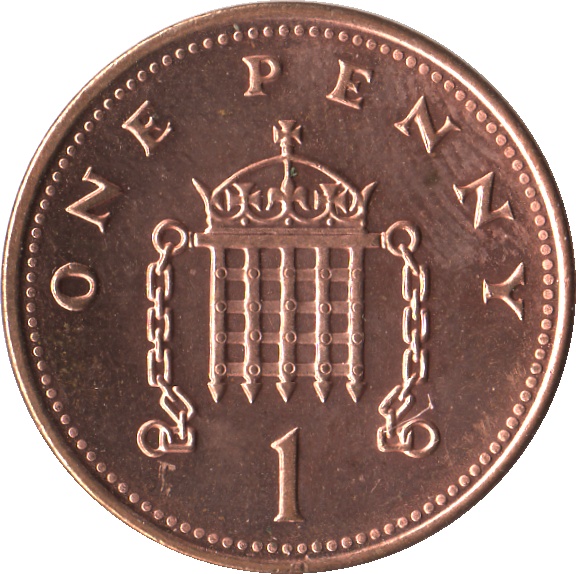
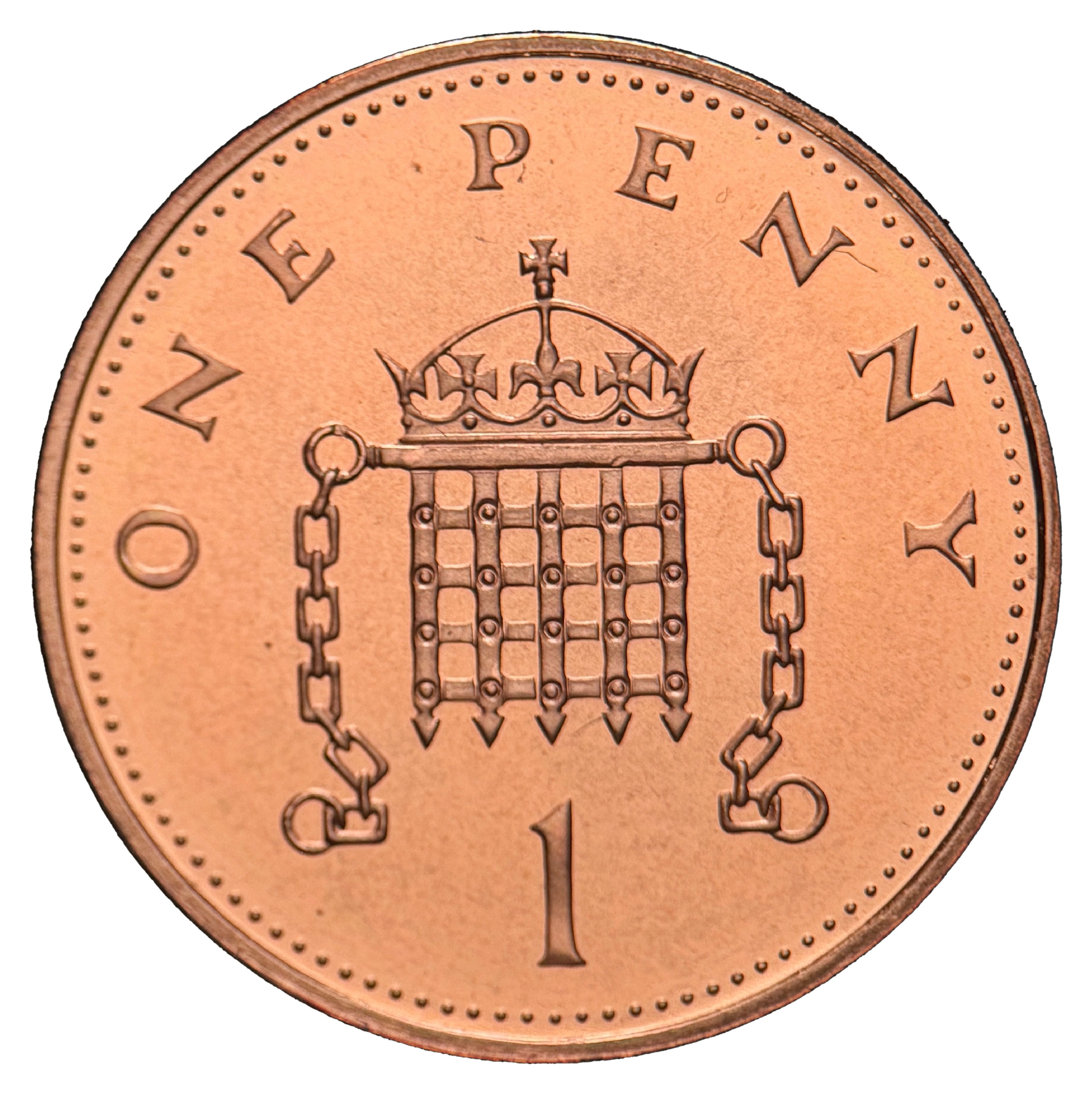
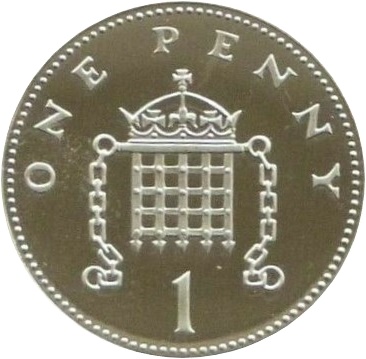
A crowned portcullis with chains (an adaptation of the Badge of Henry VII which is now the Badge of the Palace of Westminster), denomination in words above and numeral below.
Find this on eBay
Affiliatenon-magnetic set issue 1p price history
Daily limit reachedAbout the 1999 1 Penny - Elizabeth II – non-magnetic set issue
The 1999 1 Penny - Elizabeth II – non-magnetic set issue is a collector 1 penny coin, struck in bronze. It weighs 3.56g and measures 20.3mm across. Reverse design: A crowned portcullis with chains (an adaptation of the Badge of Henry VII which is now the Badge of the Palace of Westminster), denomination in words above and numeral below.
136,696 were struck.
Common questions
How much is the 1999 1 Penny - Elizabeth II – non-magnetic set issue worth?
No verified sale of the 1999 1 Penny - Elizabeth II – non-magnetic set issue has been logged on MyCoinage yet.
Is a 1999 1p magnetic?
Almost always, yes. Pennies made for circulation since September 1992 are copper-plated steel and stick to a magnet. The exception for 1999 is the bronze penny from that year's Royal Mint sets, which is not attracted. A magnet is the simplest test.
How many 1999 bronze pennies were made?
No Royal Mint figure has been found. The Mint's mintage file gives one number for the 1999 penny, 891,392,000, which is the circulating issue in copper-plated steel. It has no separate line for bronze coins made for sets.
Did the 1999 bronze 1p go into circulation?
No. Tony Clayton's reference lists it as issued in the 1999 Proof Set, and possibly the Uncirculated Coin Set, only. Check Your Change likewise says bronze blanks were used for proof set pennies while circulation coins were copper-plated steel as normal.
How can I tell a bronze 1999 penny from a normal one?
Use a magnet first: bronze is not attracted. Thickness is a second check. The Royal Mint gives 1.52mm for bronze pennies and 1.65mm for copper-plated steel ones, because steel is less dense and the weight was kept the same at 3.56g.
How do I identify the 1999 1 Penny - Elizabeth II – non-magnetic set issue?
Check the weight 3.56g and diameter 20.3mm and the metal (bronze) against the specification table on this page. The reverse design is described above.
History and design
The penny stopped being a bronze coin in 1992. The Royal Mint states that 1p and 2p coins have been made from copper-plated steel since September of that year, a change driven by rising world metal prices. The plated coins have a mild steel core, which makes them magnetic.
The 1999 bronze penny is an exception, recorded by collector references in that year's Royal Mint sets. Tony Clayton's Coins of the UK lists it as a "temporary reversion to bronze", issued in the 1999 Proof Set, and possibly the Uncirculated Coin Set, only. Check Your Change gives the same account: bronze blanks went into set coins, while pennies for circulation were copper-plated steel as normal.
It was not a circulating issue. The Royal Mint's mintage file has a single figure for the 1999 penny, 891,392,000, and that is the ordinary steel coin. No official count of the bronze pieces has been published.
The Mint has not explained the 1999 penny, but the 2p offers a parallel. Its FAQ confirms that in 1998 the 2p was struck in both bronze and copper-plated steel, and adds that keeping the ability to use either material helps it meet demand.
Nothing in the design separates this coin from the normal 1999 penny. The reverse is Christopher Ironside's crowned portcullis, with ONE PENNY above and the figure 1 below, the design used on the 1p from 1971 to 2008. The obverse has Ian Rank-Broadley's portrait of the Queen with his initials IRB below the bust. The edge is plain.
The difference is the metal: bronze, which the Royal Mint specifies as 97% copper, 2.5% zinc and 0.5% tin.
Collecting notes
Test with a magnet. A bronze penny is not attracted, while a copper-plated steel one is. Clayton calls this the easiest way to tell the two types apart. The Royal Mint also gives different thicknesses for the same 3.56g weight: 1.52mm for bronze and 1.65mm for plated steel.
Because the coin came in sets, expect a proof or uncirculated finish. A worn, non-magnetic penny dated 1999 would need a careful second look before being accepted. References differ on whether every 1999 set contains a bronze penny, so a set should be tested, not assumed.
The 2p from the 1999 Proof Set is reported in bronze too. Clayton credits the Royal Mint for that information.
Sources
The history, design, varieties and collecting notes on this page are drawn from these sources. Prices come from recorded sales, not from them.
- UK coin mintage figures (data file), The Royal Mint (read 9 Oct 2026)
- 1p Coin Designs and Specifications, The Royal Mint (read 9 Oct 2026)
- Decimal One Penny, by Tony Clayton, Coins of the UK (read 9 Oct 2026)
- 1p Coins in Circulation, Check Your Change (read 9 Oct 2026)
- What are 'bronze' coins made from? Why are some magnetic and some not?, The Royal Mint (read 9 Oct 2026)
- Decimal Two Pence, by Tony Clayton, Coins of the UK (read 9 Oct 2026)
- Penny (British decimal coin), Wikipedia (read 9 Oct 2026)
More 1 Penny coins from nearby years