1 Guinea - George III Pattern (1761)
| Country | United Kingdom |
| Year | 1761 |
| Denomination | 1 Guinea |
| Face value | £1.05 |
| Mint | Royal Mint · Llantrisant |
| Circulation | Non-circulating |
| Demonetised | Yes |
| Composition | Gold (.9167) (917/1000 fine) |
| Shape | Round |
| Edge | Plain |
| Obv. artist | Richard Yeo |
| Grade scale | UK (EF/UNC) |
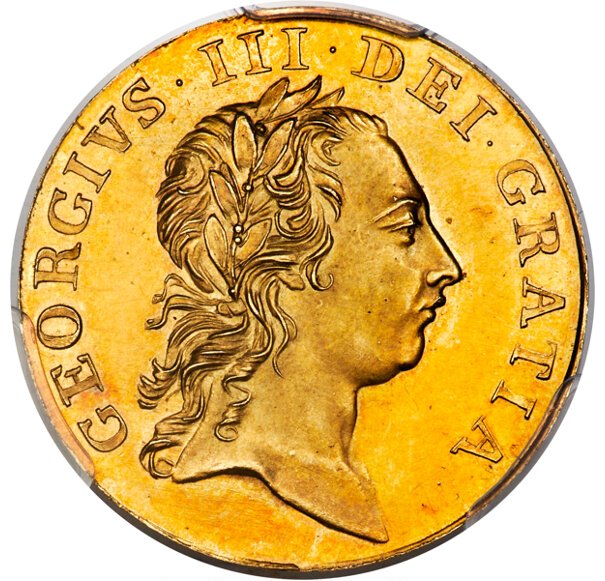
Young laureate bust of King George III right, legend around.
GEORGIVS III DEI GRATIA
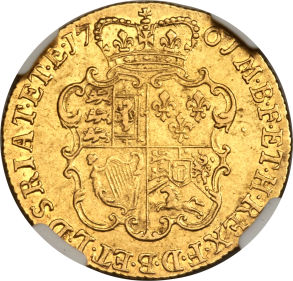
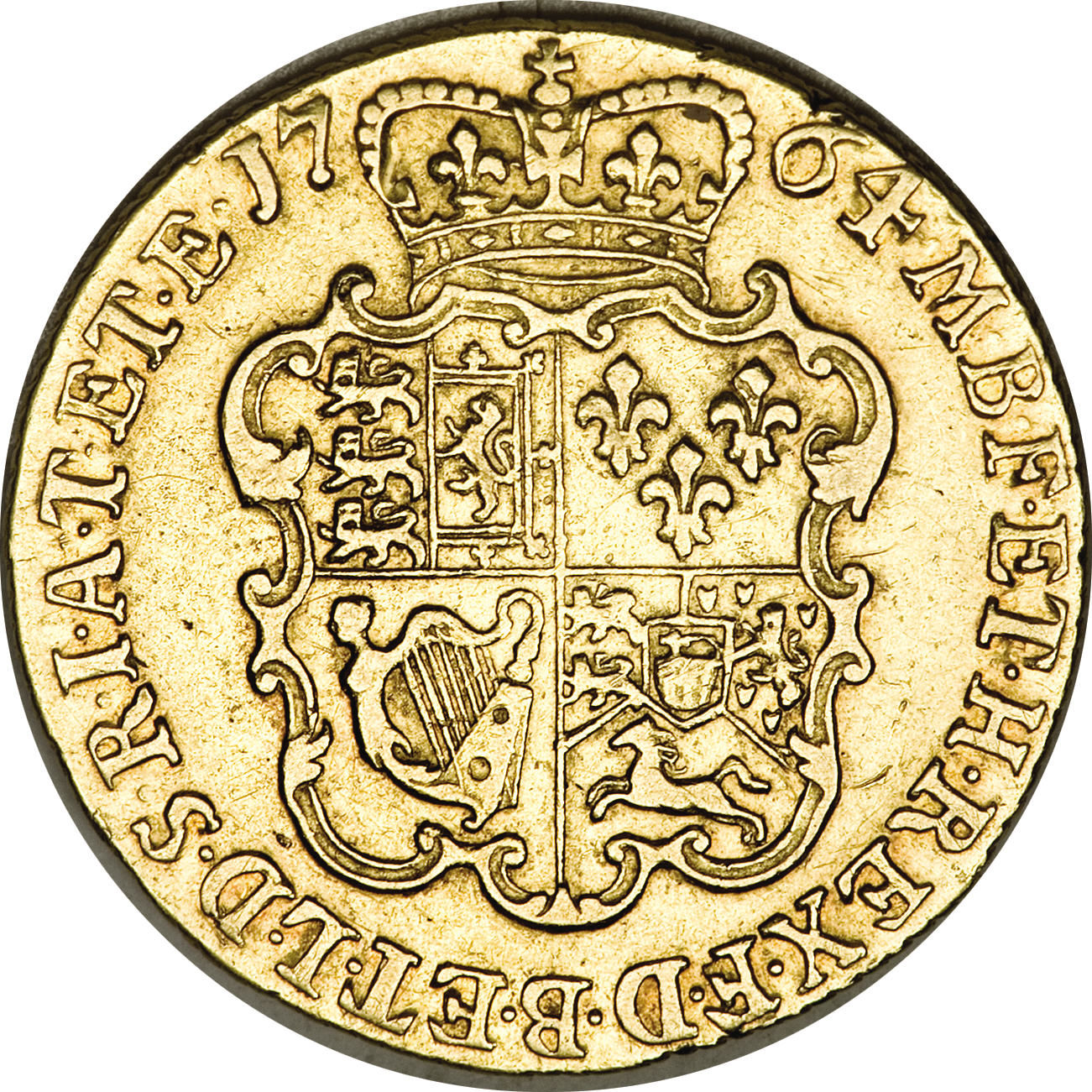
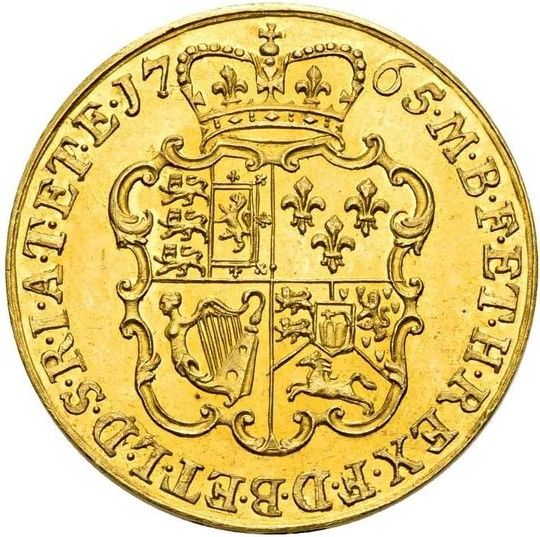
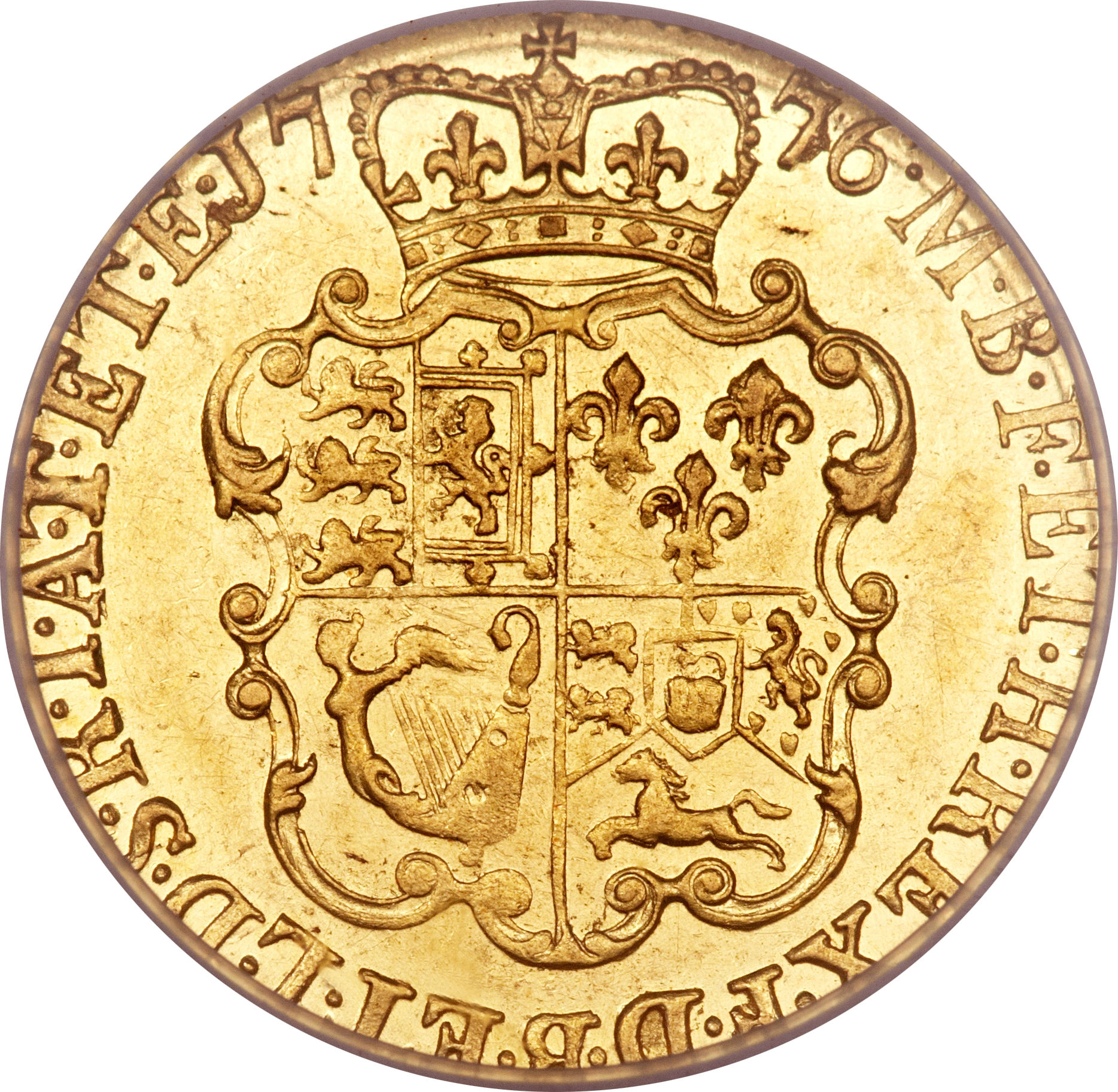
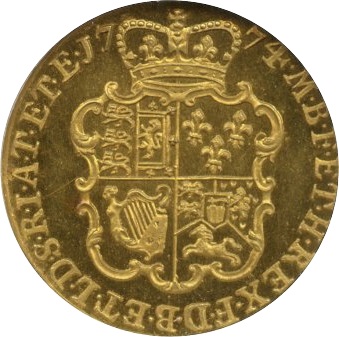
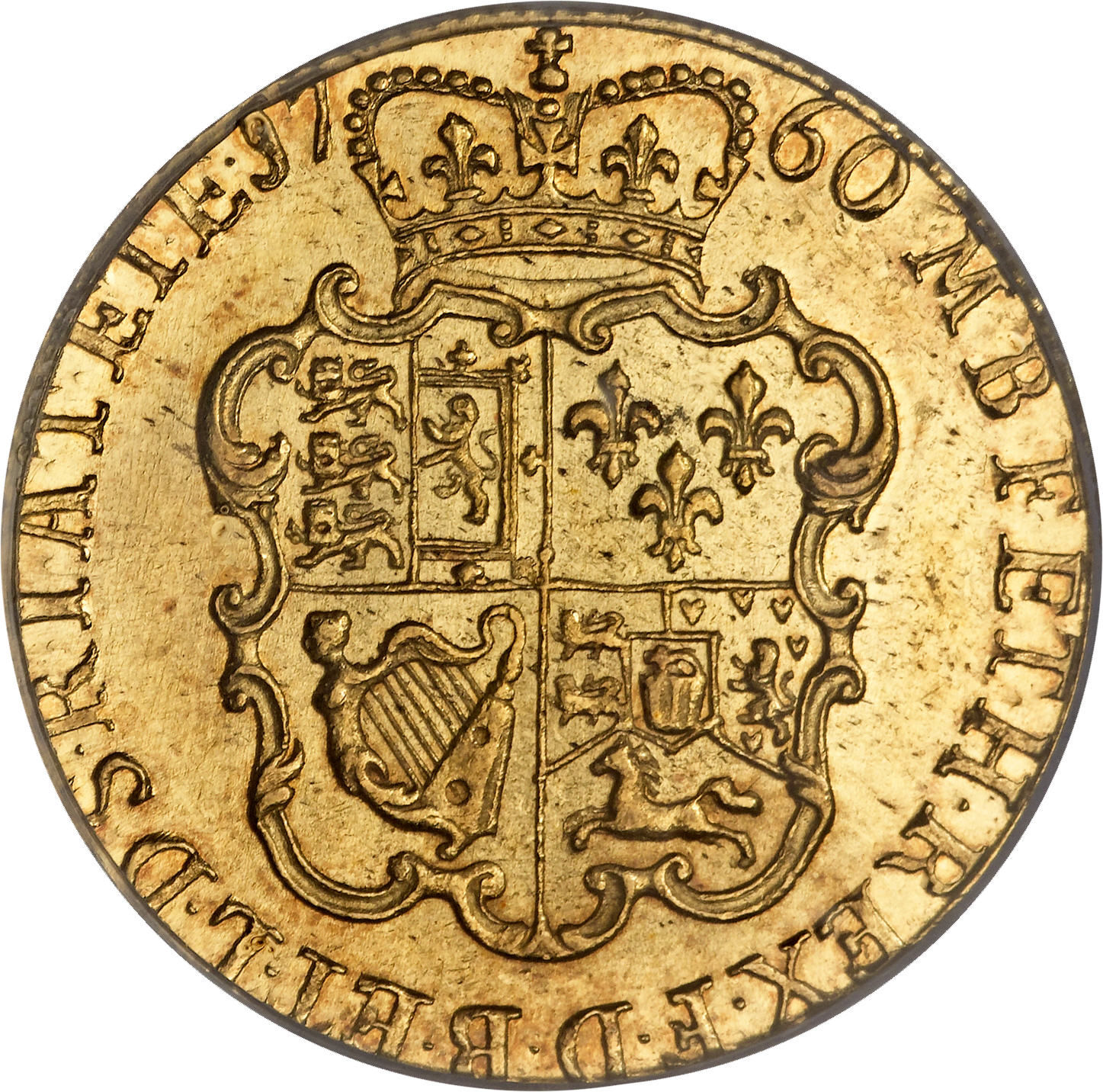
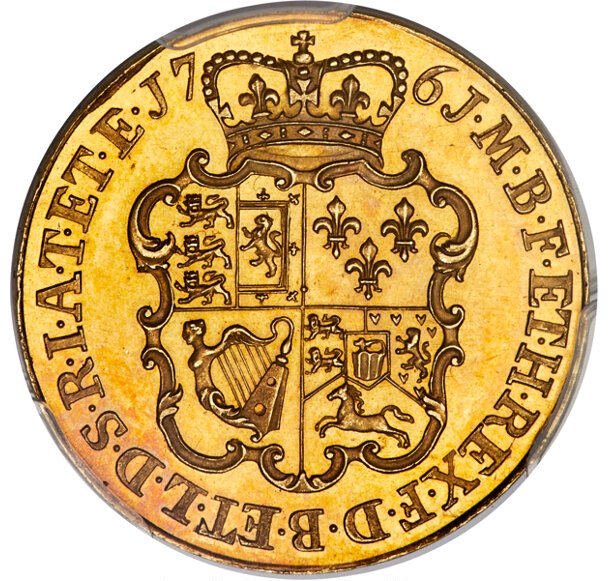
Ornate crowned, quartered shield of arms dividing date, legend around.
M B F ET H REX F D B ET L D S R I A T ET E
Find this on eBay
Affiliate1 Guinea - George III Pattern price history
Daily limit reachedAbout the 1761 1 Guinea - George III Pattern
The 1761 1 Guinea - George III Pattern is a collector 1 guinea coin, struck in 91.67% gold. Reverse design: Ornate crowned, quartered shield of arms dividing date, legend around.
It is no longer legal tender, so its value is to collectors only.
Common questions
How much is the 1761 1 Guinea - George III Pattern worth?
No verified sale of the 1761 1 Guinea - George III Pattern has been logged on MyCoinage yet.
What is the 1761 pattern guinea of George III?
A trial striking made when the first gold portrait of George III was being prepared in 1761. It has a plain edge instead of the graining of currency guineas. The Royal Mint Museum holds two, with differently arranged hair, catalogued as a pattern and a proof.
How many 1761 pattern guineas were made?
No number struck is recorded. Known examples include the Royal Mint Museum's two pieces, in its collection since at least the 1874 catalogue, and a Yeo pattern catalogued as WR 84 that Sincona sold in Zurich, catalogued with a plain edge and a weight of 8.06 g.
Who designed the 1761 pattern guinea?
Richard Yeo, according to the Royal Mint Museum, which says Yeo cut the early youthful busts because Chief Engraver John Sigismund Tanner's eyesight was failing. Older sale catalogues credited the 1761 patterns to Tanner, an attribution Spink describes as a long-running confusion.
Did the 1761 pattern guinea circulate?
No. Patterns and proofs were made to show or test a design and were kept by the Mint or given to collectors. The coin that did circulate is the 1761 first portrait guinea, struck in that year only.
History and design
George III came to the throne in October 1760, and the Mint had to prepare a new portrait for the gold. The Royal Mint Museum says the early youthful busts were cut by Richard Yeo, the Assistant Engraver, because Chief Engraver John Sigismund Tanner's eyesight was failing. Trial pieces dated 1761 survive from this work, struck with plain edges rather than the grained edge of the coins made for use.
The Royal Mint Museum holds two. RMM 942 (Hocking 1776, Wilson and Rasmussen 82) weighs 8.11 g and shows the hair hanging behind in two distinct ringlets. RMM 941 (Hocking 1777, Wilson and Rasmussen 85) weighs 8.18 g and has a more youthful head with three ringlets; the 1906 catalogue calls it a pattern and the museum's online record a proof. Both were already in the 1874 catalogue. Sincona has also sold a Yeo pattern of 1761 (Wilson and Rasmussen 84, 8.06 g, plain edge). No number struck is recorded for any of them.
The obverse carries a laureate bust of the young king facing right, with GEORGIVS III DEI GRATIA. The reverse is the garnished, crowned shield used on George III's guineas until 1786, quartering England and Scotland, France, Ireland and Hanover, with M B F ET H REX F D B ET L D S R I A T ET E and the date. Wikipedia translates the legend as King of Great Britain, France and Ireland, Defender of the Faith, Duke of Brunswick and Luneburg, Arch-Treasurer and Elector of the Holy Roman Empire. Both museum pieces are struck with the two sides the same way up.
Varieties and errors
The two heads in the Royal Mint Museum are distinct designs, told apart by the number of ringlets at the back of the hair. Spink notes that the Rev. Crowther's 1886 guide credited the 1761, 1763 and 1765 patterns to Tanner, and that sale catalogues repeated this for about 60 years.
Collecting notes
Check the edge first: a plain edge, with proof surfaces, separates these pieces from the currency guinea. The bust style then decides which pattern it is. CoinVarieties calls the currency coin, the 1761 first portrait guinea, the rarest guinea of the reign, so a 1761 guinea of either kind is a significant piece and worth having authenticated.
Sources
The history, design, varieties and collecting notes on this page are drawn from these sources. Prices come from recorded sales, not from them.
- George III, Royal Mint Museum (read 12 Oct 2026)
- Catalogue of the Coins, Tokens, Medals, Dies and Seals in the Museum of the Royal Mint, Vol. I Part I (Hocking, 1906), page 172, proofs of George III, Royal Mint Museum library (read 12 Oct 2026)
- George III pattern guinea, 1761 (RMM 942), The Royal Mint Museum, via Museum Data Service (read 12 Oct 2026)
- George III proof guinea, 1761 (RMM 941), The Royal Mint Museum, via Museum Data Service (read 12 Oct 2026)
- SINCONA British Collection, auction highlights, Sincona (read 12 Oct 2026)
- Guinea (coin), Wikipedia (read 12 Oct 2026)
- George III (1760-1820), pattern Half-Guinea, 1764, by Richard Yeo, lot 409, Spink (read 12 Oct 2026)
- Great Britain 1761 guinea, CoinVarieties (read 12 Oct 2026)
More 1 Guinea coins from nearby years