Rarely sells: 1 verified sales in the last 12 months.
½ Crown - George II Young bust (1731–1741)
| Country | United Kingdom |
| Year | 1731–1741 |
| Denomination | ½ Crown |
| Face value | 12.5p |
| Mint | Royal Mint · Llantrisant |
| Circulation | Circulating |
| Demonetised | 1969 |
| Composition | Silver (.925) (925/1000 fine) |
| Weight | 15.050g · 0.4476 t oz |
| Diameter | 34.0mm |
| Shape | Round |
| Edge | Lettered: DECVS ET TVTAMEN ANNO REGNI |
| Orientation | Coin alignment ↑↓ |
| Obv. artist | John Croker |
| Rev. artist | John Sigismund Tanner |
| Grade scale | UK (EF/UNC) |
Young laureate and draped bust of King George II left, legend around.
GEORGIVS II DEI GRATIA
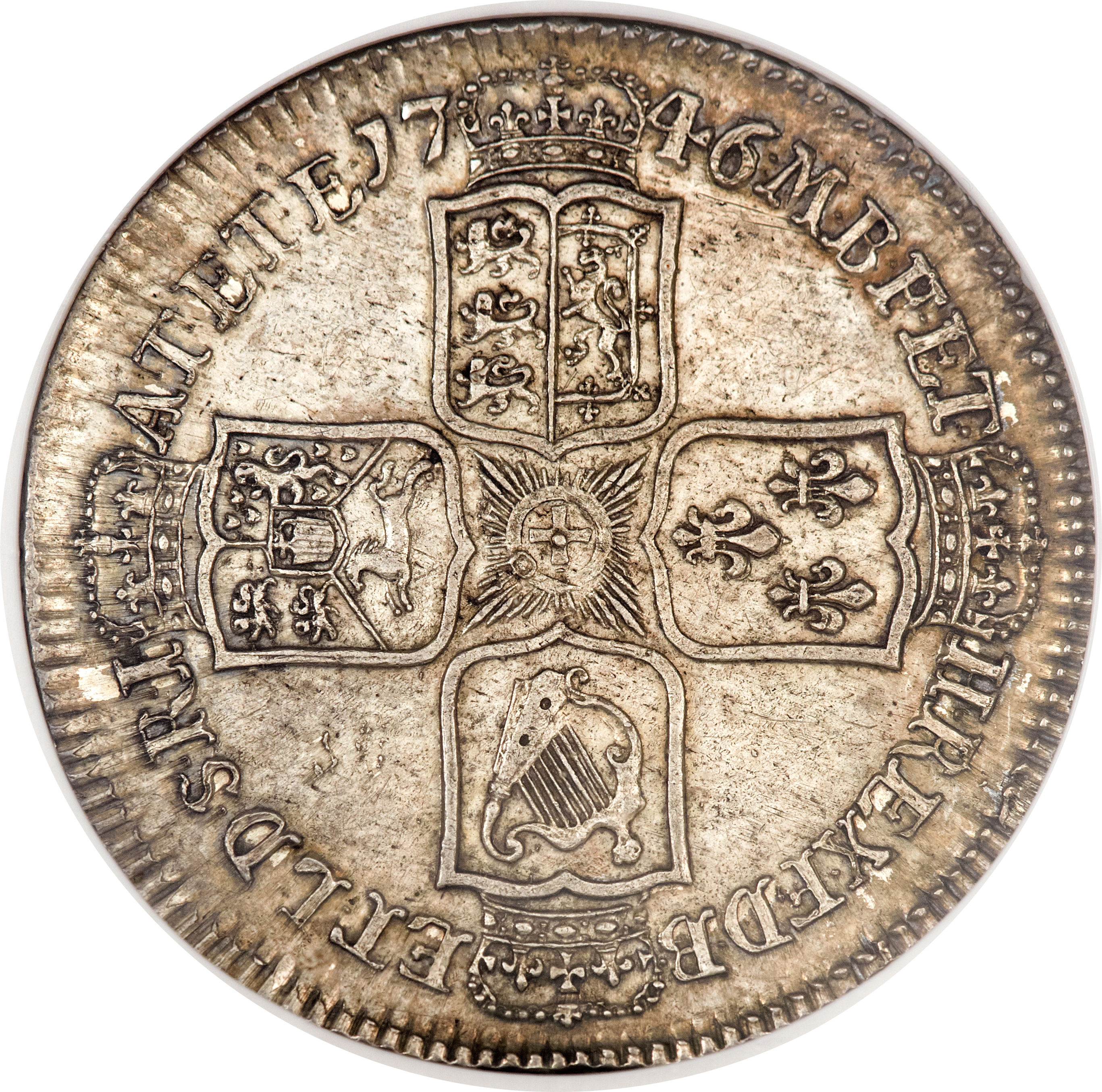
Crowned cruciform shields with central Garter star, divided date above, legend around.
M B F ET H REX F D B ET L D S R I A T ET E
Half Crown - George II Young bust market value
Find this on eBay
AffiliateHalf Crown - George II Young bust value by grade
Realised auction prices · ⭐ Pro Expand rows for individual sale records| Grade | Latest | Median | 30d Δ | All-time range | Sales (1yr) | Total sales | Last sale | |
|---|---|---|---|---|---|---|---|---|
| VF | £250.00 🔒 | £250.00 (1) | – | £250.00 – £250.00 | 1 | 1 | 10-09-2026 | |
|
Loading…
|
||||||||
About the 1731 Half Crown - George II Young bust
The 1731 Half Crown - George II Young bust is a circulating ½ crown coin issued from 1731 to 1741, struck in 92.5% silver. It weighs 15.05g and measures 34mm across. Reverse design: Crowned cruciform shields with central Garter star, divided date above, legend around.
It is no longer legal tender (withdrawn 1969), so its value is to collectors only.
Common questions
How much is the 1731 Half Crown - George II Young bust worth?
The 1731 Half Crown - George II Young bust has a price in one grade on MyCoinage so far: £250 in VF, the median of its verified sales. Its silver content is worth about £17.93 at today's spot price, which puts a floor under its value.
How many George II young bust half crowns were made?
No mintage by date has been published for George II half crowns. Scarcity is judged from what survives. The Royal Mint Museum explains that silver coin production declined through the reign because silver was worth more as bullion than as coin.
What is written on the edge of a George II half crown?
DECVS ET TVTAMEN ANNO REGNI, 'an ornament and a safeguard, in the year of the reign', followed by the regnal year in Latin words. Tony Clayton notes that every milled half crown up to 1751 carries the regnal year on the edge.
What do the roses and plumes on a 1732 half crown mean?
They are provenance marks for the source of the silver. The Royal Mint Museum links roses and plumes together to the Pitcoale and Seacoale company and roses alone, found on 1739 and 1741 half crowns, to mines in the West of England.
Who designed the George II young bust half crown?
The portrait is by John Croker, Chief Engraver from 1705 to 1741. The Royal Mint Museum says his assistant John Sigismund Tanner was responsible for the reverse dies from 1729, a period that covers every young bust half crown, first dated 1731.
How do I identify the 1731 Half Crown - George II Young bust?
Check the weight 15.05g and diameter 34mm and the metal (92.5% silver) against the specification table on this page. The reverse design is described above.
History and design
The half crown was the first of George II's large silver coins to carry his portrait, dated from 1731. Tony Clayton lists the young bust type for 1731, 1732, 1734, 1735, 1736, 1739 and 1741, with a proof in 1731, before the older bust was introduced in 1743. No mintage has been published for any date.
The Royal Mint Museum describes the reign as one in which silver coinage declined while gold grew. Silver was cheap in Europe compared with Asia, so merchants could profit from exporting it, and silver coin was worth more melted than spent. The half crown was still struck in most years of the 1730s, its roses and plumes marking silver from the Pitcoale and Seacoale company.
John Croker's young laureate and draped bust faces left, with GEORGIVS II DEI GRATIA. Croker had been Chief Engraver since 1705, and in 1729 John Sigismund Tanner was appointed as his assistant, taking charge of the reverse dies.
The reverse has four crowned shields in a cross, England impaling Scotland, France, Ireland and the Electorate, around the Garter star, with the date and the legend M B F ET H REX F D B ET L D S R I A T ET E. Coins from 1731 to 1736 carry roses and plumes in the angles, and 1739 and 1741 roses alone, which the Royal Mint Museum links to West of England mines. The edge is lettered DECVS ET TVTAMEN ANNO REGNI with the regnal year in words, as a Nottingham Museums record of a 1739 crown reads DVODECIMO, the twelfth year.
Varieties and errors
The 1731 proof is the main variety, listed by Coin Hunter with no marks in the angles. Clayton and Coin Hunter both list a 1741 overdate given as 1741/30.
Collecting notes
Read the edge as well as the faces: the lettering should be complete and the regnal year legible, and filing or tooling on the edge is a warning sign. Check the reverse angles for roses and plumes or roses. Wear shows first on the hair, the shoulder and the shield crowns.
The design continued with the older bust half crown from 1743 to 1751.
Sources
The history, design, varieties and collecting notes on this page are drawn from these sources. Prices come from recorded sales, not from them.
- George II, Royal Mint Museum (read 12 Oct 2026)
- George II half-crown, 1739, The Royal Mint Museum, via Museum Data Service (read 12 Oct 2026)
- Values of Halfcrowns, Tony Clayton, Coins of the UK (read 12 Oct 2026)
- Coin values by year, George II (year pages 1731 to 1741, read one by one), Coin Hunter (read 12 Oct 2026)
- George II half-crown, 1732, The Royal Mint Museum, via Museum Data Service (read 12 Oct 2026)
- George II half-crown, 1735, The Royal Mint Museum, via Museum Data Service (read 12 Oct 2026)
- Halfcrown, Tony Clayton, Coins of the UK (read 12 Oct 2026)
- Crown, silver, of George II (1739), Nottingham Museums, via Museum Data Service (read 12 Oct 2026)
- Half-crown, silver, of George II (1746, LIMA), Nottingham Museums, via Museum Data Service (read 12 Oct 2026)
- John Croker (engraver), Wikipedia (read 12 Oct 2026)
More ½ Crown coins from nearby years