Mythic: a key date.
½ Crown - George II Older bust (1743–1751)
| Country | United Kingdom |
| Year | 1743–1751 |
| Denomination | ½ Crown |
| Face value | 12.5p |
| Mint | Royal Mint · Llantrisant |
| Circulation | Circulating |
| Demonetised | 1969 |
| Composition | Silver (.925) (925/1000 fine) |
| Weight | 15.050g · 0.4476 t oz |
| Diameter | 34.0mm |
| Thickness | 1.90mm |
| Shape | Round |
| Edge | Lettered: DECVS ET TVTAMEN ANNO REGNI |
| Orientation | Coin alignment ↑↓ |
| Obv. artist | John Sigismund Tanner |
| Rev. artist | John Sigismund Tanner |
| Grade scale | UK (EF/UNC) |
| Tags | Cat or feline Crown Coat of Arms |
Older laureate and draped bust of King George II left, legend around.
GEORGIVS II DEI GRATIA
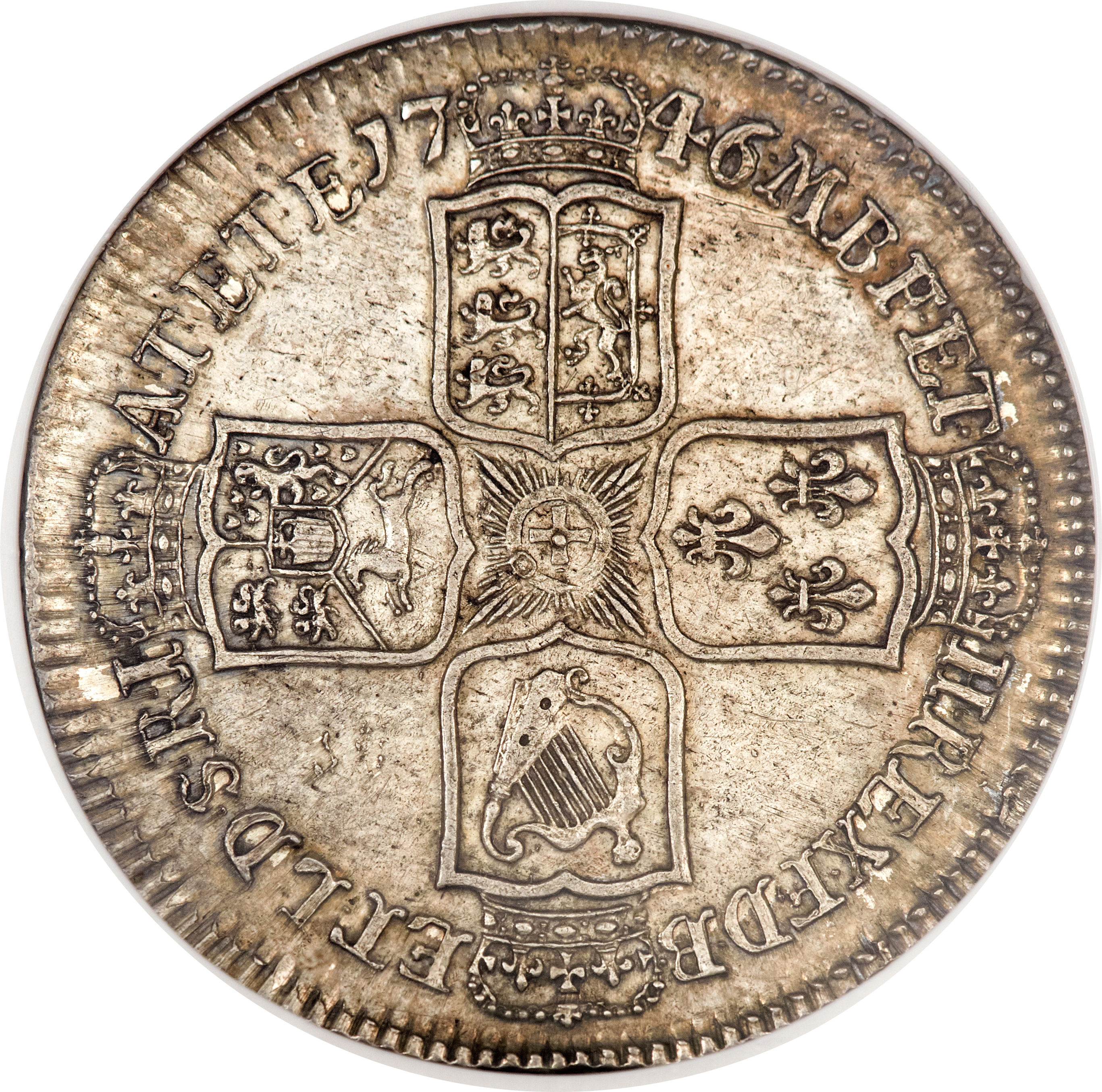
Crowned cruciform shields with central Garter star, divided date above, legend around.
M B F ET H REX F D B ET L D S R I A T ET E
Find this on eBay
AffiliateHalf Crown - George II Older bust price history
Daily limit reachedAbout the 1743 Half Crown - George II Older bust
The 1743 Half Crown - George II Older bust is a circulating ½ crown coin issued from 1743 to 1751, struck in 92.5% silver. It weighs 15.05g and measures 34mm across. Reverse design: Crowned cruciform shields with central Garter star, divided date above, legend around.
It is no longer legal tender (withdrawn 1969), so its value is to collectors only.
Common questions
How much is the 1743 Half Crown - George II Older bust worth?
No verified sale of the 1743 Half Crown - George II Older bust has been logged on MyCoinage yet. Its silver content is worth about £17.93 at today's spot price, which puts a floor under its value.
What does LIMA mean on a 1746 half crown?
It marks coins struck from captured Spanish American treasure. Tony Clayton, and a Nottingham Museums record quoting Spink, connect it with Admiral Anson's voyage round the world of 1740 to 1744. LIMA half crowns are dated 1745 and 1746.
How many George II older bust half crowns were made?
No mintage by date has been published. The type ran only to 1751. Tony Clayton notes that after 1751 there was a long gap in half crown production until the Great Recoinage of 1816.
What is written on the edge of a 1746 half crown?
DECVS ET TVTAMEN ANNO REGNI DECIMO NONO, as museum records of 1746 LIMA half crowns read. It means 'an ornament and a safeguard, in the nineteenth year of the reign'. Other dates carry their own regnal year.
Is there a 1746 half crown without LIMA?
Yes, as a proof. Clayton and Coin Hunter list a 1746 proof, and the Royal Mint Museum holds one. The Museum suggests the matching 1746 proofs of the crown, half crown, shilling and sixpence may be the Mint's first proof set.
How do I identify the 1743 Half Crown - George II Older bust?
Check the weight 15.05g and diameter 34mm and the metal (92.5% silver) against the specification table on this page. The reverse design is described above.
History and design
The older bust came to the half crown in 1743, and the type was struck for 1743, 1745, 1746, 1750 and 1751, according to Tony Clayton, with a proof in 1746. No mintage has been published for any date. Clayton notes that the half crown, issued regularly since Charles II, then disappeared for a long gap until the Great Recoinage of 1816.
The Royal Mint Museum explains the decline. Silver was worth more as bullion than as coin and was exported to Asia, and after 1745 domestic supplies dried up. The half crowns of 1750 and 1751 were made from silver obtained overseas.
The half crowns of 1745 and 1746 carry LIMA below the bust. A Nottingham Museums record quotes Spink: some of the treasure seized by Admiral Anson during his voyage round the world of 1740 to 1744, and by other privateers, was made into coin marked LIMA.
The older laureate bust faces left, draped and in armour with a lion's head on the shoulder, with GEORGIVS II DEI GRATIA. The Royal Mint Museum credits the older head to John Sigismund Tanner, who became Chief Engraver in 1741.
The reverse has the four crowned shields in a cross, England impaling Scotland, France, Ireland and the Electorate, around the Garter star, with M B F ET H REX F D B ET L D S R I A T ET E and the date. The 1743 and 1745 coins have roses in the angles; the LIMA coins have plain angles. The edge is lettered DECVS ET TVTAMEN ANNO REGNI with the regnal year, DECIMO NONO on 1746 coins.
Varieties and errors
Clayton lists 1745 with roses and with LIMA, 1746 LIMA, and a 1746/5 LIMA overdate, which Coin Hunter also records. The 1746 proof has no LIMA. The Royal Mint Museum notes that the 1746 proof crown, half crown, shilling and sixpence exist in roughly equal numbers and appear to have been struck together.
Collecting notes
Check below the bust for LIMA and the edge for a complete inscription with the regnal year. Wear shows first on the hair, the lion's head on the shoulder and the shield crowns. Earlier coins are covered by the young bust half crown, dated 1731 to 1741.
Sources
The history, design, varieties and collecting notes on this page are drawn from these sources. Prices come from recorded sales, not from them.
- George II, Royal Mint Museum (read 12 Oct 2026)
- John Sigismund Tanner, Wikipedia (read 12 Oct 2026)
- George II half crown (1745, LIMA), Nottingham Museums, via Museum Data Service (read 12 Oct 2026)
- Values of Halfcrowns, Tony Clayton, Coins of the UK (read 12 Oct 2026)
- Coin values by year, George II (year pages 1743 to 1751, read one by one), Coin Hunter (read 12 Oct 2026)
- George II half-crown, 1743, The Royal Mint Museum, via Museum Data Service (read 12 Oct 2026)
- George II half-crown, 1746, The Royal Mint Museum, via Museum Data Service (read 12 Oct 2026)
- Half-Crown coin of George II (1746, LIMA), Science Museum Group, via Museum Data Service (read 12 Oct 2026)
- Half-crown, silver, of George II (1746, LIMA), Nottingham Museums, via Museum Data Service (read 12 Oct 2026)
- Halfcrown, Tony Clayton, Coins of the UK (read 12 Oct 2026)
- George II proof half-crown, 1746, The Royal Mint Museum, via Museum Data Service (read 12 Oct 2026)
More ½ Crown coins from nearby years