Exceptional: fewer than 1,000 minted.
4 Pence - Elizabeth II Maundy pre-decimal 1st issue (1953)
"Maundy groat"
| Country | United Kingdom |
| Year | 1953 |
| Denomination | 4 Pence |
| Mintage | 1,078 |
| Mint | Royal Mint · Llantrisant |
| Series | Maundy Money |
| Circulation | Non-circulating |
| Composition | Silver (.925) (925/1000 fine) |
| Weight | 1.890g · 0.0562 t oz |
| Diameter | 18.0mm |
| Shape | Round |
| Edge | Plain |
| Orientation | Medal alignment ↑↑ |
| Obv. artist | Mary Gillick |
| Rev. artist | Jean Baptiste Merlen |
| Grade scale | UK (EF/UNC) |
Young laureate bust of Queen Elizabeth II right, legend around.
ELIZABETH II DEI GRA: BRITT: OMN: REGINA F: D:
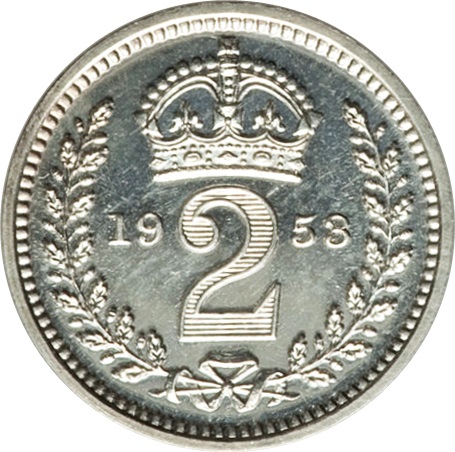
Crowned denomination dividing date within oak wreath.
Find this on eBay
Affiliate1st issue 4 Pence price history
Daily limit reachedAbout the 1953 4 Pence - Elizabeth II Maundy pre-decimal – 1st issue
The 1953 4 Pence - Elizabeth II Maundy pre-decimal – 1st issue is a collector 4 pence coin in the Maundy Money series, struck in 92.5% silver. It weighs 1.89g and measures 18mm across. Reverse design: Crowned denomination dividing date within oak wreath.
1,078 were struck.
Common questions
How much is the 1953 4 Pence - Elizabeth II Maundy pre-decimal – 1st issue worth?
No verified sale of the 1953 4 Pence - Elizabeth II Maundy pre-decimal – 1st issue has been logged on MyCoinage yet. Its silver content is worth about £2.24 at today's spot price, which puts a floor under its value.
How many 1953 Maundy fourpences were made?
CoinVarieties, which cites the Spink, Coincraft and Krause catalogues, records a mintage of 1,078 for the 1953 Maundy fourpence, the same figure it gives for the threepence. The coins were struck for the Maundy recipients and officials, not for general issue.
Why is the Maundy fourpence called a groat?
Groat was the old name for the fourpence. Tony Clayton notes that the crowned numeral design first appeared in 1686 and that, after George III, the crowned 4 was issued only for the Maundy ceremony, so collectors still call it the Maundy groat.
Is the 1953 Maundy fourpence legal tender?
Yes. Under section 2 of the Coinage Act 1971, Maundy coins issued before Decimal Day are treated as denominated in new pence, so a 1953 fourpence is legal tender as 4p. In practice it is a collector's coin and never circulates.
What makes the 1953 Maundy set special?
It is the coronation-year set and the only Elizabeth II Maundy issue whose legend includes BRITT: OMN:. A Stack's Bowers description quoted by CoinVarieties calls it by far the most difficult Maundy set of the reign to obtain, handed out by the Queen at St Paul's Cathedral.
How do I identify the 1953 4 Pence - Elizabeth II Maundy pre-decimal – 1st issue?
Check the weight 1.89g and diameter 18mm and the metal (92.5% silver) against the specification table on this page. The reverse design is described above.
History and design
The fourpence, or groat, is the largest of the four Maundy coins. Tony Clayton traces the crowned numeral design to 1686 and notes that after the reign of George III the crowned 4 was issued only for the Maundy ceremony. By 1953 the crowned 4 had been a Maundy-only coin for more than a century.
This is the groat from the Queen's first Maundy set, dated 1953. The Royal Mint records that the number of Maundy recipients matches the monarch's age, and Clayton that the amount each receives does too, so the supply of coins grows as a reign goes on. CoinVarieties gives a recorded mintage of 1,078 for the 1953 fourpence.
The proclamation of 25 November 1952 set the obverse as the Queen's effigy with ELIZABETH II DEI GRA: BRITT: OMN: REGINA F: D:. The portrait is Mary Gillick's, the one the Royal Mint says appeared on the first coins of the reign in 1953 and was kept on Maundy money long after it left the circulating coins.
The reverse is the figure 4 with the date across it, inside an oak wreath and under the crown, with a plain edge. This form of the design dates from 1822, credited to Jean Baptiste Merlen, with the crown altered by Leonard Charles Wyon in 1888.
Varieties and errors
Tony Clayton's table of Maundy sets lists a matt proof and a gold proof of the 1953 set alongside the normal issue. No mintage is published for either.
Collecting notes
The 1953 groat is the only Elizabeth II fourpence with BRITT: OMN:, and a Stack's Bowers catalogue entry quoted by CoinVarieties calls the 1953 set by far the most difficult Maundy set of the reign to obtain. Check the legend against the 1954 to 1970 groat, which reads without those words.
The coin is struck in sterling silver, the standard Maundy money returned to in 1947.
It remains legal tender at 4p under the Coinage Act 1971. For the smaller coins of the same set, see the 1953 Maundy threepence and 1953 Maundy twopence.
Sources
The history, design, varieties and collecting notes on this page are drawn from these sources. Prices come from recorded sales, not from them.
- Proclamation determining new designs for gold, silver, cupro-nickel, mixed metal and bronze coins, London Gazette issue 39703, The London Gazette (read 10 Oct 2026)
- The History of Maundy Money, The Royal Mint (read 10 Oct 2026)
- Maundy money (Royal Maundy), Wikipedia (read 10 Oct 2026)
- Coins of the UK: Four Pence (Groats), Tony Clayton (read 10 Oct 2026)
- Great Britain 1953 4 pence, CoinVarieties (read 10 Oct 2026)
- Values of Coins of the UK: Maundy Sets, Tony Clayton (read 10 Oct 2026)
- Coinage Act 1971, section 2, legislation.gov.uk (read 10 Oct 2026)
- Coins of the UK: Maundy Money, Tony Clayton (read 10 Oct 2026)
More from Maundy Money