Legendary: fewer than 100 minted.
3 Pence - Elizabeth II Maundy pre-decimal 2nd issue (1954–1970)
| Country | United Kingdom |
| Year | 1954–1970 |
| Denomination | 3 Pence |
| Mintage | 1,076 |
| Mint | Royal Mint · Llantrisant |
| Series | Maundy Money |
| Circulation | Non-circulating |
| Composition | Silver (.925) (925/1000 fine) |
| Weight | 1.410g · 0.0419 t oz |
| Diameter | 16.0mm |
| Shape | Round |
| Orientation | Medal alignment ↑↑ |
| Obv. artist | Mary Gillick |
| Rev. artist | Jean Baptiste Merlen |
| Grade scale | UK (EF/UNC) |
Young laureate bust of Queen Elizabeth II right, legend around.
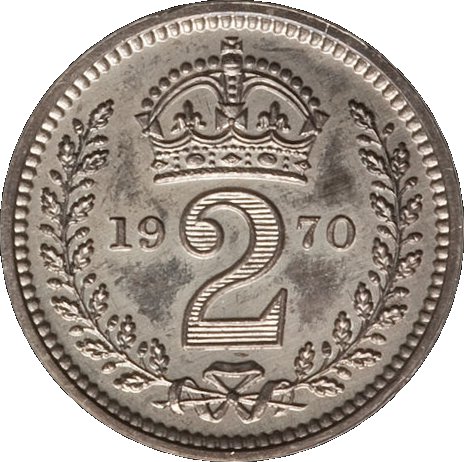
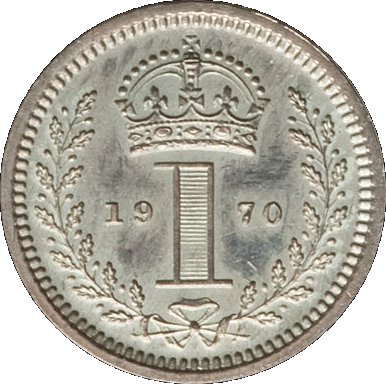
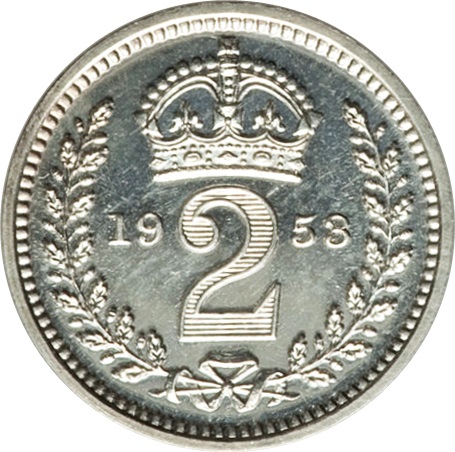
Crowned denomination dividing date within oak wreath.
Find this on eBay
Affiliate2nd issue Threepence price history
Daily limit reachedAbout the 1954 3 Pence - Elizabeth II Maundy pre-decimal – 2nd issue
The 1954 3 Pence - Elizabeth II Maundy pre-decimal – 2nd issue is a collector 3 pence coin issued from 1954 to 1970 in the Maundy Money series, struck in 92.5% silver. It weighs 1.41g and measures 16mm across. Reverse design: Crowned denomination dividing date within oak wreath.
A mintage of 1,076 is recorded for one date of this type; figures for each year are not held.
Common questions
How much is the 1954 3 Pence - Elizabeth II Maundy pre-decimal – 2nd issue worth?
No verified sale of the 1954 3 Pence - Elizabeth II Maundy pre-decimal – 2nd issue has been logged on MyCoinage yet. Its silver content is worth about £1.67 at today's spot price, which puts a floor under its value.
Is a silver threepence with a crowned 3 from the 1950s or 1960s a Maundy coin?
Yes. Tony Clayton notes that every silver threepence from 1927 onwards with a crowned 3 on the reverse is a Maundy coin. The currency threepence of the 1950s and 1960s was the twelve-sided brass coin, so a small silver threepence of these dates came from a Maundy set.
How many Maundy threepences were struck between 1954 and 1970?
Figures were found for two dates only: CoinVarieties records 1,094 for 1957 and 1,221 for 1965, the same as its twopence figures for those years. Each date was struck only for that year's recipients and a limited number of officials.
Is the Maundy threepence still legal tender?
Yes. Unlike the brass threepence, which lost legal tender status after 31 August 1971, Maundy coins were never withdrawn. The Coinage Act 1971 treats those issued before Decimal Day as denominated in new pence, so a 1954 to 1970 Maundy threepence is legal tender as 3p.
Why does the Maundy threepence still show the young portrait of the Queen?
Mary Gillick's portrait was kept on Maundy money throughout the reign. Wikipedia records that at decimalisation the Royal Mint Advisory Committee recommended keeping it out of affection for the design, and the Queen agreed. The Royal Mint Museum confirms her work still appears on Maundy money.
How do I identify the 1954 3 Pence - Elizabeth II Maundy pre-decimal – 2nd issue?
Check the weight 1.41g and diameter 16mm and the metal (92.5% silver) against the specification table on this page. The reverse design is described above.
History and design
Through the 1950s and 1960s Britain had two threepences. The coin in everyday use was the twelve-sided brass threepenny bit, while the silver threepence survived only as one of the four Maundy coins. Tony Clayton records that the silver currency threepence was last made for UK circulation in 1941, but the Maundy version, with its crowned 3, carried on every year.
This entry covers the Maundy threepences dated 1954 to 1970, after BRITT: OMN: was dropped from the Queen's title. Clayton notes that the legend was the only change to the Maundy obverse after 1953. CoinVarieties gives recorded mintages of 1,094 for 1957 and 1,221 for 1965, and Clayton points out that because both the number of recipients and the sum each receives equal the monarch's age, the supply rises as a reign goes on.
The obverse is Mary Gillick's portrait of the young Queen. When the rest of the coinage changed portrait for decimalisation, Wikipedia records that the Royal Mint Advisory Committee recommended keeping Gillick's design on the Maundy coins out of affection for it, and the Queen agreed. The Royal Mint Museum notes that her work still appears on Maundy money.
The reverse is the crowned 3 with the date across it inside an oak wreath, the 1822 design credited to Jean Baptiste Merlen, with the crown redrawn by Leonard Charles Wyon in 1888.
Collecting notes
The quickest identification is metal and shape. A small round silver threepence with a crowned 3 from these years is a Maundy coin; the twelve-sided brass coin with a portcullis is the currency piece. The two had very different fates at decimalisation: the brass coin ceased to be legal tender after 31 August 1971, while the Maundy threepence became a three new pence coin under the Coinage Act 1971 and is still legal tender.
The coin is sterling silver, the standard Maundy money returned to in 1947 when the circulating coins became cupro-nickel.
The first type, with BRITT: OMN:, is the 1953 Maundy threepence.
Sources
The history, design, varieties and collecting notes on this page are drawn from these sources. Prices come from recorded sales, not from them.
- Mary Gillick, Royal Mint Museum (read 10 Oct 2026)
- Brass threepence, Wikipedia (read 10 Oct 2026)
- The History of Maundy Money, The Royal Mint (read 10 Oct 2026)
- Maundy money (Royal Maundy), Wikipedia (read 10 Oct 2026)
- Coins of the UK: Maundy Money, Tony Clayton (read 10 Oct 2026)
- Great Britain 1957 3 pence KM-901, CoinVarieties (read 10 Oct 2026)
- Great Britain 1965 3 pence KM-901, CoinVarieties (read 10 Oct 2026)
- Coinage Act 1971, section 2, legislation.gov.uk (read 10 Oct 2026)
- Coins of the UK: Three Pence, Tony Clayton (read 10 Oct 2026)
- Values of Coins of the UK: Three Pence, Tony Clayton (read 10 Oct 2026)
More from Maundy Money