Elite: fewer than 10,000 minted.
2 Pence - George VI 3rd Maundy issue (1949–1952)
| Country | United Kingdom |
| Year | 1949–1952 |
| Denomination | 2 Pence |
| Mintage | 1,395 |
| Mint | Royal Mint · Llantrisant |
| Series | Maundy Money |
| Circulation | Non-circulating |
| Composition | Silver (.925) (925/1000 fine) |
| Weight | 0.940g · 0.0280 t oz |
| Diameter | 13.0mm |
| Shape | Round |
| Edge | Plain |
| Orientation | Medal alignment ↑↑ |
| Obv. artist | Thomas Humphrey Paget |
| Rev. artist | Jean Baptiste Merlen |
| Grade scale | UK (EF/UNC) |
Uncrowned portrait of King George VI left, legend around.
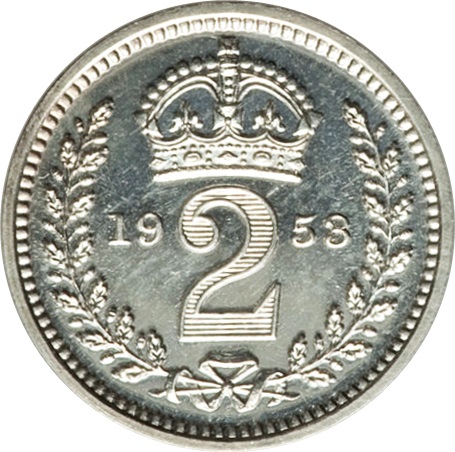
Crowned denomination dividing date within oak wreath.
Find this on eBay
AffiliateAbout the 1949 2 Pence - George VI 3rd Maundy issue
The 1949 2 Pence - George VI 3rd Maundy issue is a collector 2 pence coin issued from 1949 to 1952 in the Maundy Money series, struck in 92.5% silver. It weighs 0.94g and measures 13mm across. Reverse design: Crowned denomination dividing date within oak wreath.
A mintage of 1,395 is recorded for one date of this type; figures for each year are not held.
Common questions
How much is the 1949 2 Pence - George VI 3rd Maundy issue worth?
No verified sale of the 1949 2 Pence - George VI 3rd Maundy issue has been logged on MyCoinage yet. Its silver content is worth about £1.12 at today's spot price, which puts a floor under its value.
What is different about the 1949 Maundy twopence?
The legend. From 1 January 1949 the King's title on the coins lost IND IMP, Emperor of India, after the title was dropped in 1948. The legend became GEORGIVS VI D:G:BR:OMN:REX FIDEI DEF. The sterling silver and the crowned 2 reverse stayed as before.
Why does the 2 on a Maundy twopence look different from older ones?
Leonard Charles Wyon changed the shape of the 2 in 1888. In 1950 the Royal Mint proposed returning to the earlier, more artistic 2, but George VI refused, feeling the existing numeral matched the figures on the other Maundy coins better than the older form.
How many 1949 Maundy twopences were made?
Sovereign Rarities states that the 1949 output of the four Maundy denominations was enough for at most 1,395 complete sets, so at least that many twopences were struck that year.
Is a Maundy twopence from 1949 to 1952 legal tender?
Yes, technically. Maundy money remains legal tender, and after decimalisation in 1971 all Maundy coins were deemed to be in new pence, so the coin now counts as 2p. Because of its silver and collector interest it does not circulate.
How do I identify the 1949 2 Pence - George VI 3rd Maundy issue?
Check the weight 0.94g and diameter 13mm and the metal (92.5% silver) against the specification table on this page. The reverse design is described above.
History and design
On 22 June 1948 a royal proclamation removed Indiae Imperator, Emperor of India, from the King's style, following Indian independence. A second proclamation, dated 22 December 1948, set new designs for the coins from 1 January 1949, and it covers the Maundy fourpence, threepence, twopence and penny alongside the circulating coins. This third Maundy issue ran from 1949 to the end of the reign in 1952.
The silver stayed at .925 sterling, restored for Maundy money in 1947. Sovereign Rarities notes that the 1949 output of the four denominations was enough for no more than 1,395 complete Maundy sets.
Humphrey Paget's uncrowned portrait of George VI still faces left, with his initials HP below the truncation. The 1948 proclamation gives the new legend as GEORGIVS VI D:G:BR:OMN:REX FIDEI DEF, without the IND IMP that had closed the 1937 legend.
The reverse is unchanged: the figure 2 with the date across it, within an oak wreath surmounted by the Royal Crown, and a plain edge. Wikipedia credits the layout to Jean Baptiste Merlen in 1822. The twopence's numeral is Leonard Charles Wyon's 1888 version, and Wikipedia records a small episode from this issue: in 1950 the Royal Mint proposed going back to the pre-1888 2 as more artistic, and George VI refused, judging the existing numeral closer in style to those on the other Maundy coins.
Collecting notes
The legend is the quickest check. A George VI Maundy twopence without IND IMP is from this issue; one with it is from 1937 to 1948, and the 1947 and 1948 coins share this issue's sterling silver.
Maundy money is given in white purses at the Royal Maundy service, the number of pence matching the monarch's age, according to the Royal Mint Museum. It remains legal tender, deemed to be in new pence since 1971, but does not circulate.
Sources
The history, design, varieties and collecting notes on this page are drawn from these sources. Prices come from recorded sales, not from them.
- Royal Maundy, Wikipedia (read 10 Oct 2026)
- The London Gazette, 24 December 1948, issue 38487, page 6665 (proclamation of 22 December 1948 determining new designs), The Gazette (read 10 Oct 2026)
- George VI 1949 Maundy Set, 1st year no Emperor of India title, Sovereign Rarities (read 10 Oct 2026)
- Humphrey Paget, Royal Mint Museum (read 10 Oct 2026)
- Initials on British coins, TreasureRealm (read 10 Oct 2026)
- Maundy Money, Royal Mint Museum (read 10 Oct 2026)
- The London Gazette, 19 March 1937, issue 34381, page 1818 (coinage proclamation of 18 March 1937), The Gazette (read 10 Oct 2026)
More from Maundy Money