Elite: fewer than 10,000 minted.
4 Pence - George VI 3rd Maundy issue (1949–1952)
| Country | United Kingdom |
| Year | 1949–1952 |
| Denomination | 4 Pence |
| Mintage | 1,503 |
| Mint | Royal Mint · Llantrisant |
| Series | Maundy Money |
| Circulation | Non-circulating |
| Composition | Silver (.925) (925/1000 fine) |
| Weight | 1.890g · 0.0562 t oz |
| Diameter | 18.0mm |
| Shape | Round |
| Orientation | Medal alignment ↑↑ |
| Obv. artist | Thomas Humphrey Paget |
| Rev. artist | Jean Baptiste Merlen |
| Grade scale | UK (EF/UNC) |
Uncrowned portrait of King George VI left, legend around.
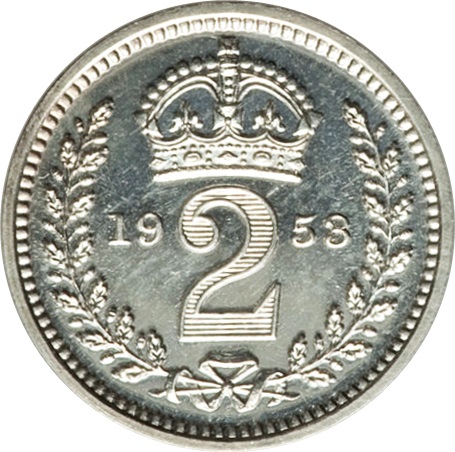
Crowned denomination dividing date within oak wreath.
Find this on eBay
AffiliateAbout the 1949 4 Pence - George VI 3rd Maundy issue
The 1949 4 Pence - George VI 3rd Maundy issue is a collector 4 pence coin issued from 1949 to 1952 in the Maundy Money series, struck in 92.5% silver. It weighs 1.89g and measures 18mm across. Reverse design: Crowned denomination dividing date within oak wreath.
A mintage of 1,503 is recorded for one date of this type; figures for each year are not held.
Common questions
How much is the 1949 4 Pence - George VI 3rd Maundy issue worth?
No verified sale of the 1949 4 Pence - George VI 3rd Maundy issue has been logged on MyCoinage yet. Its silver content is worth about £2.25 at today's spot price, which puts a floor under its value.
What changed on the Maundy fourpence in 1949?
The obverse legend. After the King ceased to be Emperor of India, IND IMP was removed from British coins from 1949, and on Maundy money the legend ended FIDEI DEF instead. Tony Clayton treats the 1949 to 1952 coins as the third George VI Maundy type.
How many George VI Maundy fourpences were made from 1949 to 1952?
Stash of Coins, citing KM 874, gives 1,503 for 1949, 1,515 for 1950, 1,580 for 1951 and 1,064 for 1952. These match the site's own rows, but no second reference has been checked, and Maundy figures vary between catalogues.
Is the 1952 Maundy fourpence a George VI coin?
Yes. Maundy coins dated 1952 carry George VI's portrait and belong to this type in Tony Clayton's list, which runs 1949, 1950, 1951 and 1952. The first Elizabeth II Maundy coins are dated 1953.
Is the Maundy fourpence silver?
Yes, sterling (0.925) silver. Maundy coins returned to sterling in 1947, when circulating coins became cupronickel, because base metal was thought unsuitable for the Maundy gift. Stash of Coins gives this type 1.89 g with 92.5% silver.
How do I identify the 1949 4 Pence - George VI 3rd Maundy issue?
Check the weight 1.89g and diameter 18mm and the metal (92.5% silver) against the specification table on this page. The reverse design is described above.
History and design
Maundy money is the special silver coinage the monarch distributes at the Royal Maundy service on Maundy Thursday. The Royal Mint Museum explains that each recipient's white purse holds Maundy coins totalling as many pence as the monarch's age. The fourpence is the largest of the four.
This third George VI type began in 1949, when IND IMP was removed from British coin legends because the King was no longer Emperor of India, as Tony Clayton explains for the sixpence. Clayton names the Maundy type after its new ending, FIDEI DEF, and lists dates from 1949 to 1952. The metal stayed sterling (0.925) silver, which had been restored for Maundy coins in 1947 when the circulating coinage became cupronickel.
Stash of Coins, citing the Krause catalogue, gives 1,503 for 1949, 1,515 for 1950, 1,580 for 1951 and 1,064 for 1952. On those figures 1952 is the lowest date of the type.
The obverse keeps Thomas Humphrey Paget's uncrowned portrait of George VI, the effigy the Royal Mint Museum calls almost certainly the design Paget himself regarded as his best. The legend now reads GEORGIVS VI D G BR OMN REX FIDEI DEF, with Defender of the Faith written as FIDEI DEF.
The reverse is the Maundy design introduced by Jean Baptiste Merlen in 1822, a crowned 4 dividing the date within an oak wreath, with the crown as altered by Leonard Charles Wyon in 1888. The Royal Collection's 1949 set is described the same way.
Varieties and errors
Tony Clayton lists a 1952 Maundy set struck as a proof in copper. It is an exceptional piece and not something found among ordinary Maundy sets.
Collecting notes
Most collectors want the fourpence with its threepence, twopence and penny, since Maundy coins were issued as sets. Clayton notes that Maundy coins since the 1820s rarely turn up below VF, so check for toning, scratches and mount marks rather than wear.
1952 is the date to watch, both as the lowest figure and as the last George VI Maundy date. Earlier coins with IND IMP are on the 1947 Maundy fourpence page.
Sources
The history, design, varieties and collecting notes on this page are drawn from these sources. Prices come from recorded sales, not from them.
- Royal Maundy, Wikipedia (read 10 Oct 2026)
- Six Pence: Sixpence, Tony Clayton, Coins of the UK (read 10 Oct 2026)
- Maundy Money, Royal Mint Museum (read 10 Oct 2026)
- Maundy Money, Tony Clayton, Coins of the UK (read 10 Oct 2026)
- Values of Maundy Sets, Tony Clayton, Coins of the UK (read 10 Oct 2026)
- Humphrey Paget, Royal Mint Museum (read 10 Oct 2026)
- Initials on British coins, TreasureRealm (read 10 Oct 2026)
- United Kingdom 4 pence 1949 (KM 874), Stash of Coins (read 10 Oct 2026)
- George VI set of four Maundy coins, 1949 (RCIN 443694), Royal Collection Trust (read 10 Oct 2026)
- Penny (British pre-decimal coin), Wikipedia (read 10 Oct 2026)
More from Maundy Money