Very Rare: fewer than 100,000 minted. Sells often: 25 verified sales in the last 12 months.
1 Pound - Elizabeth II English Oak Silver Proof (1987–1992)
Circulating version: 1987 1 Pound - Elizabeth II – English Oak
| Country | United Kingdom |
| Year | 1987–1992 |
| Denomination | 1 Pound |
| Face value | £1 |
| Mintage | 50,000 |
| Mint | Royal Mint · Llantrisant |
| Series | Round Pound Series |
| Circulation | Non-circulating |
| Demonetised | 2017 |
| Composition | Silver (.925) (925/1000 fine) |
| Weight | 9.500g · 0.2825 t oz |
| Diameter | 22.5mm |
| Shape | Round |
| Orientation | Medal alignment ↑↑ |
| Grade scale | UK (EF/UNC) |
Third crowned portrait of Queen Elizabeth II right, wearing the George IV State Diadem, legend around.
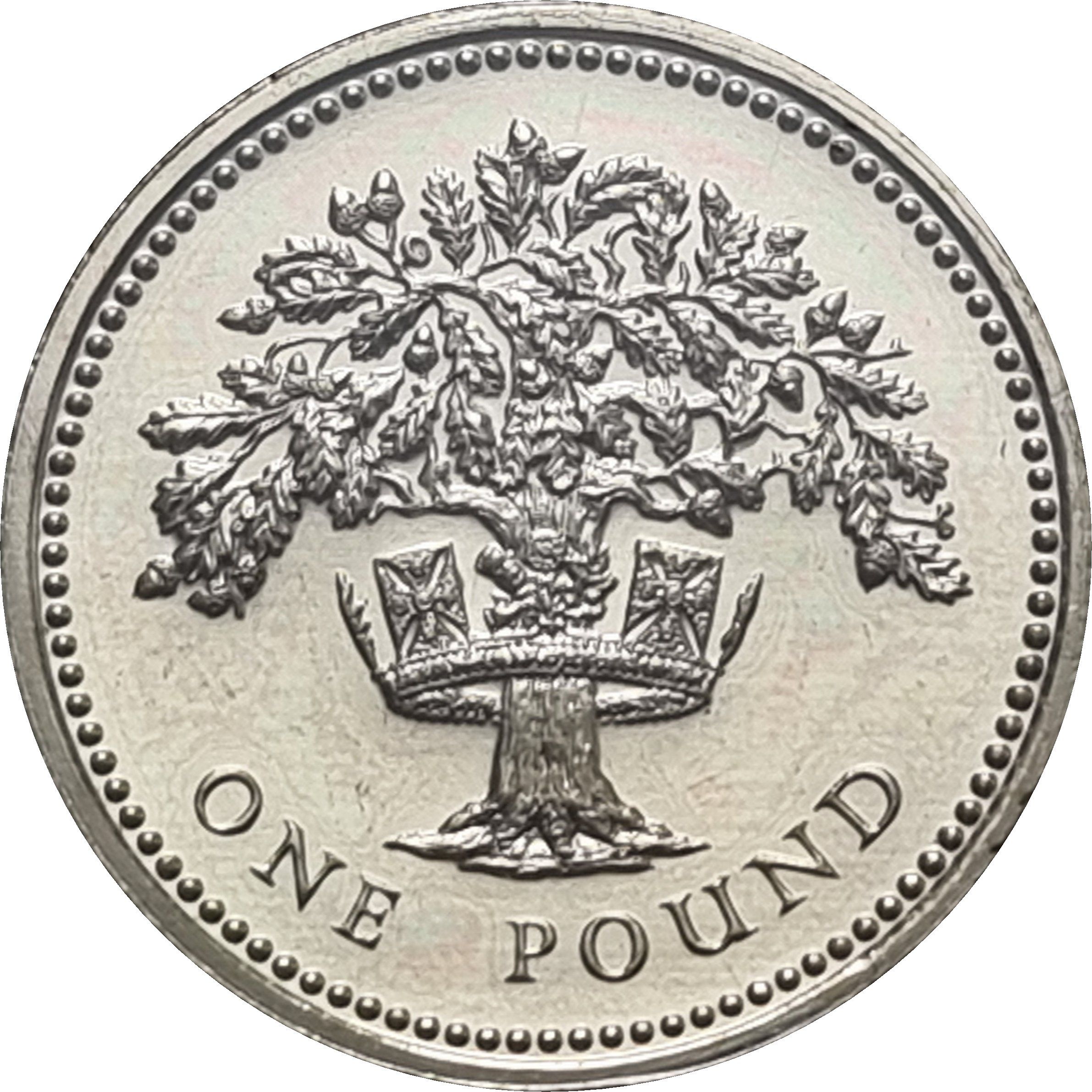
An oak tree enfiling a representation of the Royal Diadem above denomination.
Silver Proof £1 market value
Find this on eBay
AffiliateSilver Proof £1 price history
Daily limit reachedSilver Proof £1 value by year
1987 to 1992 · median sold prices| Year | Mintage | Circulated | Uncirculated | Sales | |
|---|---|---|---|---|---|
| 1987 | Not recorded | £25.00 | 20 | ||
|
VF£12.50EF£28.00UNC£95.00
⭐ Pro: the 1987 coin's sales by grade, and the chart filtered to one year
Start 7-day free trial
|
|||||
| 1992 | Not recorded | £27.10 | 5 | ||
|
VF£12.50EF£28.00UNC£95.00
⭐ Pro: the 1992 coin's sales by grade, and the chart filtered to one year
Start 7-day free trial
|
|||||
One row for each year the 1 Pound - Elizabeth II English Oak – Silver Proof was struck. Prices are medians of verified sold listings matched to that year from the listing: circulated is worn condition up to Extremely Fine, uncirculated is About Uncirculated or better. A count in brackets means fewer than three sales behind the figure; a grey figure marked "type" is the median across every year, shown where that year has no sale of its own yet. Most types have been searched year by year only since October 2026, so later years are still filling in. Use the grade table below for a price by condition across all years.
Silver Proof £1 value by grade
Realised auction prices · ⭐ Pro Expand rows for individual sale records| Grade | Latest | Median | 30d Δ | All-time range | Sales (1yr) | Total sales | Last sale | |
|---|---|---|---|---|---|---|---|---|
| FDC | £19.00 🔒 eBay | £19.00 | – | £17.95 – £25.00 | 3 | 3 | 11-08-2026 | |
|
Loading…
|
||||||||
| PR-69 | £58.00 🔒 eBay | £57.25 (2) | – | £56.50 – £58.00 | 2 | 2 | 30-07-2026 | |
|
Loading…
|
||||||||
| PR-65 | £23.89 🔒 eBay | £25.85 | – | £16.01 – £40.80 | 20 | 20 | 21-10-2026 | |
|
Loading…
|
||||||||
About the 1987 1 Pound - Elizabeth II English Oak – Silver Proof
The 1987 1 Pound - Elizabeth II English Oak – Silver Proof is a collector 1 pound coin issued from 1987 to 1992 in the Round Pound series, struck in 92.5% silver. It weighs 9.5g and measures 22.5mm across. Reverse design: An oak tree enfiling a representation of the Royal Diadem above denomination.
A mintage of 50,000 is recorded for one date of this type; figures for each year are not held. It is no longer legal tender (withdrawn 2017), so its value is to collectors only.
Common questions
How much is the 1987 1 Pound - Elizabeth II English Oak – Silver Proof worth?
Verified sold prices for the 1987 1 Pound - Elizabeth II English Oak – Silver Proof run from £19.00 to £57.25 across 3 grades, taking the median for each grade. Condition makes the difference, so check the grade table above before pricing one. Its silver content is worth about £11.28 at today's spot price, which puts a floor under its value.
How is the 1987 1 Pound - Elizabeth II English Oak – Silver Proof different from the circulating coin?
This is a collector version of the 1987 1 Pound - Elizabeth II – English Oak, not the coin found in change. It is struck in 92.5% silver rather than nickel.
How do I identify the 1987 1 Pound - Elizabeth II English Oak – Silver Proof?
Check the weight 9.5g and diameter 22.5mm and the metal (92.5% silver) against the specification table on this page. The reverse design is described above.
History and design
This is a collector version of the 1 Pound - Elizabeth II – English Oak. The history below is that coin's; the mintage, varieties and collecting notes on its page do not apply to this strike.
The Oak Tree £1 completed the first set of national round pounds. After the Royal Arms coin of 1983, the Royal Mint gave each nation a floral emblem in turn: Scotland in 1984, Wales in 1985, Northern Ireland in 1986 and England in 1987. The oak was used again in 1992, the last year a design from this series was struck.
Unlike the other floral coins, its two issues were almost the same size. The Royal Mint's figures give 39,298,502 for 1987 and 36,320,487 for 1992, a total of 75,618,989. The Thistle and Leek were each struck in far larger numbers in their first year than their second, and the Flax in far smaller numbers. Among the four designs the Oak's total ranks third, above the Flax (48,853,076) and below the Thistle (216,837,002) and the Leek (325,700,051).
Round pounds were withdrawn after the 12-sided £1 arrived on 28 March 2017, and lost their legal tender status at midnight on 15 October 2017.
Leslie Durbin's reverse is described by the Royal Mint as an oak tree and royal diadem, representing England. It is the only one of his four coins to show a tree, and it is combined with the same diadem that appears on the thistle, leek and flax designs.
The milled edge reads DECUS ET TUTAMEN, the Latin inscription first used on the 1983 pound, which Check Your Change translates as "an ornament and safeguard". The obverse on both dates has Raphael Maklouf's portrait of Elizabeth II, which the Royal Mint lists for round pounds from 1985 to 1997.
Sources
- UK coin mintage figures (data file), The Royal Mint (read 9 Oct 2026)
- £1 Coin Designs and Specifications, The Royal Mint (read 9 Oct 2026)
- 1992 Elizabeth II 'Oak Tree and Royal Diadem, Representing England' £1 Coin, The Royal Mint (read 9 Oct 2026)
- 1987 One Pound, Check Your Change (read 9 Oct 2026)
- Round £1: England: Oak Tree, Change Checker (read 9 Oct 2026)
- 1992 One Pound, Check Your Change (read 9 Oct 2026)
- Why does the edge inscription on the £2 and £1 coins sometimes appear "upside down"?, The Royal Mint (read 9 Oct 2026)
More from Round Pound Series