
Uncommon: fewer than 10,000,000 minted. Rarely sells: 1 verified sales in the last 12 months.
½ Farthing - Victoria 1st portrait incl. Colonial (1839–1856)
| Country | United Kingdom |
| Year | 1839–1856 |
| Denomination | ½ Farthing |
| Mintage by year |
Scarcest year: 677,300 struck
|
| Mint | Royal Mint · Llantrisant |
| Circulation | Circulating |
| Demonetised | 1869 |
| Composition | Copper |
| Weight | 2.360g |
| Diameter | 18.0mm |
| Thickness | 1.30mm |
| Shape | Round |
| Orientation | Medal alignment ↑↑ |
| Obv. artist | William Wyon |
| Grade scale | UK (EF/UNC) |
First uncrowned portrait ('Young Head') of Queen Victoria left, legend around.
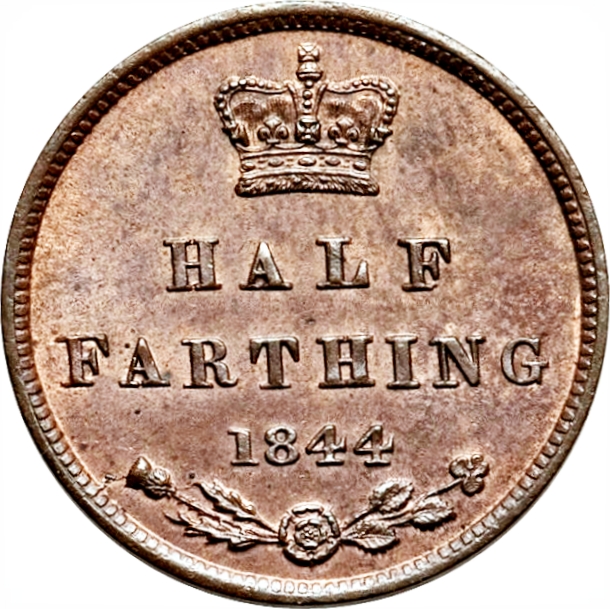
Central crowned denomination above date with rose, thistle and shamrock below date.
incl. Colonial Half Farthing market value
Find this on eBay
Affiliateincl. Colonial Half Farthing price history
Daily limit reachedincl. Colonial Half Farthing value by year
1839 to 1856 · median sold prices| Year | Mintage | Circulated | Uncirculated | Sales | |
|---|---|---|---|---|---|
| 1839 | 2,042,800 | £2.65 type | |||
| 1843 | 3,440,600 | £2.65 type | |||
| 1844 | 6,451,000 | £2.65 (1) | 1 | ||
|
VF£12.50EF£28.00UNC£95.00
⭐ Pro: the 1844 coin's sales by grade, and the chart filtered to one year
Start 7-day free trial
|
|||||
| 1847 | 3,010,500 | £2.65 type | |||
| 1852 | 989,100 | £2.65 type | |||
| 1853 | 955,200 | £2.65 type | |||
| 1854 scarcest | 677,300 | £2.65 type | |||
| 1856 | 913,900 | £2.65 type | |||
One row for each year the ½ Farthing - Victoria 1st portrait – incl. Colonial was struck. Prices are medians of verified sold listings matched to that year from the listing: circulated is worn condition up to Extremely Fine, uncirculated is About Uncirculated or better. A count in brackets means fewer than three sales behind the figure; a grey figure marked "type" is the median across every year, shown where that year has no sale of its own yet; years with no sales yet fill in as sales are recorded. Most types have been searched year by year only since October 2026, so later years are still filling in. Use the grade table below for a price by condition across all years.
incl. Colonial Half Farthing value by grade
Realised auction prices · ⭐ Pro Expand rows for individual sale records| Grade | Latest | Median | 30d Δ | All-time range | Sales (1yr) | Total sales | Last sale | |
|---|---|---|---|---|---|---|---|---|
| VF | £2.65 🔒 eBay | £2.65 (1) | – | £2.65 – £2.65 | 1 | 1 | 13-08-2026 | |
|
Loading…
|
||||||||
About the 1839 Half Farthing - Victoria – incl. Colonial
The 1839 Half Farthing - Victoria – incl. Colonial is a circulating ½ farthing coin issued from 1839 to 1856, struck in copper. It weighs 2.36g and measures 18mm across. Reverse design: Central crowned denomination above date with rose, thistle and shamrock below date.
Mintage figures are recorded for 8 years between 1839 and 1856, 18,480,400 coins in all. 1854 is the scarcest date, with 677,300 struck. It is no longer legal tender (withdrawn 1869), so its value is to collectors only.
Common questions
How much is the 1839 Half Farthing - Victoria – incl. Colonial worth?
The 1839 Half Farthing - Victoria – incl. Colonial has a price in one grade on MyCoinage so far: £2.65 in VF, the median of its verified sales.
Was the half farthing legal tender in Britain?
Yes, from 1842. It was first made in 1828 for Ceylon, and a proclamation dated 13 June 1842 made it current in the United Kingdom, in amounts up to sixpence. It was demonetised with all other copper coins at the end of 1869.
Which Victorian half farthing is the most common?
1844, with 6,451,200 struck in Coin Hunter's figures, more than any other date. Tony Clayton says the vast majority of issued half farthings are dated 1844. The lowest published figure is 1854, at 677,376.
What is the 1844 E over N half farthing?
A die error in which the E of REGINA was punched over a mistaken N. Clayton, Coin Hunter and the Old Currency Exchange all list it, and the Old Currency Exchange says it is easier to find than the 1851 overdates.
Why does the 1839 half farthing look different?
The 1839 issue, made for Ceylon, has a rose with three leaves below the date. From 1842, when the coin became current throughout the United Kingdom, the emblem changed to a rose, thistle and shamrock.
How do I identify the 1839 Half Farthing - Victoria – incl. Colonial?
Check the weight 2.36g and diameter 18mm and the metal (copper) against the specification table on this page. The reverse design is described above.
History and design
The half farthing, worth an eighth of a penny, was first struck in 1828 for Ceylon. Victoria's first issue, dated 1839, was also for Ceylon. A proclamation of 13 June 1842 made the coin legal tender in the United Kingdom, and the Royal Mint Museum notes it was a nine days' wonder that never became popular here. Tony Clayton adds that it was criticised as far too small a denomination.
Coin Hunter's figures for the dates with published mintages total 18,480,984. 1844 dominates at 6,451,200, and Clayton says the vast majority of issued coins carry that date. The lowest figure is 1854 at 677,376. The last circulating date was 1856, and all copper coins were demonetised with effect from 1 January 1870.
William Wyon redesigned the coin for Victoria. The obverse uses the dies of his Maundy fourpence, a Young Head facing left with VICTORIA D: G: BRITANNIAR: REGINA F: D: around. The reverse was made quite different from the fourpence: HALF FARTHING beneath a crown, with the date below.
The emblem under the date tells the two types apart. The 1839 Ceylon issue has a rose with three leaves; from 1842, when the coin was current across the United Kingdom, it became a rose, thistle and shamrock.
Varieties and errors
The best-known variety is the 1844 with the E of REGINA over an N, recorded by Clayton, Coin Hunter and the Old Currency Exchange. Clayton and the Old Currency Exchange also list 1851 over 5851 and 1851 over 1801, which are much harder to find; Coin Hunter and Clayton's value list describe an 1851 with the 5 over 0. Clayton separately lists an 1856 large date.
Collecting notes
Clayton notes that proofs from the 1853 proof sets have the reverse in coin orientation, upside down relative to the obverse, although medal-orientation proofs are known. Turn any proof over to check. For a date set, 1844 is the easy coin, while 1854 and 1856 have the lowest published figures.
The Mint later struck 1868 cupro-nickel proofs in the same design, which were never issued.
Sources
The history, design, varieties and collecting notes on this page are drawn from these sources. Prices come from recorded sales, not from them.
- Half farthing (British coin), Wikipedia (read 10 Oct 2026)
- Fractional Farthings, Royal Mint Museum (read 10 Oct 2026)
- Fractional Farthings, Tony Clayton, Coins of the UK (read 10 Oct 2026)
- GB & Ireland: Half-Farthings, The Old Currency Exchange (read 10 Oct 2026)
- Coin values by year, Victoria (year pages 1839 to 1856, read one by one), Coin Hunter (read 10 Oct 2026)
- Great Britain half farthing year pages, 1839 to 1856, CoinVarieties (read 10 Oct 2026)
- Values of Fractional Farthings, Tony Clayton, Coins of the UK (read 10 Oct 2026)
