½ Farthing - Victoria Copper-nickel Pattern (1868)
| Country | United Kingdom |
| Year | 1868 |
| Denomination | ½ Farthing |
| Mint | Royal Mint · Llantrisant |
| Circulation | Non-circulating |
| Demonetised | Yes |
| Composition | Copper-nickel |
| Diameter | 18.0mm |
| Shape | Round |
| Edge | Plain |
| Orientation | Medal alignment ↑↑ |
| Obv. artist | William Wyon |
| Grade scale | UK (EF/UNC) |
Central crown with legend around and small flower emblem below.
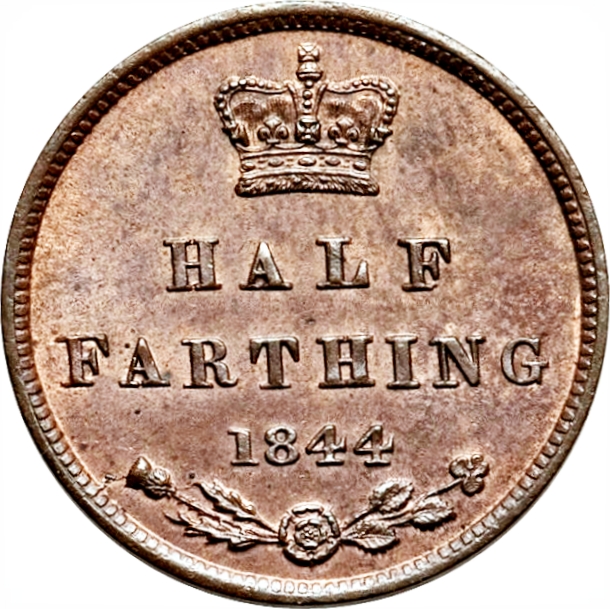
Central denomination with crown above and date below. Flower pattern below.
Find this on eBay
AffiliateHalf Farthing - Victoria Copper-nickel Pattern price history
Daily limit reachedAbout the 1868 Half Farthing - Victoria Copper-nickel Pattern
The 1868 Half Farthing - Victoria Copper-nickel Pattern is a collector ½ farthing coin, struck in copper-nickel. It measures 18mm across. Reverse design: Central denomination with crown above and date below. Flower pattern below.
It is no longer legal tender, so its value is to collectors only.
Common questions
How much is the 1868 Half Farthing - Victoria Copper-nickel Pattern worth?
No verified sale of the 1868 Half Farthing - Victoria Copper-nickel Pattern has been logged on MyCoinage yet.
Was the 1868 half farthing ever issued?
No. The last half farthings struck for circulation were dated 1856. The 1868 pieces are proofs in bronze and in cupro-nickel, made in the same design as the copper coins, and Tony Clayton and Wikipedia both record that none of that date were issued for circulation.
What metal is the 1868 half farthing?
This entry is the cupro-nickel version. The Royal Mint Museum holds one, catalogued RMM 4214, weighing 2.34 g with a plain edge. A companion proof of the same date in a copper-based metal (RMM 4213, 2.36 g) is in the same collection.
How many 1868 half farthings were made?
No figure is recorded. These were proofs, not a coinage, so no mintage was published. The Royal Mint Museum holds examples in both metals, and Clayton's value guide lists the date only as a proof, with no circulating strike.
How do I identify the 1868 Half Farthing - Victoria Copper-nickel Pattern?
Check the diameter 18mm and the metal (copper-nickel) against the specification table on this page. The reverse design is described above.
History and design
The half farthing was first struck in 1828 for Ceylon and was made legal tender in the United Kingdom in 1842. The Royal Mint Museum says it never became popular, and the last pieces struck for circulation were dated 1856. All copper coins, half farthings included, were demonetised with effect from 1 January 1870.
In 1868, twelve years after the last circulating date, the Mint struck proof half farthings in bronze and in cupro-nickel. Tony Clayton and Wikipedia both record that none of that date were issued for circulation. This entry is the cupro-nickel piece, a trial of an alternative metal rather than a coin that ever passed in change. No mintage is recorded.
Clayton states that the 1868 proofs were made in the same design as the circulating half farthings. The obverse of those coins is William Wyon's Young Head of Victoria, taken from the Maundy fourpence, with the legend VICTORIA D: G: BRITANNIAR: REGINA F: D:. The reverse has HALF FARTHING beneath a crown, the date, and the rose, thistle and shamrock below.
The Royal Mint Museum's cupro-nickel example, RMM 4214, weighs 2.34 g and has a plain edge.
Collecting notes
Confirm the metal before anything else, since the same date exists in two alloys. The Royal Mint Museum holds both 1868 metals, RMM 4214 in cupro-nickel and RMM 4213 at 2.36 g, which gives a useful weight comparison. Clayton's value guide lists 1868 only as a proof.
Anyone wanting the denomination in its circulating form should look at the copper half farthing of 1839 to 1856, of which the 1844 date is by far the most plentiful.
Sources
The history, design, varieties and collecting notes on this page are drawn from these sources. Prices come from recorded sales, not from them.
- Fractional Farthings, Tony Clayton, Coins of the UK (read 10 Oct 2026)
- Victoria proof half-farthing, 1868 (RMM 4214, cupro-nickel), The Royal Mint Museum, via Museum Data Service (read 10 Oct 2026)
- Half farthing (British coin), Wikipedia (read 10 Oct 2026)
- GB & Ireland: Half-Farthings, The Old Currency Exchange (read 10 Oct 2026)
- Victoria proof half-farthing, 1868 (RMM 4213, copper), The Royal Mint Museum, via Museum Data Service (read 10 Oct 2026)
- Fractional Farthings, Royal Mint Museum (read 10 Oct 2026)
- Values of Fractional Farthings, Tony Clayton, Coins of the UK (read 10 Oct 2026)