Common: 10,000,000 or more minted. Sells often: 156 verified sales in the last 12 months.
6 Pence - George VI 3rd coinage (1949–1952)
"Tanner"
| Country | United Kingdom |
| Year | 1949–1952 |
| Denomination | 6 Pence |
| Face value | 2.5p |
| Mintage by year |
Scarcest year: 1,013,400 struck
|
| Mint | Royal Mint · Llantrisant |
| Circulation | Circulating |
| Demonetised | 1980 |
| Composition | Copper-nickel (75% Cu, 25% Ni) |
| Weight | 2.830g |
| Diameter | 19.3mm |
| Thickness | 1.00mm |
| Shape | Round |
| Edge | Milled |
| Orientation | Medal alignment ↑↑ |
| Obv. artist | Thomas Humphrey Paget |
| Grade scale | UK (EF/UNC) |
| Tags | Crown Monogram |
Uncrowned portrait of King George VI left, legend around.
GEORGIVS VI D G BR OMN REX
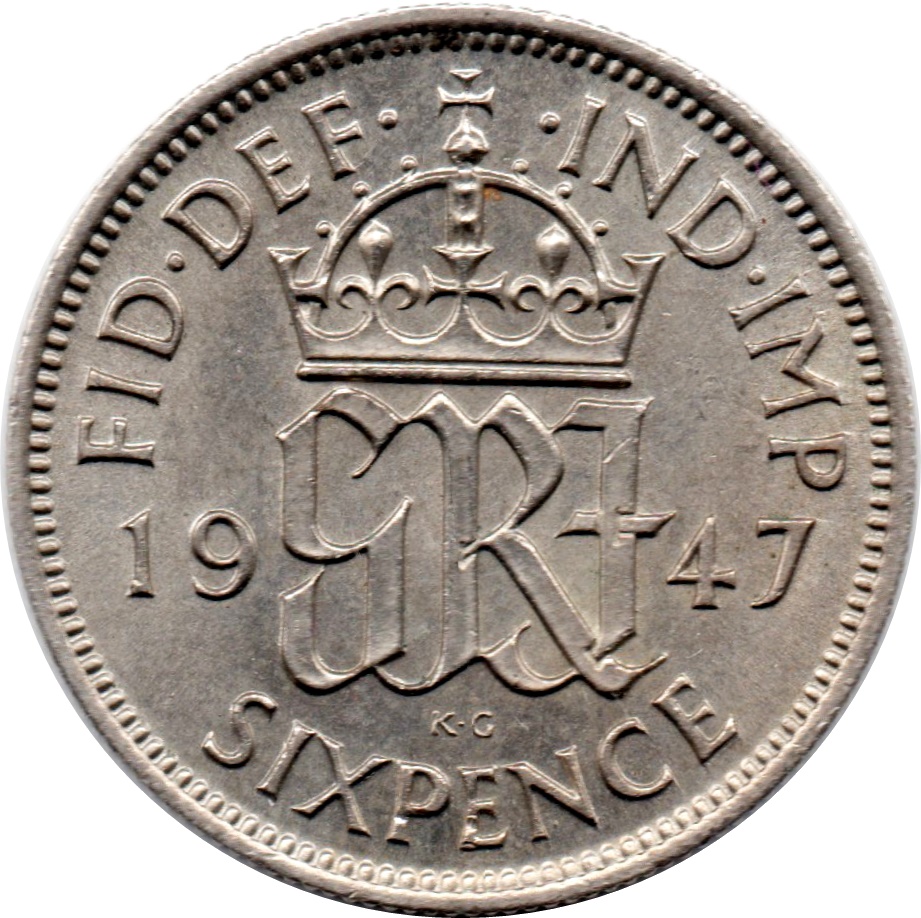
Crowned royal cypher dividing date, legend above, denomination below.
FID DEF SIXPENCE
6 Pence - George VI 3rd coinage market value
Find this on eBay
Affiliate6 Pence - George VI 3rd coinage value by year
1949 to 1952 · median sold prices| Year | Mintage | Circulated | Uncirculated | Sales | |
|---|---|---|---|---|---|
| 1949 | 41,335,500 | £2.72 | £14.00 type | 13 | |
|
VF£12.50EF£28.00UNC£95.00
⭐ Pro: the 1949 coin's sales by grade, and the chart filtered to one year
Start 7-day free trial
|
|||||
| 1950 | 32,741,900 | £1.76 | £17.10 (2) | 14 | |
|
VF£12.50EF£28.00UNC£95.00
⭐ Pro: the 1950 coin's sales by grade, and the chart filtered to one year
Start 7-day free trial
|
|||||
| 1951 | 40,399,400 | £1.81 | £6.99 | 21 | |
|
VF£12.50EF£28.00UNC£95.00
⭐ Pro: the 1951 coin's sales by grade, and the chart filtered to one year
Start 7-day free trial
|
|||||
| 1952 scarcest | 1,013,400 | £14.04 | £14.00 type | 108 | |
|
VF£12.50EF£28.00UNC£95.00
⭐ Pro: the 1952 coin's sales by grade, and the chart filtered to one year
Start 7-day free trial
|
|||||
One row for each year the 6 Pence - George VI 3rd coinage was struck. Prices are medians of verified sold listings matched to that year from the listing: circulated is worn condition up to Extremely Fine, uncirculated is About Uncirculated or better. A count in brackets means fewer than three sales behind the figure; a grey figure marked "type" is the median across every year, shown where that year has no sale of its own yet. Most types have been searched year by year only since October 2026, so later years are still filling in. Use the grade table below for a price by condition across all years.
6 Pence - George VI 3rd coinage value by grade
Realised auction prices · ⭐ Pro Expand rows for individual sale records| Grade | Latest | Median | 30d Δ | All-time range | Sales (1yr) | Total sales | Last sale | |
|---|---|---|---|---|---|---|---|---|
| UNC | £3.53 🔒 eBay | £3.53 (1) | – | £3.53 – £3.53 | 1 | 1 | 01-08-2026 | |
|
Loading…
|
||||||||
| EF | £3.61 🔒 eBay | £3.61 | – | £2.71 – £37.95 | 5 | 5 | 05-10-2026 | |
|
Loading…
|
||||||||
| VF | £14.00 🔒 eBay | £12.94 | ▲9.7% | £0.37 – £26.69 | 142 | 142 | 12-10-2026 | |
|
Loading…
|
||||||||
| F | £0.99 🔒 eBay | £1.67 | – | £0.99 – £10.80 | 4 | 4 | 27-09-2026 | |
|
Loading…
|
||||||||
| PR-65 | £19.09 🔒 eBay | £14.56 | – | £6.99 – £19.09 | 4 | 4 | 06-10-2026 | |
|
Loading…
|
||||||||
About the 1949 6 Pence - George VI 3rd coinage
The 1949 6 Pence - George VI 3rd coinage is a circulating 6 pence coin issued from 1949 to 1952, struck in copper-nickel (75% Cu, 25% Ni). It weighs 2.83g and measures 19.3mm across. Reverse design: Crowned royal cypher dividing date, legend above, denomination below.
Mintage figures are recorded for 4 years between 1949 and 1952, 115,490,200 coins in all. 1952 is the scarcest date, with 1,013,400 struck. It is no longer legal tender (withdrawn 1980), so its value is to collectors only.
Common questions
How much is the 1949 6 Pence - George VI 3rd coinage worth?
Verified sold prices for the 1949 6 Pence - George VI 3rd coinage run from £1.67 to £14.56 across 5 grades, taking the median for each grade. Condition makes the difference, so check the grade table above before pricing one.
Why is the 1952 sixpence rare?
Only 1,013,477 were struck. Tony Clayton explains that the Korean War created a demand for nickel, so no cupronickel coins were struck for UK circulation dated 1952. The 1952 sixpences were made for use in the West Indies and were only occasionally found in British change.
What does GVIR on the sixpence mean?
GVIR is the crowned royal cypher of George VI used on the sixpence from 1949. It replaced GRI, short for Georgius Rex Imperator, when the words IND IMP were also dropped, because the King was no longer Emperor of India.
How many George VI sixpences were made from 1949 to 1952?
Coin Hunter gives 41,335,515 for 1949, 32,741,955 for 1950, 40,399,491 for 1951 and 1,013,477 for 1952. Wikipedia's figures are slightly higher for 1949 to 1951, in two cases by exactly the number of proofs.
Is the 1949 to 1952 sixpence silver?
No. These sixpences are cupronickel, the copper and nickel alloy that replaced the 50% silver standard in 1947. The last silver sixpences for circulation are dated 1946.
How do I identify the 1949 6 Pence - George VI 3rd coinage?
Check the weight 2.83g and diameter 19.3mm and the metal (copper-nickel (75% Cu, 25% Ni)) against the specification table on this page. The reverse design is described above.
History and design
From 1949 the coinage dropped the abbreviation IND IMP, which Tony Clayton links to India becoming an independent republic, since the King was no longer Emperor of India. On the sixpence that meant a new reverse. The GRI cypher, whose I stood for Imperator, gave way to GVIR, and the legend shrank to FID DEF.
The coin stayed in cupronickel, the alloy used since 1947. Coin Hunter gives 41,335,515 for 1949, 32,741,955 for 1950 and 40,399,491 for 1951. The 1952 date is different: Tony Clayton writes that the Korean War created a demand for nickel, so no cupronickel coins dated 1952 were struck for UK circulation. A run of 1,013,477 sixpences was made for use in the West Indies, and they were only occasionally found in Britain.
The design ran until 1952, and the coin was demonetised at the end of June 1980.
The obverse is unchanged: Thomas Humphrey Paget's uncrowned portrait of George VI facing left, with GEORGIVS VI D G BR OMN REX around and HP below the neck. The Royal Mint Museum says it is almost certainly the design Paget himself regarded as his best.
The reverse shows the cypher G VI R under a crown, dividing the date, with FID DEF above and SIXPENCE below, as the Royal Collection describes its 1949 proof. Wikipedia notes that the lettering of the post-1949 coins is less angular than before. The edge is milled.
Collecting notes
The 1952 date is the one to look for. Its mintage is about one fortieth of any of the other three dates, and Tony Clayton notes that the coins went to the West Indies and were only occasionally found in British circulation. Check the last digit of the date carefully on any worn example offered as a 1952.
Proofs dated 1950 and 1951 exist: Coin Hunter gives 17,513 and 20,000, and Tony Clayton lists both. For the earlier GRI coins in the same metal, see the 1947 sixpence.
No recognised varieties or mint errors are documented for this coin.
Sources
The history, design, varieties and collecting notes on this page are drawn from these sources. Prices come from recorded sales, not from them.
- Coin values by year, George VI (year pages 1949 to 1952, read one by one), Coin Hunter (read 10 Oct 2026)
- One Shilling, Tony Clayton, Coins of the UK (read 10 Oct 2026)
- Sixpence (British coin), Wikipedia (read 10 Oct 2026)
- Six Pence: Sixpence, Tony Clayton, Coins of the UK (read 10 Oct 2026)
- Sixpence, Royal Mint Museum (read 10 Oct 2026)
- Humphrey Paget, Royal Mint Museum (read 10 Oct 2026)
- Initials on British coins, TreasureRealm (read 10 Oct 2026)
- George VI Proof sixpence, 1949 (RCIN 443772), Royal Collection Trust (read 10 Oct 2026)
- Values of Sixpences, Tony Clayton, Coins of the UK (read 10 Oct 2026)
- George Kruger Gray, Wikipedia (read 10 Oct 2026)
More 6 Pence coins from nearby years