Legendary: fewer than 100 minted.
4 Pence - George III Maundy issues (1817–1820)
| Country | United Kingdom |
| Year | 1817–1820 |
| Denomination | 4 Pence |
| Mintage | 1,386 |
| Mint | Royal Mint · Llantrisant |
| Series | Maundy Money |
| Circulation | Non-circulating |
| Composition | Silver (.925) (925/1000 fine) |
| Weight | 1.890g · 0.0562 t oz |
| Diameter | 18.0mm |
| Shape | Round |
| Edge | Plain |
| Orientation | Medal alignment ↑↑ |
| Obv. artist | Benedetto Pistrucci |
| Grade scale | UK (EF/UNC) |
Laureate bust of King George III right, legend around, date below.
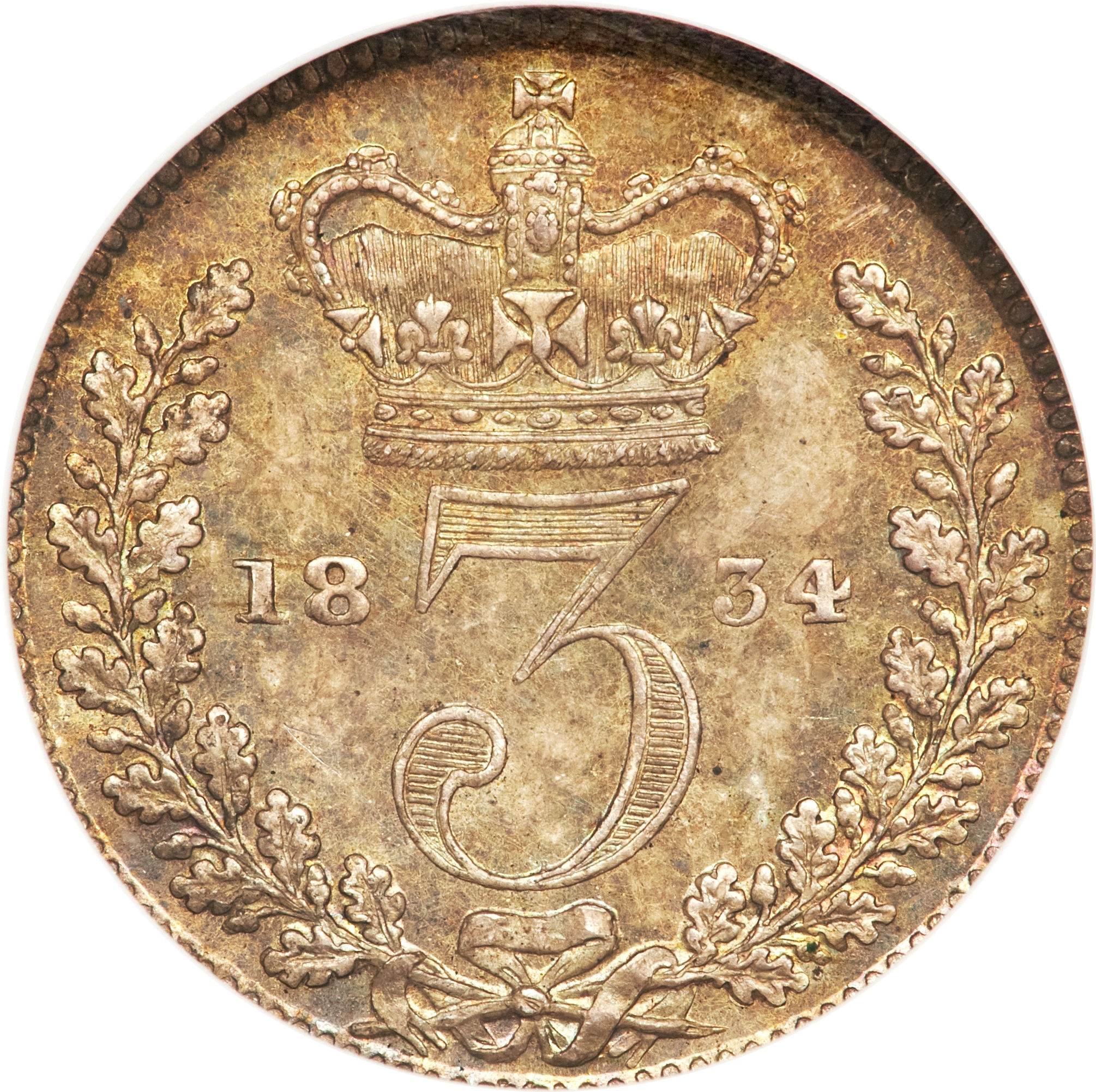
Central crowned denomination with legend around.
Find this on eBay
Affiliate4 Pence - George III Maundy issues price history
Daily limit reachedAbout the 1817 4 Pence - George III Maundy issues
The 1817 4 Pence - George III Maundy issues is a collector 4 pence coin issued from 1817 to 1820 in the Maundy Money series, struck in 92.5% silver. It weighs 1.89g and measures 18mm across. Reverse design: Central crowned denomination with legend around.
A mintage of 1,386 is recorded for one date of this type; figures for each year are not held.
Common questions
How much is the 1817 4 Pence - George III Maundy issues worth?
No verified sale of the 1817 4 Pence - George III Maundy issues has been logged on MyCoinage yet. Its silver content is worth about £2.25 at today's spot price, which puts a floor under its value.
How many George III Maundy fourpences were made?
CoinVarieties, citing the standard catalogues, gives 1,188 for 1818, struck for the Maundy sets. No published figure for 1817 or 1820 was found, so the total for the type is not known.
What changed on the groat in 1817?
Wikipedia says Benedetto Pistrucci's new obverse moved the date to the obverse and changed the reverse legend to BRITANNIARUM REX FID DEF. The coin also became smaller, about 1.89 g, after the Great Recoinage raised the shillings struck per troy pound of silver from 62 to 66.
Is the George III Maundy groat legal tender?
Wikipedia states that all Maundy pieces, from before and after Decimal Day in 1971, are by law deemed denominated in new pence, and Tony Clayton records the crowned 4 groat as revalued at 4 new pence. It is kept by collectors and never spent.
Are there 1819 George III Maundy coins?
No. Tony Clayton lists Maundy fourpences dated 1817, 1818 and 1820 only, and his Maundy set list likewise jumps from 1818 to 1820.
How do I identify the 1817 4 Pence - George III Maundy issues?
Check the weight 1.89g and diameter 18mm and the metal (92.5% silver) against the specification table on this page. The reverse design is described above.
History and design
The Great Recoinage of 1816 to 1817 brought a new silver coinage, and the Maundy money followed. Wikipedia's Royal Maundy article explains that the date 1800, kept on Maundy pieces through the Napoleonic Wars, was finally changed in 1816, and that the coins were made slightly smaller because the Mint raised the number of shillings struck from a troy pound of sterling silver from 62 to 66. The groat fell to about 1.89 g.
This third George III groat was struck in 1817, 1818 and 1820, according to Tony Clayton. Wikipedia notes that groats of these later dates are more likely to be found in better condition, having been given out at the Royal Maundy, though some entered circulation afterwards. CoinVarieties gives 1,188 for 1818; no figures are published for 1817 or 1820.
Wikipedia credits the new obverse to Benedetto Pistrucci in 1817. It shows a laureate head of the King facing right, with GEORGIUS III DEI GRATIA and the date now on the obverse. Thomas Wyon the younger, the Mint's chief engraver, struck the Maundy money of 1817.
The reverse keeps the crowned 4 but with a new legend, BRITANNIARUM REX FID DEF, King of the Britains, Defender of the Faith. A Nottingham Museums register entry for an 1818 groat records both legends. The Royal Mint Museum's 1817 example weighs 1.85 g, has a plain edge and is in medal alignment.
Collecting notes
Clayton's Maundy list shows full four-coin sets for 1817, 1818 and 1820. Because the coins were mostly saved by recipients, wear is less of a concern than cleaning, scratches and mount marks. The date is on the obverse, not on the reverse as on earlier groats.
No recognised varieties or mint errors are documented for this coin. It was preceded by the larger groat of 1795 and 1800, and the Maundy threepence of 1817 to 1820 belongs to the same sets.
Sources
The history, design, varieties and collecting notes on this page are drawn from these sources. Prices come from recorded sales, not from them.
- Fourpence (British coin), Wikipedia (read 12 Oct 2026)
- Four Pence, Tony Clayton, Coins of the UK (read 12 Oct 2026)
- Values of Fourpence (Groats), Tony Clayton, Coins of the UK (read 12 Oct 2026)
- Royal Maundy, Wikipedia (read 12 Oct 2026)
- Groat of George III, 1818 (NCM 1900-694), Nottingham Museums, via Museum Data Service (read 12 Oct 2026)
- Threepence (British coin), Wikipedia (read 12 Oct 2026)
- George III Maundy fourpence, 1817 (RMM 1266), The Royal Mint Museum, via Museum Data Service (read 12 Oct 2026)
- Great Britain 1818 4 pence, CoinVarieties (read 12 Oct 2026)
- Values of Maundy Sets, Tony Clayton, Coins of the UK (read 12 Oct 2026)
- Thomas Wyon, Wikipedia (read 12 Oct 2026)
More from Maundy Money