Elite: fewer than 10,000 minted.
3 Pence - George III Maundy issues (1817–1820)
| Country | United Kingdom |
| Year | 1817–1820 |
| Denomination | 3 Pence |
| Mintage | 1,584 |
| Mint | Royal Mint · Llantrisant |
| Series | Maundy Money |
| Circulation | Non-circulating |
| Composition | Silver (.925) (925/1000 fine) |
| Weight | 1.410g · 0.0419 t oz |
| Diameter | 16.0mm |
| Shape | Round |
| Edge | Plain |
| Orientation | Medal alignment ↑↑ |
| Obv. artist | Benedetto Pistrucci |
| Grade scale | UK (EF/UNC) |
Laureate bust of King George III right, legend around, date below.
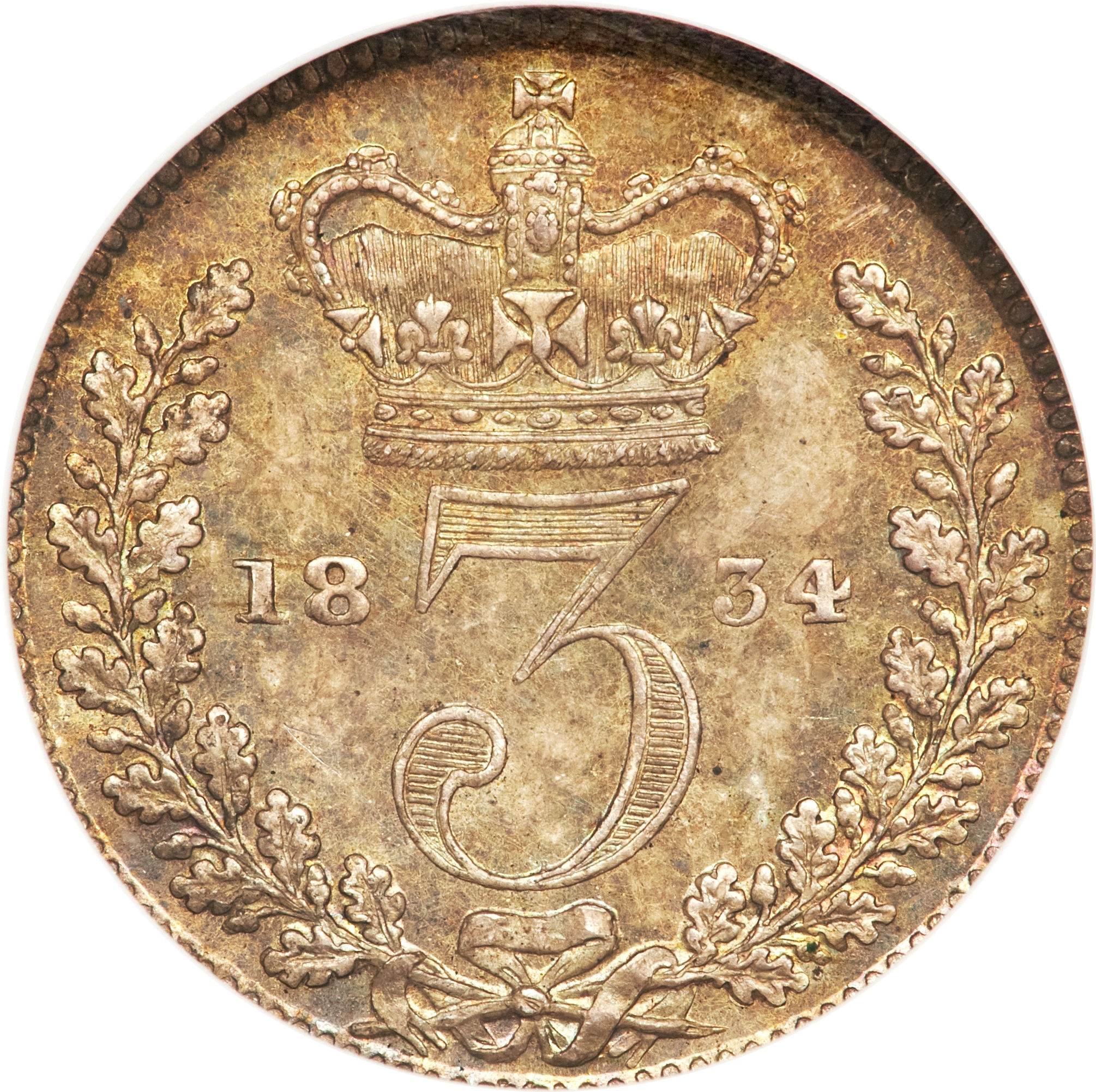
Central crowned denomination with legend around.
Find this on eBay
Affiliate3 Pence - George III Maundy issues price history
Daily limit reachedAbout the 1817 3 Pence - George III Maundy issues
The 1817 3 Pence - George III Maundy issues is a collector 3 pence coin issued from 1817 to 1820 in the Maundy Money series, struck in 92.5% silver. It weighs 1.41g and measures 16mm across. Reverse design: Central crowned denomination with legend around.
A mintage of 1,584 is recorded for one date of this type; figures for each year are not held.
Common questions
How much is the 1817 3 Pence - George III Maundy issues worth?
No verified sale of the 1817 3 Pence - George III Maundy issues has been logged on MyCoinage yet. Its silver content is worth about £1.68 at today's spot price, which puts a floor under its value.
How many George III Maundy threepences were made?
CoinVarieties, citing the standard catalogues, gives 1,584 for 1818 and 1,320 for 1820, both struck for the Maundy sets. No figure for 1817 was found in a published reference.
Why is the 1817 threepence smaller than earlier ones?
The Great Recoinage of 1816 raised the number of shillings struck from a troy pound of sterling silver from 62 to 66, so the coins became lighter. The threepence fell from about 1.5 g and 17 mm to 1.4 g and 16 mm.
Who designed the 1817 Maundy threepence?
The laureate head is the 1817 design of Benedetto Pistrucci, according to Wikipedia. Thomas Wyon the younger, the Mint's chief engraver, struck the Maundy money of 1817. The crowned 3 continues a reverse used since the 17th century.
Is a George III Maundy threepence legal tender?
Wikipedia states that all Maundy pieces, from before and after Decimal Day in 1971, are by law deemed denominated in new pence. The coins are technically legal tender but are kept by collectors rather than spent.
How do I identify the 1817 3 Pence - George III Maundy issues?
Check the weight 1.41g and diameter 16mm and the metal (92.5% silver) against the specification table on this page. The reverse design is described above.
History and design
The Great Recoinage of 1816 to 1817 brought a new silver coinage, and the Maundy money changed with it. Wikipedia's Royal Maundy article explains that the Mint raised the number of shillings struck from a troy pound of sterling silver from 62 to 66, so the Maundy pieces became slightly smaller once the frozen 1800 date was finally changed. The threepence dropped to 1.4 g and 16 mm, a standard Tony Clayton says held until 1945.
This threepence was struck in 1817, 1818 and 1820, the last dates of the reign. Wikipedia notes that these coins are usually found in very fine condition, a sign that they were issued as Maundy money rather than spent. CoinVarieties gives 1,584 for 1818 and 1,320 for 1820; no 1817 figure is published.
The obverse carries a laureate head of the King facing right, with the date moved underneath and the legend GEORGIUS III DEI GRATIA. Wikipedia credits this 1817 Maundy design to Benedetto Pistrucci, and the Royal Mint Museum confirms that Pistrucci modelled George III's portraits for the new silver of 1817. Thomas Wyon the younger, chief engraver, struck the Maundy money of 1817.
The reverse has a crowned 3 with a new legend, BRITANNIARUM REX FID DEF, King of the Britains, Defender of the Faith. The Royal Mint Museum's 1817 example has a plain edge and medal alignment.
Collecting notes
Clayton's Maundy list shows full four-coin sets for 1817, 1818 and 1820, with no 1819 issue. Because the coins were saved rather than spent, worn examples are uncommon, so check for cleaning, scratches and mount marks rather than wear.
No recognised varieties or mint errors are documented for this coin. Its predecessor is the larger threepence of 1795 and 1800, and the Maundy fourpence of 1817 to 1820 belongs to the same sets.
Sources
The history, design, varieties and collecting notes on this page are drawn from these sources. Prices come from recorded sales, not from them.
- Threepence (British coin), Wikipedia (read 12 Oct 2026)
- Benedetto Pistrucci, Royal Mint Museum (read 12 Oct 2026)
- Values of Maundy Sets, Tony Clayton, Coins of the UK (read 12 Oct 2026)
- Values of Three Pence, Tony Clayton, Coins of the UK (read 12 Oct 2026)
- Royal Maundy, Wikipedia (read 12 Oct 2026)
- Fourpence (British coin), Wikipedia (read 12 Oct 2026)
- Thomas Wyon, Wikipedia (read 12 Oct 2026)
- George III Maundy threepence, 1817 (RMM 1267), The Royal Mint Museum, via Museum Data Service (read 12 Oct 2026)
- Great Britain 1818 3 pence, CoinVarieties (read 12 Oct 2026)
- Great Britain 1820 3 pence, CoinVarieties (read 12 Oct 2026)
- Three Pence, Tony Clayton, Coins of the UK (read 12 Oct 2026)
More from Maundy Money