Common: 10,000,000 or more minted. Sells often: 48 verified sales in the last 12 months.
2 Shillings - George VI with 'IND:IMP' (1947–1948)
"Florin"
| Country | United Kingdom |
| Year | 1947–1948 |
| Denomination | 2 Shillings |
| Face value | 10p |
| Mintage by year |
Scarcest year: 22,910,000 struck
|
| Mint | Royal Mint · Llantrisant |
| Circulation | Circulating |
| Demonetised | 1993 |
| Composition | Copper-nickel |
| Weight | 11.310g |
| Diameter | 28.5mm |
| Thickness | 2.50mm |
| Shape | Round |
| Edge | Milled |
| Orientation | Medal alignment ↑↑ |
| Obv. artist | Thomas Humphrey Paget |
| Rev. artist | George Kruger Gray |
| Grade scale | UK (EF/UNC) |
Uncrowned portrait of King George VI left, legend around.
GEORGIVS VI D:G:BR:OMN:REX
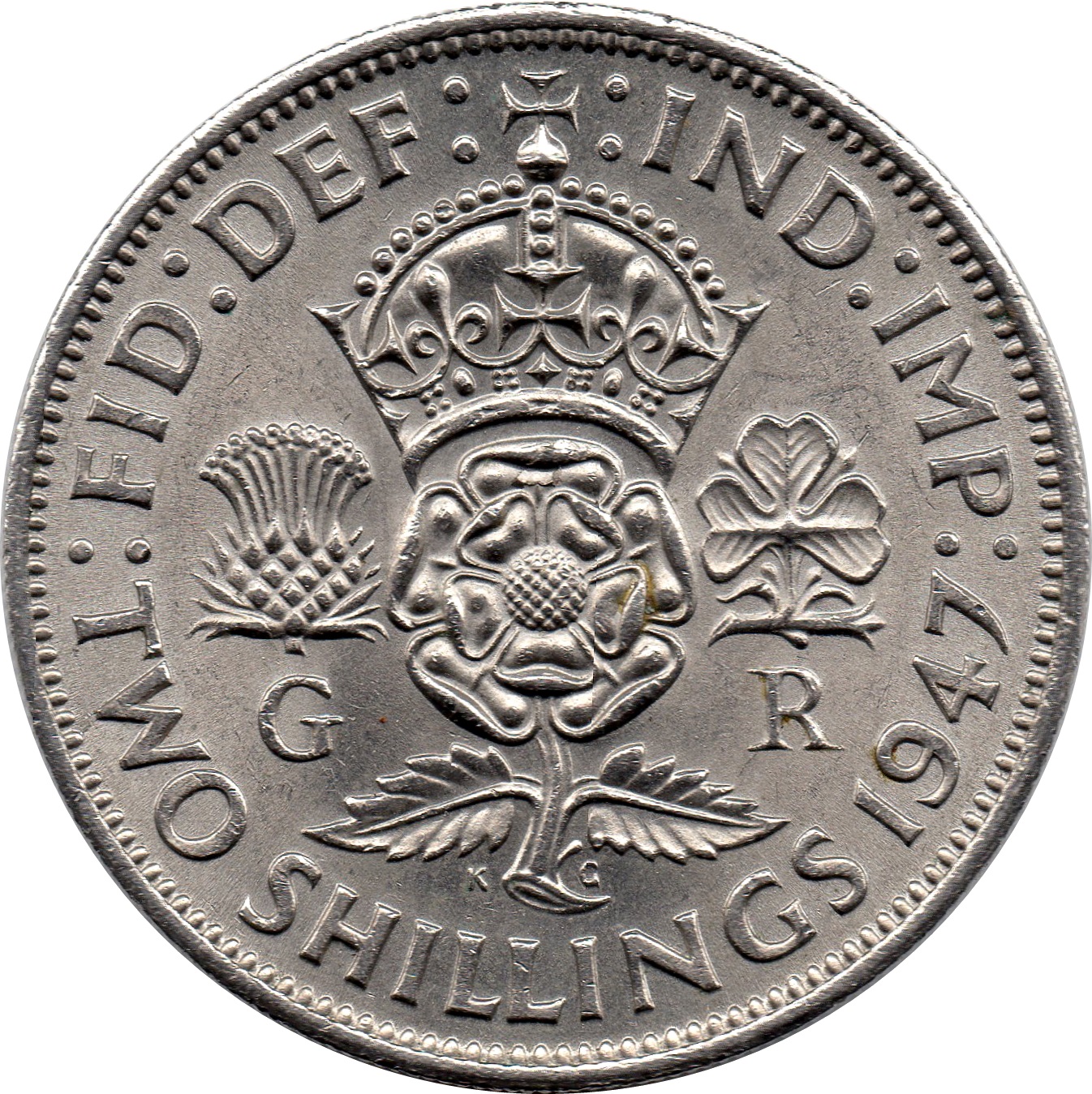
Crowned Tudor rose flanked by thistle and shamrock, legend above, denomination and date below
FID:DEF:IND:IMP TWO SHILLINGS
2 Shillings - George VI with 'IND:IMP' market value
Find this on eBay
Affiliate2 Shillings - George VI with 'IND:IMP' price history
Daily limit reached2 Shillings - George VI with 'IND:IMP' value by year
1947 to 1948 · median sold prices| Year | Mintage | Circulated | Uncirculated | Sales | |
|---|---|---|---|---|---|
| 1947 scarcest | 22,910,000 | £2.03 | 32 | ||
|
VF£12.50EF£28.00UNC£95.00
⭐ Pro: the 1947 coin's sales by grade, and the chart filtered to one year
Start 7-day free trial
|
|||||
| 1948 | 67,553,600 | £1.59 | 16 | ||
|
VF£12.50EF£28.00UNC£95.00
⭐ Pro: the 1948 coin's sales by grade, and the chart filtered to one year
Start 7-day free trial
|
|||||
One row for each year the 2 Shillings - George VI with 'IND:IMP' was struck. Prices are medians of verified sold listings matched to that year from the listing: circulated is worn condition up to Extremely Fine, uncirculated is About Uncirculated or better. A count in brackets means fewer than three sales behind the figure; a grey figure marked "type" is the median across every year, shown where that year has no sale of its own yet. Most types have been searched year by year only since October 2026, so later years are still filling in. Use the grade table below for a price by condition across all years.
2 Shillings - George VI with 'IND:IMP' value by grade
Realised auction prices · ⭐ Pro Expand rows for individual sale records| Grade | Latest | Median | 30d Δ | All-time range | Sales (1yr) | Total sales | Last sale | |
|---|---|---|---|---|---|---|---|---|
| VF | £1.16 🔒 eBay | £2.98 | ▲82.8% | £0.52 – £16.15 | 48 | 48 | 13-10-2026 | |
|
Loading…
|
||||||||
About the 1947 2 Shillings - George VI with 'IND:IMP'
The 1947 2 Shillings - George VI with 'IND:IMP' is a circulating 2 shillings coin issued from 1947 to 1948, struck in copper-nickel. It weighs 11.31g and measures 28.5mm across. Reverse design: Crowned Tudor rose flanked by thistle and shamrock, legend above, denomination and date below.
Mintage figures are recorded for 2 years between 1947 and 1948, 90,463,600 coins in all. 1947 is the scarcest date, with 22,910,000 struck. It is no longer legal tender (withdrawn 1993), so its value is to collectors only.
Common questions
How much is the 1947 2 Shillings - George VI with 'IND:IMP' worth?
The 1947 2 Shillings - George VI with 'IND:IMP' has a price in one grade on MyCoinage so far: £2.98 in VF, the median of its verified sales.
Does a 1947 florin contain silver?
No. The 1947 florin is cupro-nickel, 75 percent copper and 25 percent nickel. A proclamation of November 1946 set the designs for the new cupro-nickel coins, and the Royal Mint Museum notes that all of them were dated 1947 to make a clean break from silver.
How many 1947 florins were minted?
Coin Hunter and Wikipedia both give 22,910,085. The following year was about three times larger, at roughly 67.6 million, the highest figure for any George VI florin. Neither date is scarce, and Tony Clayton notes that both were issued in large quantities.
Why did British coins change from silver to cupro-nickel in 1947?
To recover silver. The Royal Mint Museum says the silver in British coins was needed for industry and to repay the 88 million ounces the United Kingdom had borrowed from the United States during the war. The Coinage Act, 1946 introduced cupro-nickel in its place.
Is the 1947 florin still legal tender?
No. Florins passed as 10p after decimalisation in 1971 and circulated alongside the decimal coin. The Royal Mint Museum records that they were withdrawn when the old large 10p pieces ceased to be legal tender at the end of June 1993.
How do I identify the 1947 2 Shillings - George VI with 'IND:IMP'?
Check the weight 11.31g and diameter 28.5mm and the metal (copper-nickel) against the specification table on this page. The reverse design is described above.
History and design
This is the florin that marks the end of silver in everyday British coins. The Royal Mint Museum explains that the silver was needed for industry and to repay the 88 million ounces the United Kingdom had borrowed from the United States during the war. The Coinage Act, 1946 introduced cupro-nickel, and to make a clean break every cupro-nickel coin was dated 1947, with issues to the banks starting on 2 January.
A proclamation of 29 November 1946 gave the new florin the same design as the silver one. Wikipedia notes that its weight and diameter were unchanged, and the alloy was 75 percent copper and 25 percent nickel. Tony Clayton writes that apart from the metal the coins were unchanged, and that they were issued in large quantities in both years.
Coin Hunter and Wikipedia agree on 22,910,085 for 1947. For 1948 they give 67,553,636 and 67,553,838, either way the highest of any George VI florin. In 1949 the legend was shortened, so this type lasted only two years.
The reverse is George Kruger Gray's crowned rose between a thistle and a shamrock, with G under the thistle and R under the shamrock. The proclamation gives the inscription FID DEF IND IMP with TWO SHILLINGS and the date. Kruger Gray's initials sit either side of the stalk above SHILLINGS.
The obverse keeps Humphrey Paget's portrait of the King facing left, which the Royal Mint Museum records was produced in little more than a month after the abdication, with GEORGIVS VI D G BR OMN REX around it. HP appears below the neck. The edge is milled.
Collecting notes
A florin with IND IMP dated 1947 or 1948 is cupro-nickel; one dated 1937 to 1946 is silver. The two look alike, so the date is the check. The silver florin of 1937 to 1946 and the 1949 to 1951 florin without IND IMP have their own pages.
Neither date is scarce; 1947 has about a third of the 1948 mintage. No recognised varieties or mint errors are documented for this type. These florins kept circulating as 10p long after decimalisation, and the Royal Mint Museum records that they were finally withdrawn at the end of June 1993.
Sources
The history, design, varieties and collecting notes on this page are drawn from these sources. Prices come from recorded sales, not from them.
- 1947 Coin Values, George VI, Coin Hunter (read 10 Oct 2026)
- Florin, Royal Mint Museum (read 10 Oct 2026)
- 1948 Coin Values, George VI, Coin Hunter (read 10 Oct 2026)
- Florin (British coin), Wikipedia (read 10 Oct 2026)
- Proclamation determining designs for cupro-nickel coins of the realm (29 November 1946), The London Gazette (read 10 Oct 2026)
- Consequences of the Second World War, Royal Mint Museum (read 10 Oct 2026)
- Humphrey Paget, Royal Mint Museum (read 10 Oct 2026)
- Initials on British coins, TreasureRealm (read 10 Oct 2026)
- UK Coins of George VI, Tony Clayton, Coins of the UK (read 10 Oct 2026)
- Ten Pence: Florin, Tony Clayton, Coins of the UK (read 10 Oct 2026)
More 2 Shillings coins from nearby years