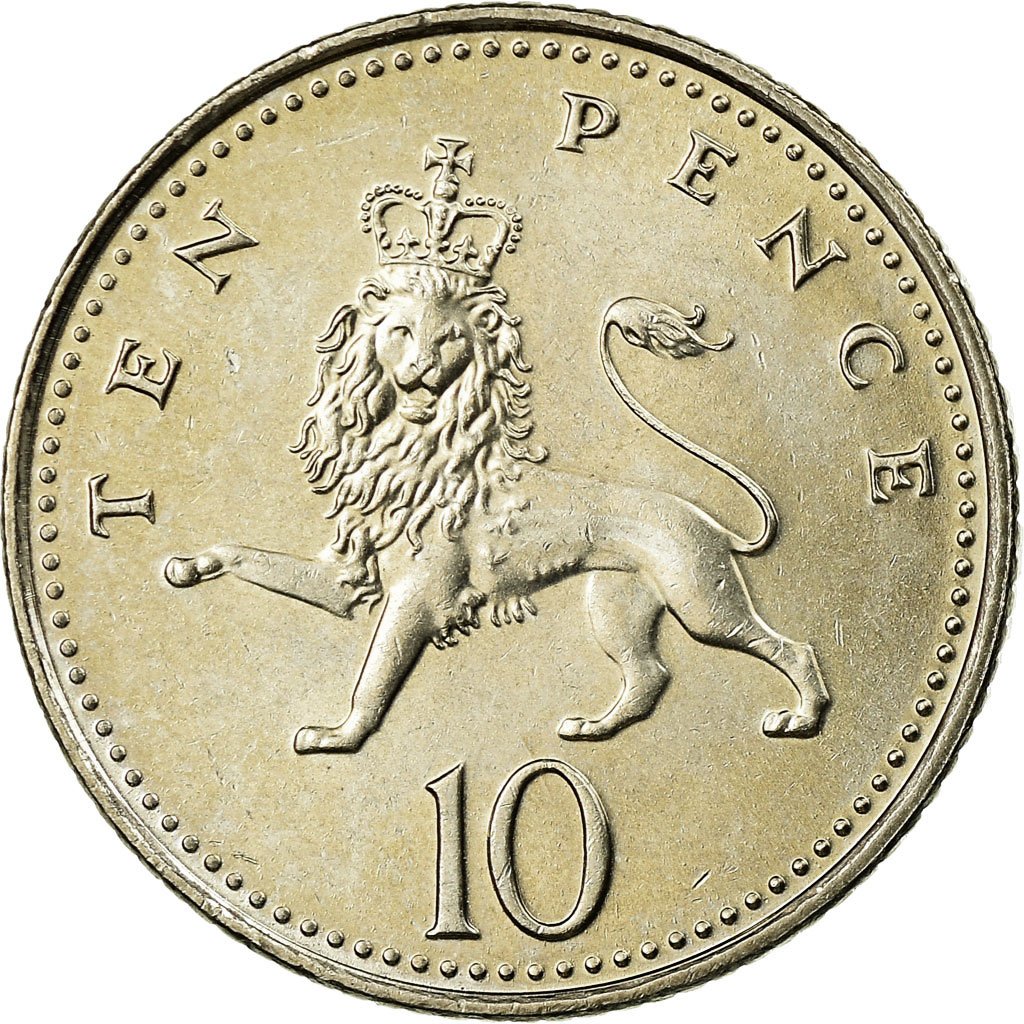
10 Decimal Pence Uniface Pattern (1963)
| Country | United Kingdom |
| Year | 1963 |
| Denomination | 10 Pence |
| Face value | 10p |
| Mint | Royal Mint · Llantrisant |
| Circulation | Non-circulating |
| Composition | Copper-nickel |
| Weight | 11.400g |
| Shape | Round |
| Edge | Milled |
| Rev. artist | Christopher Ironside |
| Grade scale | UK (EF/UNC) |
| Spink | S12Standard |
St George on horseback slaying the dragon above denomination, legend and date around
Blank.
DECIMAL PENCE 1963
Find this on eBay
Affiliate10 Decimal Pence Uniface Pattern price history
Daily limit reachedAbout the 1963 10 Decimal Pence Uniface Pattern
The 1963 10 Decimal Pence Uniface Pattern is a collector 10 pence coin, struck in copper-nickel. It weighs 11.4g. Reverse design: Blank.
Common questions
How much is the 1963 10 Decimal Pence Uniface Pattern worth?
No verified sale of the 1963 10 Decimal Pence Uniface Pattern has been logged on MyCoinage yet.
What is the 1963 ten decimal pence uniface?
It is a one-sided trial piece with Christopher Ironside's design of St George on horseback slaying the dragon, the figure 10 and the legend DECIMAL PENCE 1963. It belongs to the Royal Mint's early, secret decimal preparations and was never issued as coin.
Was a St George 10p ever issued?
No. Ironside's St George design was dropped when an open design competition was called in 1966. The 10p issued from April 1968 carried one of the new designs he entered for that competition instead.
Is the 1963 decimal 10p pattern legal tender?
No. A uniface pattern was never currency and has no legal face value. Decimalisation was announced only in March 1966, and the first 10p coins went into circulation in April 1968, according to the Royal Mint Museum.
How many 1963 ten decimal pence unifaces exist?
No production figure is published. The Royal Mint Museum holds about fifteen examples in two versions, numbered RMM 3141 to RMM 3155, and the Royal Collection holds others presented by the Royal Mint.
How do I identify the 1963 10 Decimal Pence Uniface Pattern?
Check the weight 11.4g and the metal (copper-nickel) against the specification table on this page. The reverse design is described above.
History and design
This uniface trial carries a design for a decimal ten pence on one side and nothing on the other. It was struck during the Royal Mint's preparations for decimal coinage, which went on in secret in the early 1960s, well before the government announced the change in March 1966. The designs came from Christopher Ironside, part of the joint Royal College of Art and Royal Designers for Industry team whose entry the Mint chose.
The Royal Mint Museum dates its examples to 1963 and records them as made at Tower Hill. In 1966 an open competition was ordered, and Ironside's first set was put aside. The 10p that entered circulation in April 1968 used one of his new competition designs instead. No production figure is published.
The struck side shows St George in a flowing cape on horseback slaying the dragon, above a large 10, with the legend DECIMAL PENCE 1963 in a beaded border. The Royal Mint lists the 10p among Ironside's unadopted designs as St George and the dragon. The edge is milled and the back plain. The Royal Collection also holds a two-sided 1963 pattern pairing this reverse with Arnold Machin's portrait of the Queen.
Varieties and errors
The Royal Mint Museum records two versions. The first weighs about 11.4g. A second, described as a modified design, weighs about 13.1g. Both are cupro-nickel with a milled edge and a plain back. Sovereign Rarities has described the 10 in a boxed set as silver.
Collecting notes
Weigh any example to tell the two versions apart. Single pieces and boxed sets both appear; Sovereign Rarities has offered an eight-piece set in a box lettered PATTERNS FOR THE DECIMAL CURRENCY 1963. For the companion piece in the same series, see the five decimal pence uniface.
Sources
The history, design, varieties and collecting notes on this page are drawn from these sources. Prices come from recorded sales, not from them.
- Elizabeth II uniface reverse ten decimal pence, 1963 (RMM 3142), The Royal Mint Museum, via Museum Data Service (read 10 Oct 2026)
- Elizabeth II uniface reverse ten decimal pence, 1963, modified design (RMM 3150), The Royal Mint Museum, via Museum Data Service (read 10 Oct 2026)
- Elizabeth II Uniface pattern 10 decimal pence. Type II. (RCIN 443832), Royal Collection Trust (read 10 Oct 2026)
- Elizabeth II pattern 10 decimal pence, 1963. Type II. (RCIN 443831), Royal Collection Trust (read 10 Oct 2026)
- Elizabeth II 1963 pattern Uniface Decimal 8-coin Set with original box, Sovereign Rarities (read 10 Oct 2026)
- The UK Coins That Were Never Made, The Royal Mint (read 10 Oct 2026)
- Christopher Ironside's Designs, The Royal Mint (read 10 Oct 2026)
- Decimalisation, Royal Mint Museum (read 10 Oct 2026)
More 10 Pence coins from nearby years