9 Pence - George III Bank Token Pattern (1812)
| Country | United Kingdom |
| Year | 1812 |
| Denomination | 9 Pence |
| Mint | Royal Mint · Llantrisant |
| Circulation | Non-circulating |
| Demonetised | Yes |
| Composition | Silver (.925) (925/1000 fine) |
| Shape | Round |
| Edge | Plain |
| Orientation | Medal alignment ↑↑ |
| Grade scale | UK (EF/UNC) |
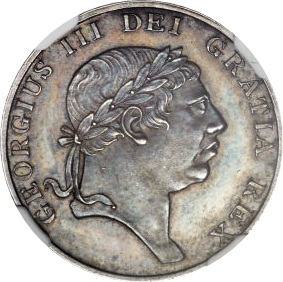
Laureate bust right.
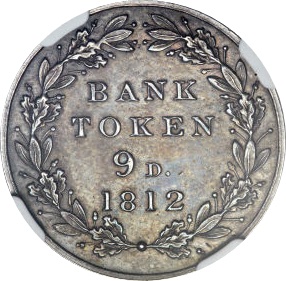
Value and date within an oak wreath.
Find this on eBay
AffiliatePattern 9 Pence price history
Daily limit reachedPattern 9 Pence value by grade
Realised auction prices · ⭐ Pro Expand rows for individual sale records| Grade | Latest | Median | 30d Δ | All-time range | Sales (1yr) | Total sales | Last sale | |
|---|---|---|---|---|---|---|---|---|
| BU | £1,200.00 🔒 | £1,200.00 (1) | – | £1,200.00 – £1,200.00 | 0 | 1 | 05-06-2016 | |
|
Loading…
|
||||||||
About the 1812 9 Pence - George III Bank Token – Pattern
The 1812 9 Pence - George III Bank Token – Pattern is a collector 9 pence coin, struck in 92.5% silver. Reverse design: Value and date within an oak wreath.
It is no longer legal tender, so its value is to collectors only.
Common questions
How much is the 1812 9 Pence - George III Bank Token – Pattern worth?
The 1812 9 Pence - George III Bank Token – Pattern has a price in one grade on MyCoinage so far: £1,200 in BU, the median of its verified sales.
Was the 1812 ninepence ever issued?
No. Tony Clayton records that a ninepence token was prepared alongside the Bank of England's three shillings and eighteenpence tokens, but it did not progress beyond the pattern stage and was never issued for circulation.
Why did the Bank of England issue silver tokens?
In the later years of George III's reign silver was expensive and silver coin was acutely short. Clayton explains that the Bank of England issued three shilling and eighteenpence tokens from 1811 to 1816 to fill the gap, and that after 1820 they were accepted only as bullion.
Where can the 1812 ninepence be seen?
The Royal Mint Museum holds two silver examples, RMM 1159 and RMM 1160, weighing 3.52 g and 3.82 g, both with plain edges. They are listed in the Mint's collection catalogues of 1874 and 1906.
History and design
Late in George III's reign the price of silver was high and silver coin was in acutely short supply. Tony Clayton explains that the Bank of England responded by issuing its own silver tokens, of three shillings and of eighteenpence, from 1811 until 1816. The Great Recoinage followed in 1816, and after 1820 the tokens were accepted only as bullion.
A ninepence was planned to complete the series. Clayton records that a ninepence token was prepared but did not progress beyond the pattern stage, and that it is a scarce piece never issued for circulation. No figure for the number struck is published.
The Royal Mint Museum holds two examples, both catalogued as George III pattern ninepences of 1812, struck in silver at the Royal Mint on Tower Hill. RMM 1159 weighs 3.52 g and RMM 1160 weighs 3.82 g. Both have plain edges and the dies aligned the same way up (a die axis of 360 degrees). They carry different numbers in the standard ESC catalogue, 1480 and 1478, and are recorded in the Mint's collection catalogues of 1874 and 1906.
Clayton notes that the issued tokens changed design in 1812, from a draped bust of the king in Roman armour to a laureate head with a truncated neck, with changes to the reverse as well. The museum records do not describe the ninepence's design.
Collecting notes
This is a pattern, not a coin that circulated, and examples are scarce. Anything offered should be compared with the museum pieces for weight, edge and metal, and checked against the ESC numbers given for them. The issued tokens it was meant to accompany include the 1812 eighteenpence Bank token.
Sources
The history, design, varieties and collecting notes on this page are drawn from these sources. Prices come from recorded sales, not from them.
- 18 and 20 Pence (The Eighteen Pence Bank Token), Tony Clayton, Coins of the UK (read 12 Oct 2026)
- Three Shillings, 40d and 45d (The Three Shillings Bank Token), Tony Clayton, Coins of the UK (read 12 Oct 2026)
- George III pattern ninepence, 1812 (RMM 1159), The Royal Mint Museum, via Museum Data Service (read 12 Oct 2026)
- George III pattern ninepence, 1812 (RMM 1160), The Royal Mint Museum, via Museum Data Service (read 12 Oct 2026)