
Uncommon: fewer than 10,000,000 minted. Rarely sells: 3 verified sales in the last 12 months.
6 Pence - George III New coinage (1816–1820)
| Country | United Kingdom |
| Year | 1816–1820 |
| Denomination | 6 Pence |
| Face value | 2.5p |
| Mintage by year |
Scarcest year: 1,448,900 struck
|
| Mint | Royal Mint · Llantrisant |
| Circulation | Circulating |
| Demonetised | 1980 |
| Composition | Silver (.925) (925/1000 fine) |
| Weight | 2.830g · 0.0842 t oz |
| Diameter | 19.0mm |
| Thickness | 0.50mm |
| Shape | Round |
| Orientation | Medal alignment ↑↑ |
| Obv. artist | Benedetto Pistrucci, Thomas Wyon |
| Grade scale | UK (EF/UNC) |
Laureate portrait of King George III right, legend around, date below.
GEOR:III D:G:BRITT:REX F:D:
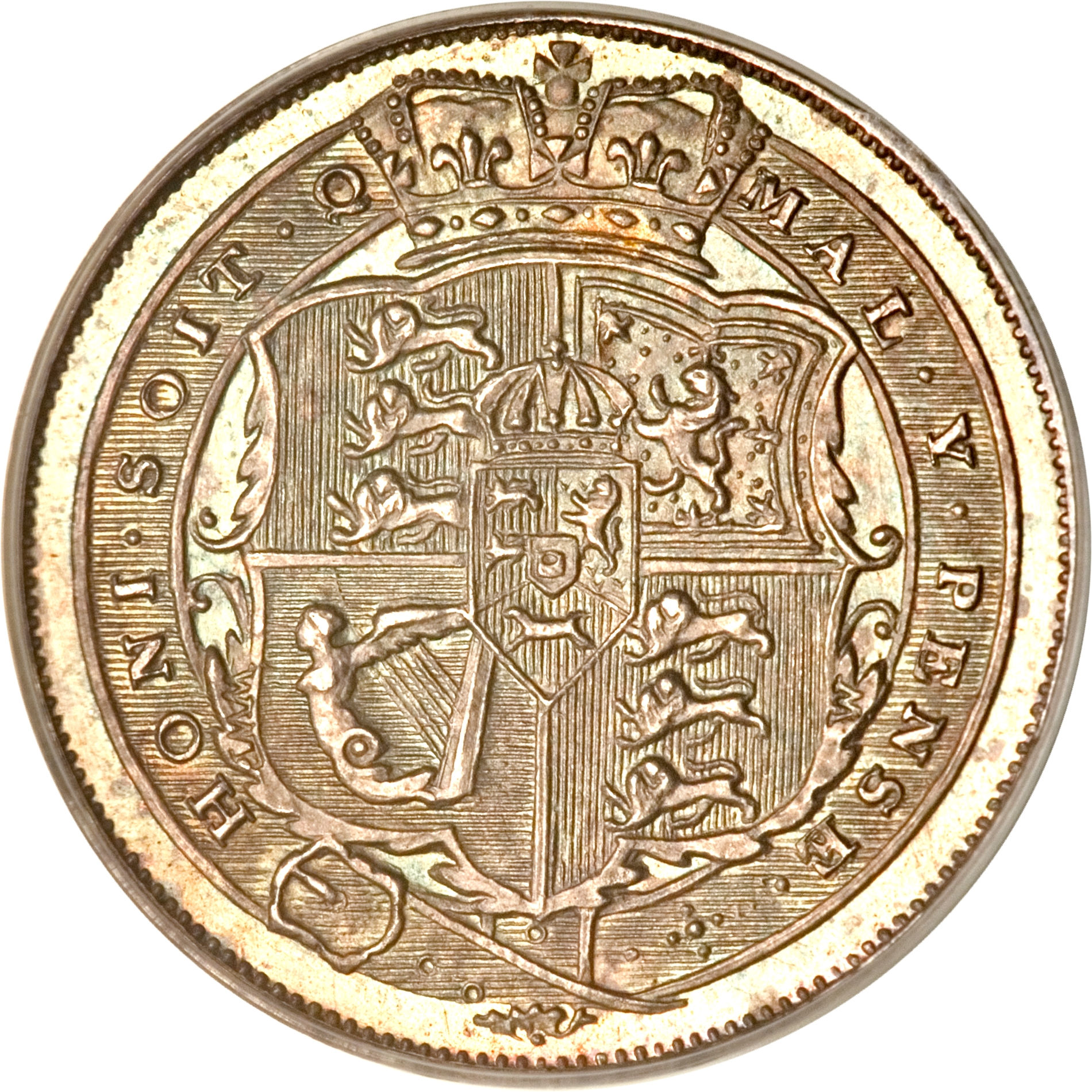
Crowned quartered shield of arms, overlaid with smaller crowned shield, legend around on garter.
HONI SOIT QUI MAL Y PENSE
6 Pence - George III New coinage market value
Find this on eBay
Affiliate6 Pence - George III New coinage price history
Daily limit reached6 Pence - George III New coinage value by year
1816 to 1820 · median sold prices| Year | Mintage | Circulated | Uncirculated | Sales | |
|---|---|---|---|---|---|
| 1816 | Not recorded | £107.50 | 4 | ||
|
VF£12.50EF£28.00UNC£95.00
⭐ Pro: the 1816 coin's sales by grade, and the chart filtered to one year
Start 7-day free trial
|
|||||
| 1817 | 10,921,600 | £107.50 type | |||
| 1818 | 4,284,700 | £107.50 type | |||
| 1819 | 4,712,400 | £107.50 type | |||
| 1820 scarcest | 1,448,900 | £107.50 type | |||
One row for each year the 6 Pence - George III New coinage was struck. Prices are medians of verified sold listings matched to that year from the listing: circulated is worn condition up to Extremely Fine, uncirculated is About Uncirculated or better. A count in brackets means fewer than three sales behind the figure; a grey figure marked "type" is the median across every year, shown where that year has no sale of its own yet; years with no sales yet fill in as sales are recorded. Most types have been searched year by year only since October 2026, so later years are still filling in. Use the grade table below for a price by condition across all years.
6 Pence - George III New coinage value by grade
Realised auction prices · ⭐ Pro Expand rows for individual sale records| Grade | Latest | Median | 30d Δ | All-time range | Sales (1yr) | Total sales | Last sale | |
|---|---|---|---|---|---|---|---|---|
| VF | £85.00 🔒 | £130.00 | – | £85.00 – £140.00 | 2 | 3 | 12-10-2026 | |
|
Loading…
|
||||||||
| AG | £9.99 🔒 eBay | £9.99 (1) | – | £9.99 – £9.99 | 1 | 1 | 07-10-2026 | |
|
Loading…
|
||||||||
About the 1816 6 Pence - George III New coinage
The 1816 6 Pence - George III New coinage is a circulating 6 pence coin issued from 1816 to 1820, struck in 92.5% silver. It weighs 2.83g and measures 19mm across. Reverse design: Crowned quartered shield of arms, overlaid with smaller crowned shield, legend around on garter.
Mintage figures are recorded for 4 years between 1817 and 1820, 21,367,600 coins in all. 1820 is the scarcest date, with 1,448,900 struck. It is no longer legal tender (withdrawn 1980), so its value is to collectors only.
Common questions
How much is the 1816 6 Pence - George III New coinage worth?
Verified sold prices for the 1816 6 Pence - George III New coinage run from £9.99 to £130 across 2 grades, taking the median for each grade. Condition makes the difference, so check the grade table above before pricing one. Its silver content is worth about £3.36 at today's spot price, which puts a floor under its value.
How many George III sixpences were made after 1816?
Coin Hunter gives 10,921,680 for 1817, 4,284,720 for 1818, 4,712,400 for 1819 and 1,488,960 for 1820. No figure is published for 1816, although Coinvarieties calls it the most common date of the type.
Which George III sixpence date is the scarcest?
On recorded mintage, 1820, at 1,488,960 in Coin Hunter's figures. A Heritage catalogue quoted by Coinvarieties also calls 1818 decidedly scarcer than the first two dates. The 1820 inverted 1 and I over S varieties are relatively scarce, according to Tony Clayton.
Who designed the 1816 sixpence?
Benedetto Pistrucci modelled the king's portrait, which was used for both the shilling and the sixpence. Wikipedia records that Thomas Wyon of the Mint adapted the model and engraved it in steel. The designer of the shield reverse is not recorded in published references.
Is an 1817 sixpence still legal tender?
No. Sixpences stayed legal tender after decimalisation at 2.5 new pence, but Wikipedia records that this ended on 30 June 1980, and the Royal Mint Museum confirms the sixpence was demonetised in 1980.
How do I identify the 1816 6 Pence - George III New coinage?
Check the weight 2.83g and diameter 19mm and the metal (92.5% silver) against the specification table on this page. The reverse design is described above.
History and design
Before 1816 the Royal Mint had struck sixpences only once in George III's reign, in 1787, and Wikipedia notes that issue did little to ease the chronic shortage of silver. The Great Recoinage of 1816 changed that. New silver was struck in sterling at 66 shillings to the troy pound, which set the sixpence at 2.828 g, and the coins were made in quantity.
Coin Hunter gives 10,921,680 sixpences for 1817, 4,284,720 for 1818, 4,712,400 for 1819 and 1,488,960 for 1820. No figure is published for 1816, which Coinvarieties nonetheless calls the most common date. A Heritage catalogue it quotes calls 1818 decidedly scarcer than the first two dates.
Wikipedia records that Benedetto Pistrucci made three portraits of the king for the recoinage, one of which served for both the shilling and the sixpence, and that Thomas Wyon of the Mint adapted and engraved it in steel. The obverse shows the laureate head facing right with GEOR:III D:G:BRITT:REX F:D: and the date below.
The reverse, described in a Science Museum Group record, has the crowned shield of the royal arms with England in the first and fourth quarters, Scotland in the second and Ireland in the third. The arms of Hanover sit on a central shield under the electoral cap, and the Garter with HONI SOIT QUI MAL Y PENSE encircles it. Tony Clayton notes that it closely matches the shilling.
Varieties and errors
Clayton picks out two varieties of 1820, an inverted 1 in the date and an I of HONI cut over an S, both relatively scarce. Coin Hunter and Clayton list an 1819 with a very small 8. Coinvarieties notes 1817 proofs with plain or reeded edges.
Collecting notes
These were working coins, so most show wear on the hair and on the Garter lettering. Read the date and motto carefully for the 1819 and 1820 varieties. The companion shilling is the 1816 to 1820 shilling. Sixpences remained legal tender at 2.5 new pence until 30 June 1980.
Sources
The history, design, varieties and collecting notes on this page are drawn from these sources. Prices come from recorded sales, not from them.
- The Sixpence and Values of Sixpences, Tony Clayton, Coins of the UK (read 12 Oct 2026)
- Great Britain 1816, 1817, 1818 and 1819 6 pence pages, CoinVarieties (read 12 Oct 2026)
- Benedetto Pistrucci, Wikipedia (read 12 Oct 2026)
- Coin values by year, George III (year pages 1816 to 1820, read one by one), Coin Hunter (read 12 Oct 2026)
- Sixpence 1816, ABDMS019268, Aberdeen Archives, Gallery and Museums, via Museum Data Service (read 12 Oct 2026)
- Object search: George III sixpence 1816 (Science Museum Group record, V&A no. 1802-1902), Museum Data Service (read 12 Oct 2026)
- Sixpence (British coin), Wikipedia (read 12 Oct 2026)
- Sixpence, Royal Mint Museum (read 12 Oct 2026)
- Great Recoinage of 1816, Wikipedia (read 12 Oct 2026)
More 6 Pence coins from nearby years


