Rare: fewer than 500,000 minted.
6 Pence - George III Early coinage (1787)
| Country | United Kingdom |
| Year | 1787 |
| Denomination | 6 Pence |
| Face value | 2.5p |
| Mintage | 712,380 |
| Mint | Royal Mint · Llantrisant |
| Circulation | Circulating |
| Demonetised | Yes |
| Composition | Silver (.925) (925/1000 fine) |
| Weight | 3.000g · 0.0892 t oz |
| Diameter | 21.0mm |
| Shape | Round |
| Orientation | Medal alignment ↑↑ |
| Obv. artist | Lewis Pingo |
| Rev. artist | Lewis Pingo |
| Grade scale | UK (EF/UNC) |
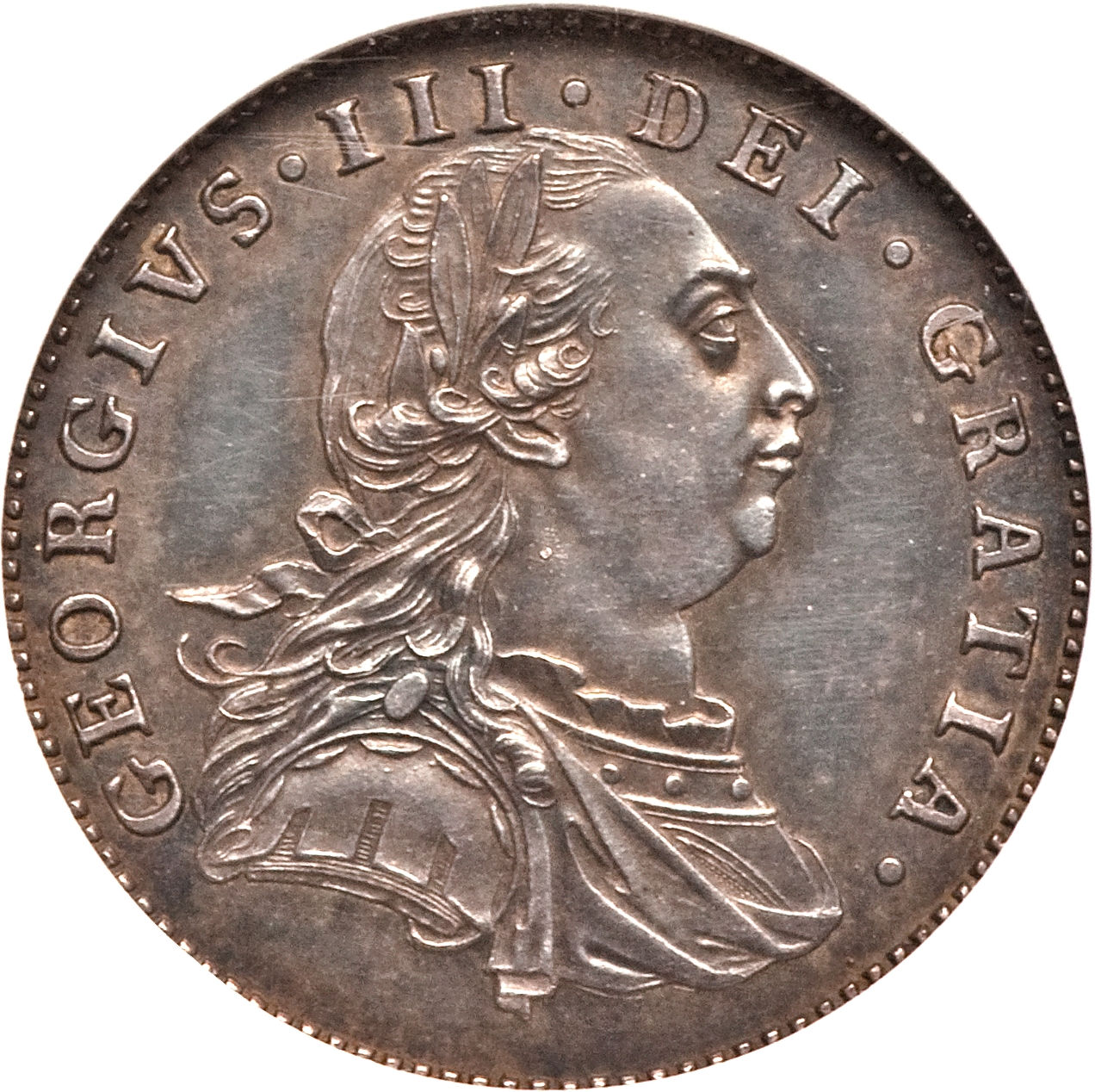
Laureate and draped bust of King George III right, legend around.
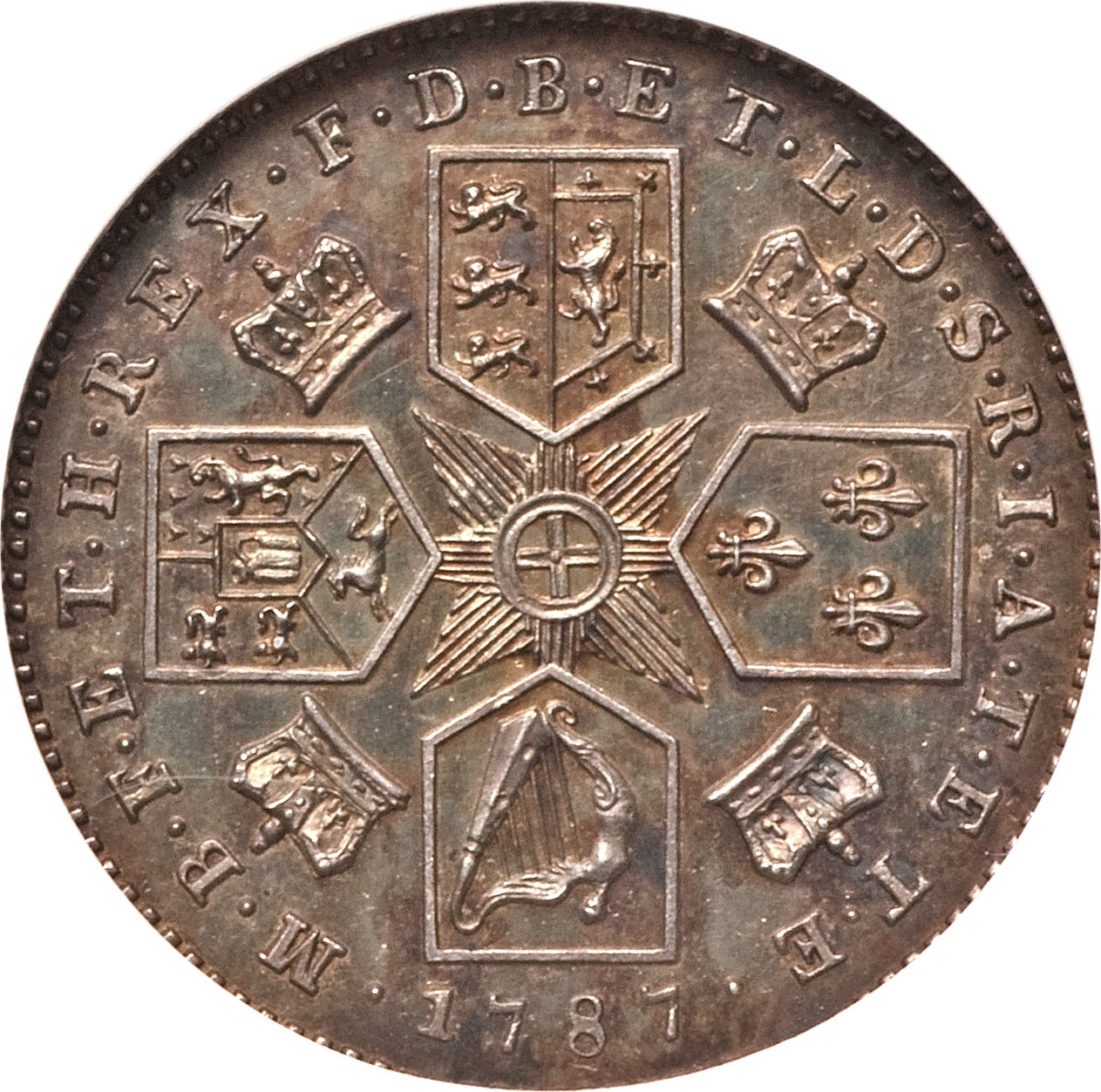
Cruciform shields around central Garter star with crowns in angles, legend around, date below.
Find this on eBay
Affiliate6 Pence - George III Early coinage price history
Daily limit reachedAbout the 1787 6 Pence - George III Early coinage
The 1787 6 Pence - George III Early coinage is a circulating 6 pence coin, struck in 92.5% silver. It weighs 3g and measures 21mm across. Reverse design: Cruciform shields around central Garter star with crowns in angles, legend around, date below.
712,380 were struck. It is no longer legal tender, so its value is to collectors only.
Common questions
How much is the 1787 6 Pence - George III Early coinage worth?
No verified sale of the 1787 6 Pence - George III Early coinage has been logged on MyCoinage yet. Its silver content is worth about £3.56 at today's spot price, which puts a floor under its value.
Is the 1787 sixpence rare?
No. Coinvarieties, citing the standard catalogues, describes its mintage as unknown but not rare, and Tony Clayton says the two main varieties, with and without hearts in the Hanoverian shield, are equally common. Proofs are scarce.
Why did George III issue only one sixpence before 1816?
The Royal Mint struck very little silver in the 18th century. Clayton notes that 1787 was the only sixpence in the first 55 years of the reign. Coinvarieties adds that the shortage of small change led to a mass of private tokens.
What does semee of hearts mean on a sixpence?
It is a heraldic term for 'dotted with'. On one 1787 reverse the Hanoverian shield, in the fourth position, is filled with small hearts; on the other it is plain. Clayton and Coin Hunter both list the two versions.
Who made the 1787 sixpence?
Lewis Pingo, chief engraver of the Royal Mint from 1779. Wikipedia, drawing on the Dictionary of National Biography, says he engraved the dies for the shillings and sixpences of 1787.
How do I identify the 1787 6 Pence - George III Early coinage?
Check the weight 3g and diameter 21mm and the metal (92.5% silver) against the specification table on this page. The reverse design is described above.
History and design
Silver coinage almost stopped in the 18th century, and Tony Clayton notes that this was the only sixpence issued in the first 55 years of George III's reign. The Heritage catalogue quoted by Coinvarieties calls it the first sixpence since 1758, and says the Mint was producing nowhere near enough small change for the industrial boom, so private tokens filled the gap until the reform of 1816 to 1817.
Wikipedia's sixpence article says the 1787 issue did little to relieve the chronic shortage of silver coin in circulation. No reliable mintage is published; Coinvarieties, citing the standard catalogues, gives it as unknown but not rare.
Lewis Pingo, chief engraver of the Royal Mint from 1779, engraved the dies for both the 1787 shillings and sixpences, according to Wikipedia's article based on the Dictionary of National Biography. Museum records, such as those at Aberdeen, describe a laureate cuirassed bust of the king facing right, and a reverse of shields in a cross with crowns between them and the Garter star at the centre.
Wikipedia notes that this cross of shields, introduced on the sixpence under Charles II, continued with minor changes through George III's reign. The 1787 coin was its last outing, as the Great Recoinage brought in a single crowned shield. Coinvarieties gives a weight of 3.01 g in sterling silver.
Varieties and errors
Clayton describes two main varieties, equally common: the Hanoverian shield (in the fourth position) either semee of hearts, meaning scattered with small hearts, or plain. Coin Hunter lists the same pair. Proofs exist, including a plain-edge proof with hearts described in a Heritage catalogue.
Collecting notes
Identify the reverse first by looking for hearts in the Hanoverian shield, which may need a glass on a worn coin. Wear shows first on the hair, the laurel and the crowns. Clayton contrasts the few varieties of the sixpence with the more numerous ones of the 1787 shilling.
Sources
The history, design, varieties and collecting notes on this page are drawn from these sources. Prices come from recorded sales, not from them.
- The Sixpence and Values of Sixpences, Tony Clayton, Coins of the UK (read 12 Oct 2026)
- Great Britain 1787 6 pence, CoinVarieties (read 12 Oct 2026)
- Lewis Pingo, Wikipedia (read 12 Oct 2026)
- 1787 Coin Values, George III, Coin Hunter (read 12 Oct 2026)
- Sixpence (British coin), Wikipedia (read 12 Oct 2026)
- Object search: George III sixpence 1787, Museum Data Service (read 12 Oct 2026)
More 6 Pence coins from nearby years