5 Shillings 6 Pence - George III Bank Token Pattern (1811)
| Country | United Kingdom |
| Year | 1811 |
| Denomination | 5 Shillings 6 Pence |
| Face value | 27.5p |
| Mint | Royal Mint · Llantrisant |
| Circulation | Non-circulating |
| Demonetised | Yes |
| Composition | Copper |
| Shape | Round |
| Edge | Plain |
| Grade scale | UK (EF/UNC) |
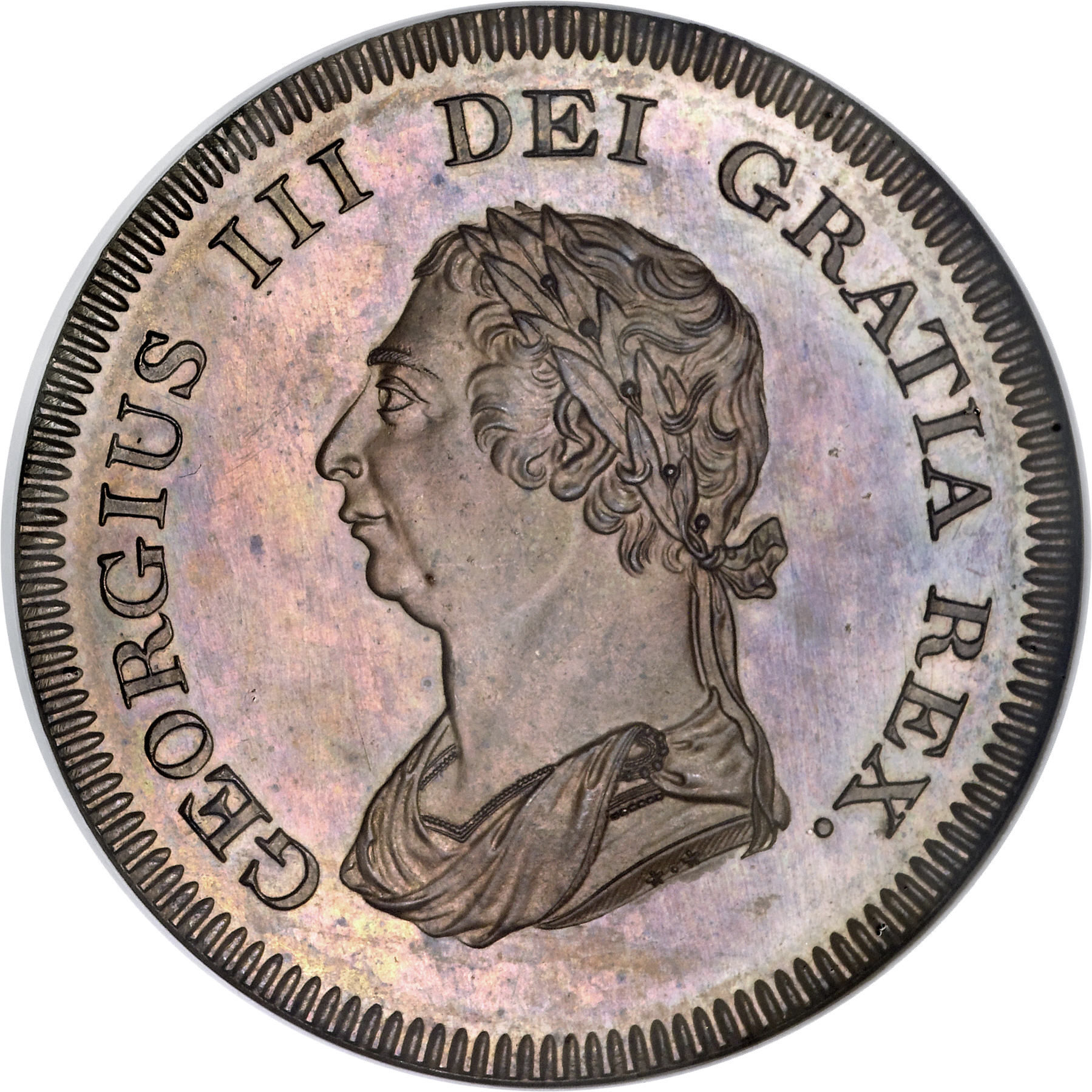
Laureate and draped bust left.
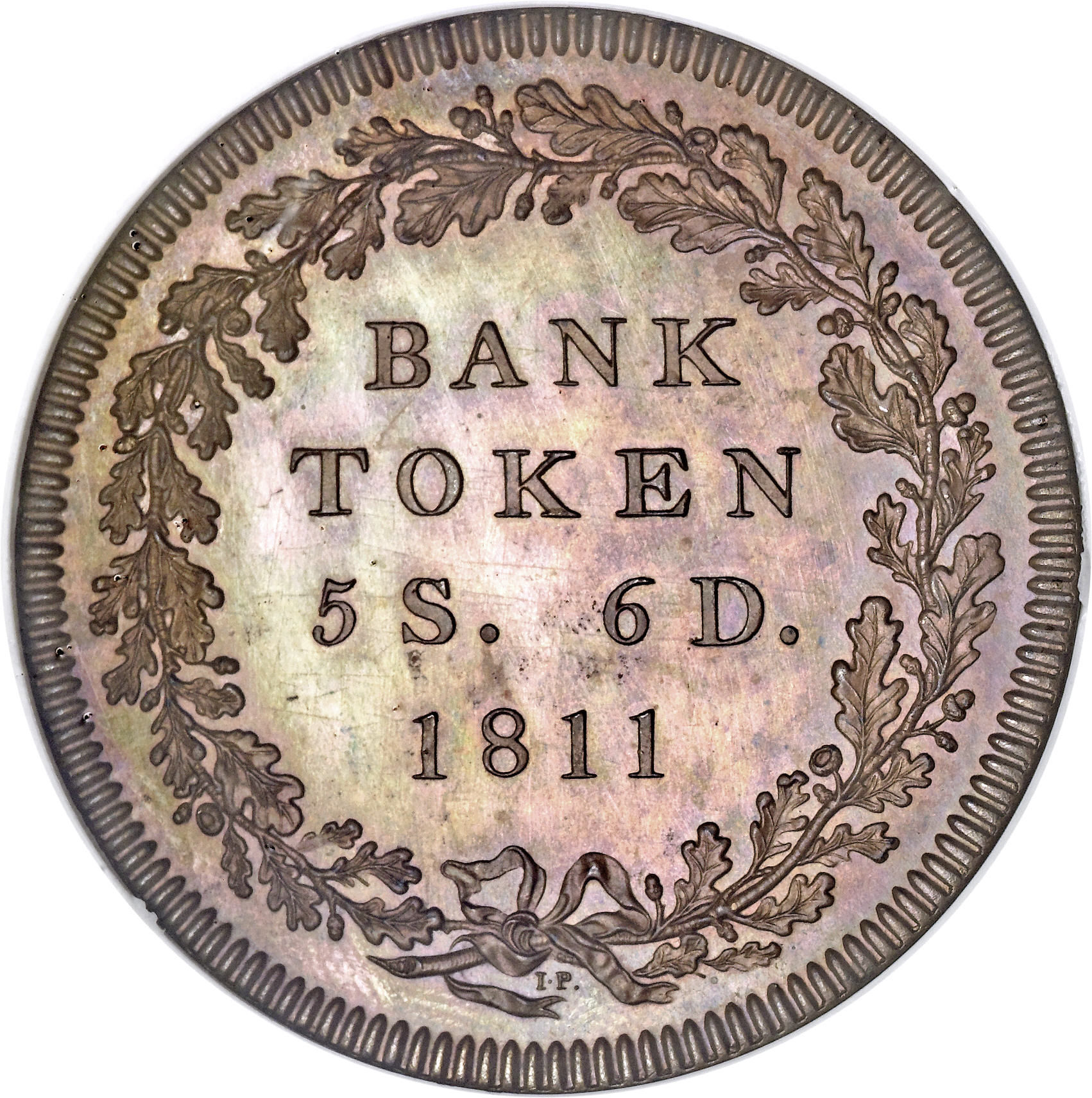
Value and date within an oak wreath.
Pattern 5 Shillings 6 Pence market value
Find this on eBay
AffiliatePattern 5 Shillings 6 Pence price history
Daily limit reachedPattern 5 Shillings 6 Pence value by grade
Realised auction prices · ⭐ Pro Expand rows for individual sale records| Grade | Latest | Median | 30d Δ | All-time range | Sales (1yr) | Total sales | Last sale | |
|---|---|---|---|---|---|---|---|---|
| FDC | £1,400.00 🔒 | £1,400.00 (1) | – | £1,400.00 – £1,400.00 | 0 | 1 | 03-12-2018 | |
|
Loading…
|
||||||||
| VF | £500.00 🔒 | £500.00 (1) | – | £500.00 – £500.00 | 0 | 1 | 05-03-2006 | |
|
Loading…
|
||||||||
| PR-65 | £1,660.75 🔒 | £1,660.75 (1) | – | £1,660.75 – £1,660.75 | 0 | 1 | 01-05-2025 | |
|
Loading…
|
||||||||
About the 1811 5 Shillings 6 Pence - George III Bank Token – Pattern
The 1811 5 Shillings 6 Pence - George III Bank Token – Pattern is a collector 5 shillings 6 pence coin, struck in copper. Reverse design: Value and date within an oak wreath.
It is no longer legal tender, so its value is to collectors only.
Common questions
How much is the 1811 5 Shillings 6 Pence - George III Bank Token – Pattern worth?
Verified sold prices for the 1811 5 Shillings 6 Pence - George III Bank Token – Pattern run from £500 to £1,661 across 3 grades, taking the median for each grade. Condition makes the difference, so check the grade table above before pricing one.
Was a five shillings and sixpence coin ever issued?
No. The Bank of England's own history records that plans were announced in 1811 for tokens of 5s 6d, 3s and 1s 6d, but the 5s 6d piece was never issued. Specimens exist as patterns; the 3s and 1s 6d tokens circulated from 1811 to 1816.
Why five shillings and sixpence?
The Bank of England's silver dollar of 1804 was tariffed at five shillings, but as the price of silver rose the dollars commanded a premium, and the Bank gave notice that it would accept them at 5s 6d. The planned token matched that new rate.
What does I.P. on the 1811 pattern stand for?
John Phillp, who designed the piece. Baldwin's describes I.P. below the oak wreath on the reverse as standing for J. Philip the designer, and Spink attributes the type to John Phillp, with some strikings made later by W J Taylor.
Is the 1811 5s 6d pattern silver?
The pieces on record are struck in copper, some as proofs with prooflike fields. The Bank of England Museum also holds a copper gilt 5s 6d pattern with Britannia on the reverse, a different design from the wreath type.
History and design
During the long wars with France silver coin was scarce, and the Bank of England stepped in. Its own history, Britannia and the Bank, records that Spanish dollars were first countermarked with a small head of George III, and that after these were widely counterfeited the Bank issued its own dollar from 1804, struck at Boulton's mint in Birmingham over Spanish coins and valued at five shillings. As the price of silver rose, those dollars commanded a premium and the Bank gave notice that it would accept them at 5s 6d.
In 1811 plans were announced for new tokens of 5s 6d, 3s and 1s 6d. The 3s and 1s 6d tokens were issued from 1811 to 1816. The 5s 6d was never issued, although, as the Bank notes, specimens exist. This entry is one of them: a copper pattern dated 1811. By the end of 1816 the Great Recoinage was almost complete, and the Bank's tokens were called in soon after.
The obverse shows a large laureate and draped bust of George III facing left, with GEORGIUS III DEI GRATIA REX and toothed borders. Christie's notes a mark on the truncation, and Baldwin's describes five berries in the wreath and a square beaded breastplate.
The reverse matches the issued smaller tokens in style: BANK TOKEN 5S. 6D. 1811 in four lines within an oak wreath, with the initials I.P. below for the designer, John Phillp. The edge is plain. The Bank of England describes a second kind of specimen with a Britannia reverse, which Wildwinds attributes to Kuchler.
Varieties and errors
Weights vary between pieces, from 25.63 g to 32.78 g in the catalogues, and Spink describes some as later strikings by W J Taylor after Phillp. The Britannia type is a separate pattern for the same value.
Collecting notes
No number struck is recorded. The pieces sold by Spink were proofs or prooflike, one graded PF64 BN by NGC; Christie's sold another in good very fine with verdigris on the reverse. Copper can develop verdigris, so check the surfaces closely.
Check whether a piece is an original or a later Taylor striking; Spink's descriptions of die axis, stops and weight help. The issued tokens of the same series are the three shillings of 1811 and the eighteen pence.
Sources
The history, design, varieties and collecting notes on this page are drawn from these sources. Prices come from recorded sales, not from them.
- Britannia and the Bank, 1694 to 1961, Bank of England (read 12 Oct 2026)
- George III, Bank of England, Pattern Five Shillings and Sixpence struck in Copper, Baldwin's (read 12 Oct 2026)
- The Pywell-Phillips Collection, lot 438: Pattern Dollar of Five Shillings and Sixpence, 1811, Spink (read 12 Oct 2026)
- George III, pattern Five Shillings and Sixpence, 1811, struck in copper, Christie's (read 12 Oct 2026)
- Summer Auction, lot 404: Pattern Dollar of Five Shillings and Sixpence, 1811, Spink (read 12 Oct 2026)
- Bank of England five shilling six pence pattern token (T051), Bank of England Museum, via Museum Data Service (read 12 Oct 2026)
- British coins of George III, Wildwinds (read 12 Oct 2026)
- Pictures of Coins of the UK: Crowns of George III, Tony Clayton, Coins of the UK (read 12 Oct 2026)