Uncommon: fewer than 10,000,000 minted.
1½ Pence - Victoria 1st portrait Colonial issue (1838–1870)
"Quatty"
| Country | United Kingdom |
| Year | 1838–1870 |
| Denomination | 1½ Pence |
| Mintage by year |
Scarcest year: 95,000 struck
|
| Mint | Royal Mint · Llantrisant |
| Circulation | Circulating |
| Demonetised | Yes |
| Composition | Silver (.925) (925/1000 fine) |
| Weight | 0.710g · 0.0211 t oz |
| Diameter | 12.0mm |
| Shape | Round |
| Edge | Plain |
| Orientation | Coin alignment ↑↓ |
| Obv. artist | William Wyon |
| Grade scale | UK (EF/UNC) |
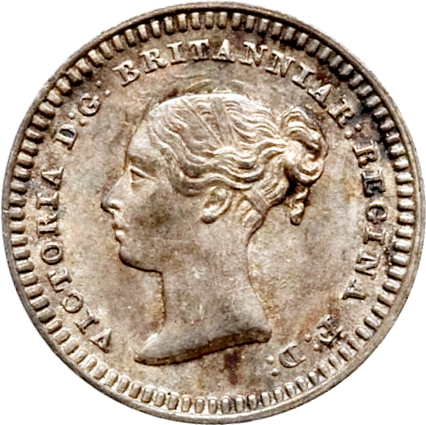
Young uncrowned portrait ('Young Head') of Queen Victoria left, legend around.
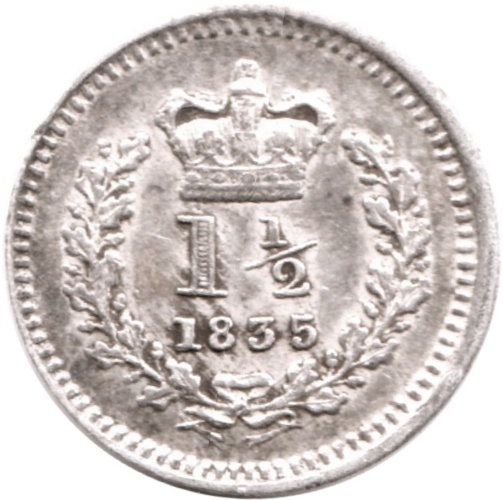
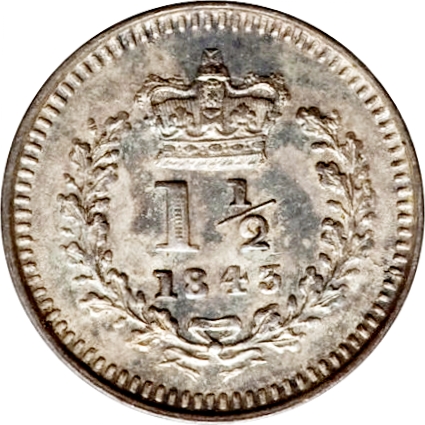
Crowned denomination above date within oak wreath.
Find this on eBay
AffiliateColonial issue 1Half Pence price history
Daily limit reachedColonial issue 1Half Pence value by year
1838 to 1862 · median sold prices| Year | Mintage | Circulated | Uncirculated | Sales | |
|---|---|---|---|---|---|
| 1838 | 539,000 | ||||
| 1839 | 760,000 | ||||
| 1840 scarcest | 95,000 | ||||
| 1841 | 158,000 | ||||
| 1842 | 1,869,000 | ||||
| 1843 | 475,000 | ||||
| 1860 | 160,000 | ||||
| 1862 | 256,000 |
One row for each year the 1½ Pence - Victoria 1st portrait – Colonial issue was struck. Prices are medians of verified sold listings matched to that year from the listing: circulated is worn condition up to Extremely Fine, uncirculated is About Uncirculated or better. A count in brackets means fewer than three sales behind the figure; a grey figure marked "type" is the median across every year, shown where that year has no sale of its own yet; years with no sales yet fill in as sales are recorded. Most types have been searched year by year only since October 2026, so later years are still filling in. Use the grade table below for a price by condition across all years.
About the 1838 1Half Pence - Victoria – Colonial issue
The 1838 1Half Pence - Victoria – Colonial issue is a circulating 1½ pence coin issued from 1838 to 1870, struck in 92.5% silver. It weighs 0.71g and measures 12mm across. Reverse design: Crowned denomination above date within oak wreath.
Mintage figures are recorded for 8 years between 1838 and 1862, 4,312,000 coins in all. 1840 is the scarcest date, with 95,000 struck. It is no longer legal tender, so its value is to collectors only.
Common questions
How much is the 1838 1Half Pence - Victoria – Colonial issue worth?
No verified sale of the 1838 1Half Pence - Victoria – Colonial issue has been logged on MyCoinage yet.
Was the three halfpence coin used in Britain?
No. Tony Clayton says the silver three halfpence never circulated in the United Kingdom. It was struck for colonies, mainly Ceylon and the West Indies, which used sterling coin. Collectors treat it as part of the British series because it closely resembles the Maundy coins.
What was the three halfpence worth in the colonies?
Clayton records that in Ceylon it passed for 4 stivers, while in Jamaica, British Guiana and Trinidad it was a quarter of a real. Wikipedia adds that Jamaicans called it a quatty, because it was a quarter of a sixpence.
Which Victorian three halfpence dates exist?
Wikipedia lists currency dates 1838 to 1843, 1860 and 1862, with proofs dated 1870 closing the series. CoinVarieties, quoting Krause, gives 760,000 for 1839, 475,000 for 1843 and 160,000 for 1860. The 1870 date is a proof only.
Who designed the Victorian three halfpence?
The obverse carries William Wyon's Young Head of Queen Victoria, the portrait used on her coins from 1838. The reverse, a crowned 1½ over the date in a wreath, was first used in 1834 under William IV and continued unchanged.
How do I identify the 1838 1Half Pence - Victoria – Colonial issue?
Check the weight 0.71g and diameter 12mm and the metal (92.5% silver) against the specification table on this page. The reverse design is described above.
History and design
The three halfpence was a colonial coin. Wikipedia describes it as produced for circulation in British colonies, mainly Ceylon and the West Indies, which used sterling coin and had no monetary policy of their own; this is why it counts as part of the British series. Tony Clayton states plainly that it never circulated in the United Kingdom. It was first struck in 1834 for William IV and continued under Victoria.
Clayton records that in Ceylon it passed for 4 stivers, and in Jamaica, British Guiana and Trinidad for a quarter of a real. Jamaicans, according to Wikipedia, called it a quatty, a quarter of a sixpence. Victorian currency dates run from 1838 to 1843, then 1860 and 1862. CoinVarieties, quoting Krause, gives 760,000 for 1839, 475,000 for 1843 and 160,000 for 1860. A proof dated 1870 closed the series.
The obverse carries William Wyon's Young Head of the Queen with the legend VICTORIA D G BRITANNIAR REGINA F D. The reverse is unchanged from William IV's coins: the figure 1½ beneath a crown and over the date, all within a wreath.
The coin is struck in sterling silver, weighs about 0.7 g and is 12 mm across, with a plain edge. Clayton notes its close resemblance to the Maundy coins, which share the crowned numeral layout.
Varieties and errors
Clayton's values page lists an 1843 coin with the date cut over 34. No other varieties or mint errors are documented for this type.
Collecting notes
At 12 mm across, the date needs magnification to read, especially when checking for the 1843/34 overdate. Of the three dates with a recorded figure, 1860 is the lowest at 160,000, under a quarter of the 1839 total. Clayton calls the 1870 proof rare.
For a coin of similar size and design struck for both Maundy and colonial use, see the Young Head twopence.
Sources
The history, design, varieties and collecting notes on this page are drawn from these sources. Prices come from recorded sales, not from them.
- Three halfpence (British coin), Wikipedia (read 10 Oct 2026)
- The Penny-Halfpenny (or Three Halfpence), Tony Clayton, Coins of the UK (read 10 Oct 2026)
- Great Britain 1839, 1843, 1860 and 1870 1-1/2 pence (pages read one by one), CoinVarieties (read 10 Oct 2026)
- Values of Penny-Halfpenny Coins, Tony Clayton, Coins of the UK (read 10 Oct 2026)
- Coin values by year, Victoria (year pages 1838 to 1862, read one by one), Coin Hunter (read 10 Oct 2026)
- The Wyons: A Dynasty of Engravers, Royal Mint Museum (read 10 Oct 2026)