
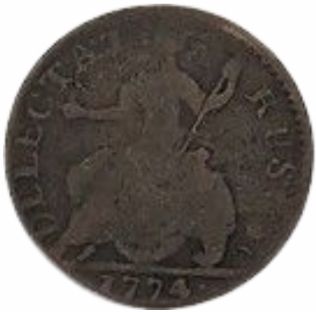
½ Penny - George III Evasion Token (1774)
"Evasion halfpenny"
| Country | United Kingdom |
| Year | 1774 |
| Denomination | ½ Penny |
| Mint | Royal Mint · Llantrisant |
| Circulation | Circulating |
| Demonetised | Yes |
| Composition | Copper |
| Weight | 6.000g |
| Diameter | 25.0mm |
| Thickness | 1.00mm |
| Shape | Round |
| Orientation | Coin alignment ↑↓ |
| Grade scale | UK (EF/UNC) |
Oversized bust of King George the third, with words surrounding it.
Britannia sitting while holding a flower in her right hand and a staff in her left. The
Find this on eBay
AffiliateAbout the 1774 Halfpenny - George III Evasion Token
The 1774 Halfpenny - George III Evasion Token is a circulating ½ penny coin, struck in copper. It weighs 6g and measures 25mm across. Reverse design: Britannia sitting while holding a flower in her right hand and a staff in her left. The.
It is no longer legal tender, so its value is to collectors only.
Common questions
How much is the 1774 Halfpenny - George III Evasion Token worth?
No verified sale of the 1774 Halfpenny - George III Evasion Token has been logged on MyCoinage yet.
What is an evasion halfpenny?
It is a private copper piece made to pass as a halfpenny while differing just enough from the regal coin to escape the counterfeiting laws, which covered only exact copies. Typical pieces have a bust and a seated Britannia, but with altered or nonsense legends.
Is an evasion halfpenny a real coin?
No. It was never issued by the Mint or authorised as currency. Evasions circulated because small change was short and many people could not read the legends, but shopkeepers could weigh them and pay out less, so whoever accepted them at face value lost out.
Can the date on an evasion halfpenny be trusted?
Not necessarily. Museum examples carry dates from the 1770s and 1790s and even 1696, and Bill McKivor's history notes that most evasions seem to have been made between 1795 and 1800, even though manufacture began in the mid 1770s.
How are evasion halfpennies catalogued?
The first listing was in Atkins, published in 1892. Cobwright's book of 1987, updated in 1993, is now the standard reference, according to the late Bill McKivor's Copper Corner history, and evasions are usually identified by their Cobwright number.
How do I identify the 1774 Halfpenny - George III Evasion Token?
Check the weight 6g and diameter 25mm and the metal (copper) against the specification table on this page. The reverse design is described above.
History and design
Tony Clayton notes that by 1770 most halfpence in circulation seem to have been forgeries. Bill McKivor's history of evasion tokens records an estimate that by 1753 no more than two-fifths of the coin in circulation was genuine, and that by 1771 magistrates had been given powers to search for and destroy coining equipment. The law, however, applied only to exact copies of the regal coin.
Forgers responded with evasions: pieces that looked enough like a halfpenny to pass in a handful of change, but changed the legend or the portrait so that they were not, in law, counterfeit coin. McKivor dates the start of their manufacture to the mid 1770s, with most made between 1795 and 1800. This entry is dated 1774, within the years of George III's first regal halfpenny, struck at the Tower from 1770 to 1775.
Evasions copied the general look of the regal halfpenny, a bust on one side and a seated Britannia on the other, while altering the words. McKivor cites legends such as 'George Rules', 'George Reigns' and 'Briton's Happy Isles' in place of the regal GEORGIVS III REX and BRITANNIA. Museum examples include a 1777 piece in Chippenham Museum reading BRITAIN RULES and GOD SAVE THE KING, and Fitzwilliam Museum pieces that put a bust of Hugh Latimer and the date 1696 on a George III era token.
The site describes this piece as having an oversized bust of the king and Britannia holding a flower and a staff. Its exact legends are not recorded here.
Collecting notes
Evasions are a collecting field of their own. McKivor names Atkins (1892) as the first listing and Cobwright (1987, updated 1993) as the standard reference, and a piece should be identified by its Cobwright number. Dates on evasions are not reliable guides to when they were made.
Weight separates them from the regal coin: they were made light, and the Royal Mint Museum's genuine halfpennies of the 1770s weigh around 9.4 g to 9.9 g. Compare an example with the regal 1770s halfpenny, and expect blundered or altered legends rather than GEORGIVS III REX.
Sources
The history, design, varieties and collecting notes on this page are drawn from these sources. Prices come from recorded sales, not from them.
- 18th Century 'Evasion' Tokens, Bill McKivor, The Copper Corner (archived by the Conder Token Collectors Club) (read 12 Oct 2026)
- Object search: evasion halfpenny George (Chippenham Museum, Fitzwilliam Museum, Leicester and Dorset records), Museum Data Service (read 12 Oct 2026)
- George III halfpenny, 1770 (RMM 1070), The Royal Mint Museum, via Museum Data Service (read 12 Oct 2026)
- The Halfpenny, Tony Clayton, Coins of the UK (read 12 Oct 2026)
More ½ Penny coins from nearby years


