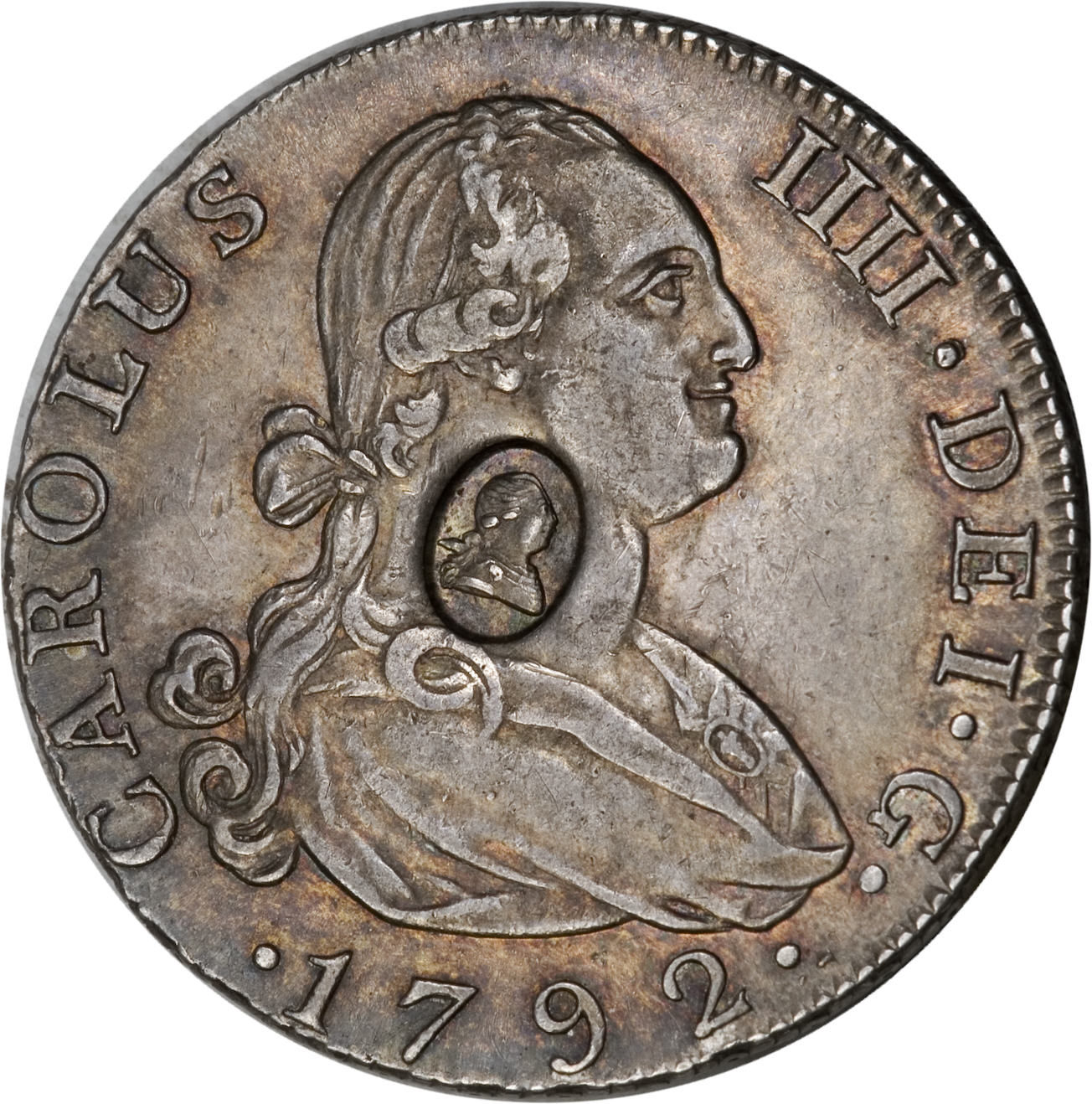
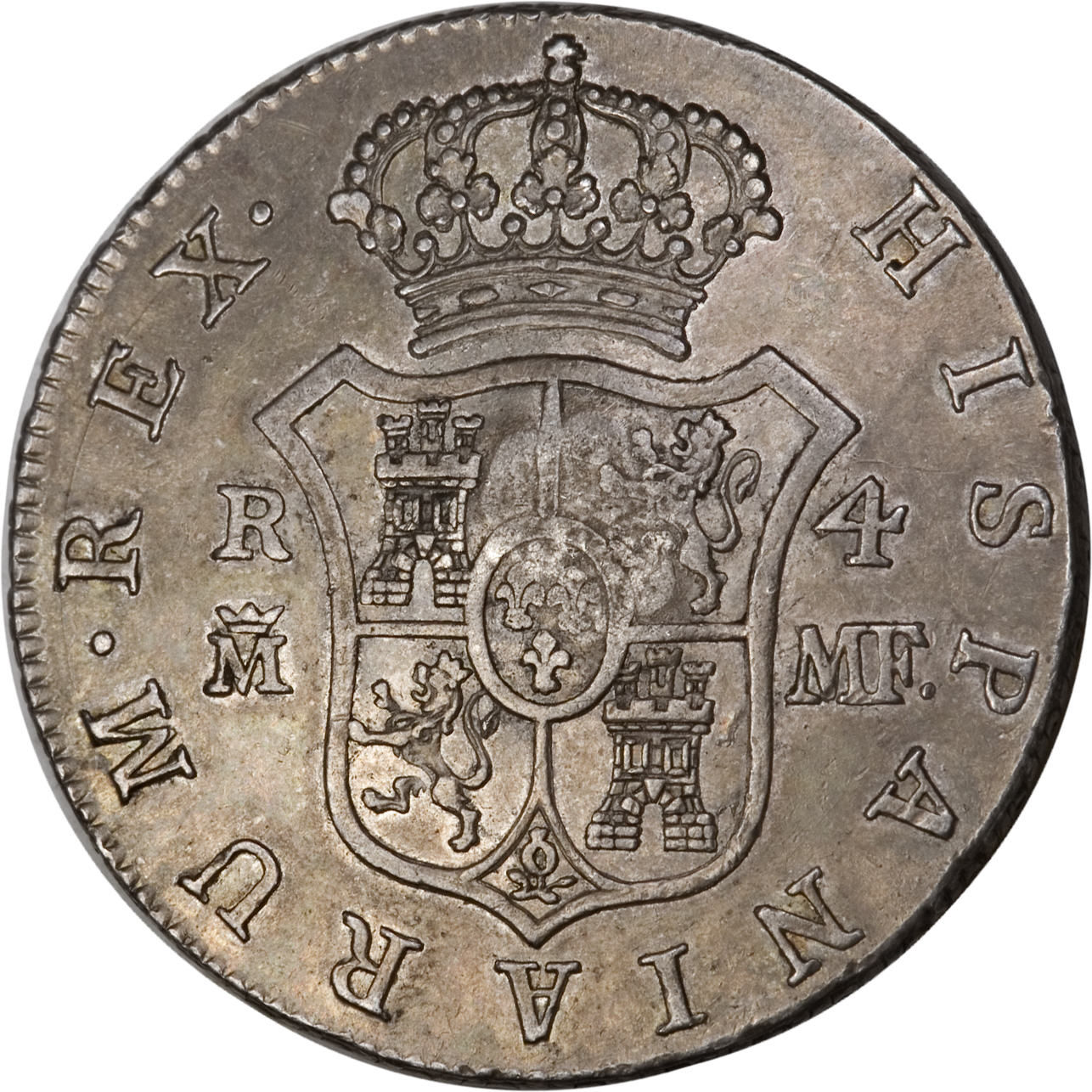
½ Dollar - George III Type I countermarked oval (1799)
"Oval countermark half dollar"
| Country | United Kingdom |
| Year | 1799 |
| Denomination | 2 Shillings 4½ Pence |
| Mint | Royal Mint · Llantrisant |
| Circulation | Circulating |
| Demonetised | Yes |
| Composition | Silver (.896) (896/1000 fine) |
| Weight | 13.500g · 0.3889 t oz |
| Diameter | 32.5mm |
| Shape | Round |
| Orientation | Medal alignment ↑↑ |
| Grade scale | UK (EF/UNC) |
Draped bust of King Carlos IV of Spain facing right; legend around, date below.
Crowned shield of arms dividing denomination, legend around
Find this on eBay
Affiliateoval Half Dollar price history
Daily limit reachedAbout the 1799 Half Dollar - George III Type I countermarked – oval
The 1799 Half Dollar - George III Type I countermarked – oval is a circulating 2 shillings 4½ pence coin, struck in 89.6% silver. It weighs 13.5g and measures 32.5mm across. Reverse design: Crowned shield of arms dividing denomination, legend around.
It is no longer legal tender, so its value is to collectors only.
Common questions
How much is the 1799 Half Dollar - George III Type I countermarked – oval worth?
No verified sale of the 1799 Half Dollar - George III Type I countermarked – oval has been logged on MyCoinage yet. Its silver content is worth about £15.58 at today's spot price, which puts a floor under its value.
What is an oval countermarked half dollar?
A Spanish silver four reales coin stamped with a small oval punch bearing the head of George III. The Bank of England had Spanish dollars and halves marked this way to make up for the lack of British silver coin at the end of the 18th century.
Why does a 1799 half dollar have an earlier date on it?
The date on the coin belongs to the Spanish host. Auction and museum examples are dated 1784, 1792, 1795 and 1796. The 1799 in the catalogue name refers to the countermark issue, not to the date struck on the coin.
Where did the oval punch come from?
The Royal Mint Museum says it was the punch normally used at Goldsmiths' Hall to hallmark silver plate. A Treasury warrant of 3 March 1797 told the Royal Mint to stamp the King's head used at Goldsmiths' Hall on silver dollars sent by the Bank of England.
How can I tell if the countermark is genuine?
Be careful with unusual host coins. Manville, quoted by a specialist site, warns that counterfeit punches are known and that the more exotic the host coin, the more likely it was made for collectors. Most genuine half dollars are on mainland Spanish coins.
How do I identify the 1799 Half Dollar - George III Type I countermarked – oval?
Check the weight 13.5g and diameter 32.5mm and the metal (89.6% silver) against the specification table on this page. The reverse design is described above.
History and design
By 1797 Britain was desperately short of silver coin. The Royal Mint Museum explains that the Bank of England bought Spanish silver dollars and had them countermarked with a small oval punch bearing the head of George III, the mark normally used at Goldsmiths' Hall for hallmarking plate. A specialist page on British countermarks quotes the Treasury warrant of 3 March 1797 that told the Royal Mint to apply the King's head to dollars sent by the Bank.
The dollars went out in spring 1797 at 4s 9d. They were widely counterfeited, and the Royal Mint Museum records that they ceased to be legal tender from the end of October 1797. Half dollars, Spanish four reales pieces, were marked with the same punch. Spink catalogues them under the Bank's emergency issues of 1797 to 1799, and the same specialist page dates them to 1799. No figure for the number marked has been found.
There is no new design. The host coin is a Spanish silver four reales, usually from Madrid, with the bust of the Spanish king and a crowned shield of arms. Sovereign Rarities describes a 1796 example of Charles IV with the legend CAROLVS.IIII. DEI. GRATIA and .HISPANIARUM. REX. A Leicester Museums example is a Charles III piece of 1784.
The countermark is a small oval with the laureate head of George III, stamped on the Spanish king's bust. Spink lists examples of about 13.2 g and 13.3 g.
Varieties and errors
The date on the coin is the host's date. Documented examples include 1784, 1792, 1795 and 1796, all from Madrid. The variety lies in the host coin rather than the British mark.
Collecting notes
Authenticity is the main concern. Manville, quoted on the same specialist page, warns that counterfeit punches are known and that the more exotic the host coin, the more likely the piece was concocted for collectors. Genuine punches were also used at assay offices for years afterwards, so a real oval mark does not by itself prove a Bank of England issue. Compare the head with an accepted example and check that the host is a Spanish four reales.
Dealers grade the countermark and the host coin separately, since one can be much better preserved than the other. The full-size piece is the oval countermarked dollar, which Tony Clayton notes gave rise to the saying that two kings' heads were not worth a crown.
Sources
The history, design, varieties and collecting notes on this page are drawn from these sources. Prices come from recorded sales, not from them.
- George III, Royal Mint Museum (read 12 Oct 2026)
- British counterstamps on Maria Theresia Talers, theresia.name (read 12 Oct 2026)
- Five Shillings, Quarter Guinea and Five and Six, Tony Clayton, Coins of the UK (read 12 Oct 2026)
- George III oval countermark Half Dollar (1796 MF host), Sovereign Rarities (read 12 Oct 2026)
- Lot 1667: Oval-Countermark Half-Dollar, 1795 MF, Spink (read 12 Oct 2026)
- Lot 363: Oval-Countermark Half-Dollar, 1792 MF, Spink (read 12 Oct 2026)
- Half dollar, countermarked coin, Carlos III, 1784 (L.N836.1982.0.0), Leicester Museums and Galleries, via Museum Data Service (read 12 Oct 2026)