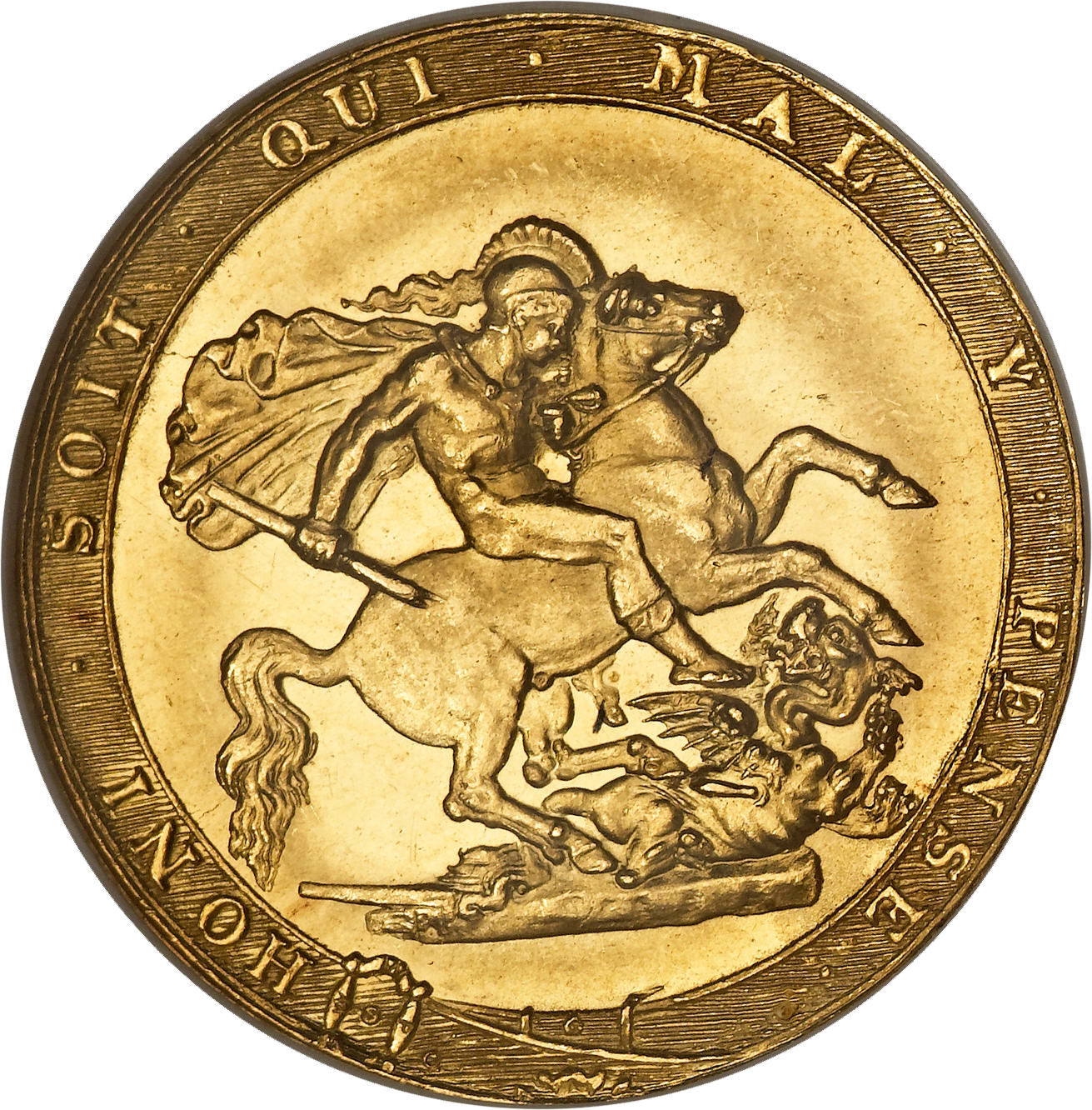
1 Sovereign - George III Pattern (1816)
| Country | United Kingdom |
| Year | 1816 |
| Denomination | 1 Sovereign |
| Face value | £1 |
| Mint | Royal Mint · Llantrisant |
| Series | Sovereign |
| Circulation | Non-circulating |
| Demonetised | Yes |
| Composition | Gold (.9167) (917/1000 fine) |
| Weight | 7.970g · 0.2349 t oz |
| Diameter | 22.1mm |
| Shape | Round |
| Orientation | Coin alignment ↑↓ |
| Obv. artist | Thomas Wyon junior |
| Grade scale | UK (EF/UNC) |
Laureate portrait of King George III right, legend around.
Ornate crowned quartered shield of arms, legend around, divided date below.
Find this on eBay
Affiliate1 Sovereign - George III Pattern price history
Daily limit reachedAbout the 1816 1 Sovereign - George III Pattern
The 1816 1 Sovereign - George III Pattern is a collector 1 sovereign coin in the Sovereign series, struck in 91.67% gold. It weighs 7.97g and measures 22.1mm across. Reverse design: Ornate crowned quartered shield of arms, legend around, divided date below.
It is no longer legal tender, so its value is to collectors only.
Common questions
How much is the 1816 1 Sovereign - George III Pattern worth?
No verified sale of the 1816 1 Sovereign - George III Pattern has been logged on MyCoinage yet. Its gold content is worth about £704 at today's spot price, which puts a floor under its value.
What is the 1816 pattern sovereign?
A trial piece for the new twenty-shilling gold coin authorised in the recoinage of 1816. It was engraved by Thomas Wyon junior, the Mint's Chief Engraver, while designs were still being tested. The sovereign actually issued from 1817 used Pistrucci's St George and the dragon instead.
Was the 1816 pattern sovereign ever in circulation?
No. Patterns were made to test designs and were not issued as money. The sovereign entered circulation in late 1817 with a different reverse, so a sovereign dated 1816 can only be a pattern.
Who was Thomas Wyon junior?
An engraver appointed to the Mint in 1811 as a young artist of promising abilities, who became Chief Engraver in 1815 while still in his early twenties. His younger cousin William Wyon became Second Engraver in 1816, and Thomas died in September 1817.
How do I identify the 1816 1 Sovereign - George III Pattern?
Check the weight 7.97g and diameter 22.1mm and the metal (91.67% gold) against the specification table on this page. The reverse design is described above.
History and design
The recoinage after Waterloo needed a new gold coin. Wikipedia records that the Coinage Act 1816 put Britain on the gold standard, and that on 3 August 1816 the Prince Regent accepted a Privy Council recommendation for gold coins including a twenty-shilling piece, which became the sovereign. The Master of the Mint, William Wellesley Pole, wanted it to look as different from the guinea as possible.
The Royal Mint Museum notes that preparing this post-Waterloo coinage involved a great deal of experimentation, much of it on design, and its collection includes 1816 pattern half sovereigns in gold and silver. This piece is a pattern for the sovereign itself, dated 1816. A Baldwin's press release of 2013 describes an 1816 gold pattern sovereign from the Bentley Collection as engraved by Thomas Wyon junior. No number struck is recorded.
The obverse carries a laureate head of George III. Thomas Wyon junior, who had become Chief Engraver in 1815, cut the dies, while the Italian gem engraver Benedetto Pistrucci, at the Mint from 1816, supplied portrait models of the king for the new gold and silver. The Royal Mint describes the related 1816 pattern half sovereigns as a short series with reverses of either crowned national emblems or a shield of arms within the Garter.
In the end the Mint chose Pistrucci's own St George and the dragon for the gold, and the sovereign issued in 1817 has no heraldic reverse at all.
Collecting notes
Patterns of this kind were never released as money, so any example is a collector's or museum piece. The Royal Mint's 1906 collection catalogue lists the 1816 pattern half sovereigns in gold and silver but no 1816 pattern sovereign, so museum comparisons are scarce. Check the date, the metal and the weight against a published catalogue description.
A silver striking is listed separately as the 1816 pattern sovereign in silver. The issued coin is the 1817 sovereign.
Sources
The history, design, varieties and collecting notes on this page are drawn from these sources. Prices come from recorded sales, not from them.
- Baldwins to auction final part of the Bentley Collection (The E-Sylum, vol. 16 no. 13), Numismatic Bibliomania Society (read 12 Oct 2026)
- George III pattern half-sovereign, 1816 (RMM 1180), The Royal Mint Museum, via Museum Data Service (read 12 Oct 2026)
- Sovereign (British coin), Wikipedia (read 12 Oct 2026)
- George III, Royal Mint Museum (read 12 Oct 2026)
- 1816 George III Pattern Gold Half Sovereign, The Royal Mint (read 12 Oct 2026)
- Catalogue of the Coins, Tokens, Medals, Dies and Seals in the Museum of the Royal Mint, Vol. I Part I (Hocking, 1906), pages 163 to 164, Royal Mint Museum library (read 12 Oct 2026)
More from Sovereign