Ads off, prices on.Pro is £1.99 a month or £19.99 a year: no adverts, unlimited coins, price alerts. Try it free for 7 days.Try Pro free for 7 days.
Try Pro free →
Guide
Half Sovereign Worth 2026: £360 Bullion to £5,000+ Rarities, 1817 to Today
A common-date half sovereign is worth £360–£410 today: its 3.66 g of fine gold is
£344 at the current spot price, plus a dealer premium of 5 to 15%. Victorian shield-backs and
branch-mint coins carry a collector premium on top, and a handful of dates (1923 SA, the 1937 proof, the 1839
Una and Lion proof) run to thousands. It has been struck almost continuously since 1817 at exactly half the gold
of a full sovereign (3.66 g vs 7.32 g), is capital-gains-tax exempt as UK legal tender, and costs
about half a sovereign's ticket (about £720). This guide covers gold content, Victorian
rarities, the four branch-mint marks (S, M, P, SA), modern bullion premium, and authentication.
In brief. Modern bullion half sovereign at gold spot £2,922/oz (2 November 2026): £360–£410.
Common-date Victorian Jubilee Head: £390–£480. Common-date shield-back Victorian: £430–£580.
1923 SA Pretoria: £3,000-5,500. 1937 George VI proof: £800-1,500.
1839 Una and Lion proof: £3,500-7,000+. CGT-exempt as 50p face-value UK legal tender.
No half sovereigns struck 1938-1979.
WatchGold Sovereigns, Half Sovereigns, Quarter Sovereign, Shield back, different headsCompares sovereign sizes incl. half sovereign (Sovereign Saurus) Video: Sovereign Saurus on YouTube
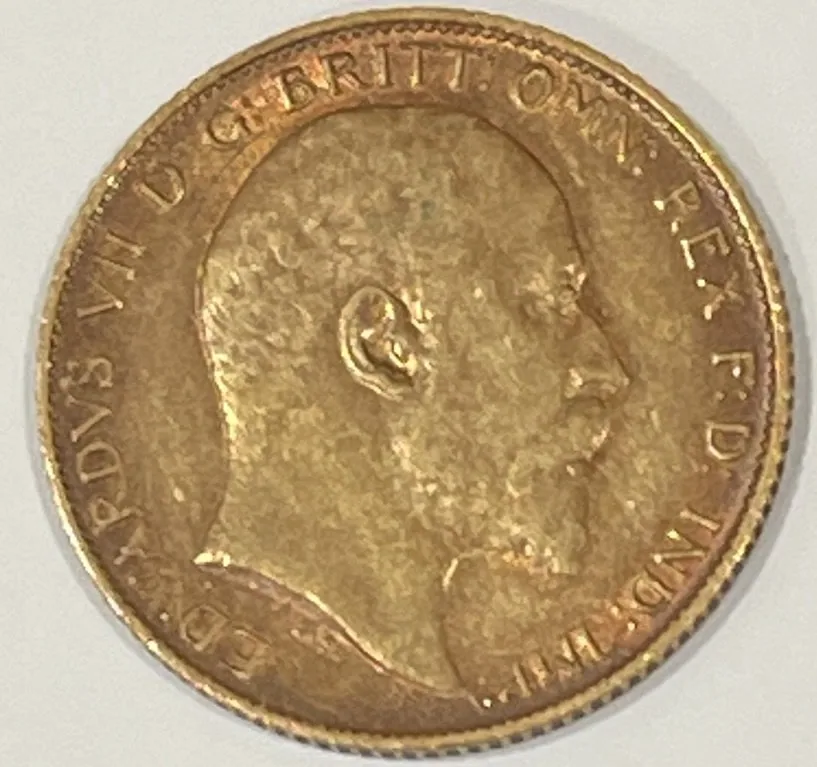
The obverse of a 1907 half sovereign.Image: 1907 half sovereign obverse by Gary Greenbaum for the image, George William de Saulles designed the coin., Wikimedia Commons, Public domain
Values below are for London-mint coins in collectable circulated condition (Fine to VF unless
stated); branch-mint coins carry the premiums covered in the next section. The common-date rows are
today’s melt (£344 at £2,922/oz, 2 November 2026) plus the usual dealer and
collector premium, so they move with the gold price × 0.118 oz.
No half sovereigns were struck 1938–1979. For a specific date and grade, open the coin's page
via the catalogue for its realised-sale history,
or get the live bullion floor from the sovereign value calculator.
Half sovereigns were struck at four of the six sovereign branch mints:
S, Sydney (1871-1916): 5-15% premium over London equivalents.
M, Melbourne (1873-1915): 10-25% premium. Key date: 1885 M shield-back at £2,500-4,500.
P, Perth (1899-1920): 15-30% premium.
SA, Pretoria (1923-1926): 30-50% premium. Key date: 1923 SA at £3,000-5,500.
The Bombay Mint did not strike half sovereigns, and the Ottawa Mint did not strike half
sovereigns, only full sovereigns. See our sovereign mint marks guide
for the full mint mark reference.
Featured half sovereigns on MyCoinage
Want it year by year? Our
sovereign value by year chart
lists every year with mintage and the median realised price from verified sales, full and half sovereign.
For the full sovereign by monarch and its lowest-mintage dates, see sovereign values UK.
Frequently asked questions
How much is a half sovereign worth?
A common-date modern half sovereign trades close to its gold-content value: at gold spot of £2,922/oz (2 November 2026), the gold content (3.66 g of .9167 fine gold) is worth roughly £344. Bullion-grade common-date half sovereigns sell at £360–£410 at UK bullion dealers (5-15% premium over melt). Older Victorian half sovereigns command higher premium: 1838 first year £800-1,500; common-date Victorian shield-back £430–£580; common-date Victorian Jubilee Head £390–£480. Branch-mint half sovereigns (Sydney, Melbourne, Perth, Pretoria) trade at £410–£580 in common dates, much higher for key dates.
How much gold is in a half sovereign?
A half sovereign weighs 3.99 g total of which 3.66 g is pure gold (.9167 fine, also expressed as 22-carat). The remainder is copper, added to harden the alloy for circulation use. The gold content of a half sovereign is exactly half of a full sovereign (3.66 g vs 7.32 g) at the same fineness. A half sovereign is roughly 0.118 troy ounces of fine gold. At a gold spot price of £2,922/oz, the pure-gold value is approximately £344. Bullion premium adds 5-15% to this melt value.
When were half sovereigns minted?
The half sovereign was struck almost continuously from 1817 to 1937, then resumed for collector and bullion use from 1980 to today. The 1817-1937 run covers George III, George IV, William IV, Victoria (Young Head, Jubilee Head, Veiled Head), Edward VII and George V. The 1937 final-year was struck only as Coronation proof for the abdicated Edward VIII originally; the George VI 1937 proof set contains the only George VI half sovereign. From 1980 onwards Elizabeth II half sovereigns have been struck for bullion and proof markets, with continuous annual issues to today's Charles III. 1938-1979 had no half sovereign production at all.
What is the rarest half sovereign?
In modern issue: the 1937 George VI proof half sovereign (mintage 5,500 in the Coronation proof set) trades at £800-1,500. In branch mints: the 1923 SA Pretoria half sovereign (mintage 4,406) at £3,000-5,500; the 1885 M Melbourne shield-back at £2,500-4,500. In Victorian: the 1839 proof half sovereign from the Una and the Lion proof set is the most-collected pre-Decimal half sovereign at £3,500-7,000+; the standard 1838 first-year young head trades at £800-1,500. The Bombay Mint did not strike half sovereigns. The Ottawa Mint did not strike half sovereigns.
Are half sovereigns CGT-exempt?
Yes. Half sovereigns are UK legal tender at 50p face value, which means they are capital-gains-tax exempt for UK residents on any future profit. The CGT exemption applies regardless of mint of origin (Sydney, Melbourne, Perth, Pretoria all qualify) and regardless of date. Combined with the smaller bullion size (compared to a full sovereign), half sovereigns are popular as a tax-efficient gold holding for UK investors who want gold exposure without the £500+ ticket size of full sovereigns or Britannias. See our CGT-exempt UK coins guide.
Half sovereign vs full sovereign, which to buy?
For pure bullion: full sovereigns are more cost-efficient, their bullion premium over melt (5-10%) is lower than half sovereigns (10-15%) because the per-coin manufacturing cost is amortised across more gold. For gift-giving, fractional gold or smaller-ticket buys: half sovereigns are more flexible, the smaller value (about £360 vs about £720 at today's gold price) makes them suitable for graduations, christenings, or first-time buyers. For collector value: half sovereigns have lower mintages than full sovereigns at every branch mint, making them statistically rarer, but full sovereigns command higher demand and faster realised-price growth. See our sovereigns vs Britannias guide.
How can I tell a real half sovereign from a fake?
Five checks. (1) Weight: 3.99 g ± 0.05 g. Use a digital scale to 0.01 g precision. (2) Diameter: 19.30 mm. (3) Thickness: 1.52 mm. (4) Magnetic test: 22-carat gold is non-magnetic. Any pull on a magnet means the coin is plated steel or brass. (5) Sound test: a genuine half sovereign rings with a clear high-pitched tone when balanced on a fingertip and tapped; counterfeits sound dull. For high-value Victorian and branch-mint half sovereigns (£500+), professional grading by PCGS or NGC is essential. Counterfeit half sovereigns are common, particularly the 19.30 mm diameter is replicated in 22-carat plated brass that fools beginners.
Where can I buy half sovereigns?
For modern bullion-grade: UK bullion dealers including Atkinsons Bullion, Baird & Co, BullionByPost, and The Royal Mint. Bullion premium 5-15% over melt; expect £360–£410 per coin at today's gold price. For Victorian and branch-mint examples: UK numismatic auction houses (Spink, Baldwin's, Noonans) for the strongest selection. For graded slabbed examples: PCGS or NGC slabbed pieces on eBay UK.
How do half sovereigns compare to fractional Britannias?
Both are UK legal-tender bullion gold and CGT-exempt. The half sovereign (3.99 g, 22-carat alloy) is the smaller, more historic option with continuous issuance since 1817 and a strong numismatic premium for older dates. The 1/2 oz Britannia (15.55 g, 24-carat .9999 fine) is larger, purer and more modern, 4× the gold content of a half sovereign. For investors: 1/2 oz Britannia is more cost-efficient on bullion premium per gram. For collectors: half sovereigns offer historic depth and branch-mint variety that Britannias cannot match. Most UK gold collectors hold both formats. See our sovereigns vs Britannias guide for the full bullion comparison.
How do I store half sovereigns?
For modern bullion examples: PVC-free coin capsules or Mylar flips, in a low-humidity environment (< 50% RH). Avoid touching surfaces; hold by edges only. For numismatic Victorian and branch-mint examples: same protective storage plus consider PCGS or NGC slab encapsulation for any coin worth £300+. Slabs protect the coin physically and provide third-party authentication and grade attestation that adds 15-25% to resale value. Insurance: most home-contents policies cap collectable cover at £1,500-3,000 per item; for a half-sovereign collection >£5,000, consider specialist coin insurance. See our coin collection insurance UK guide.
We use cookies to keep you signed in, a first-party cookie to see how the site is used, and Google Analytics.
No thanks turns off our own record; you can change it any time in your account.
Cookie Policy