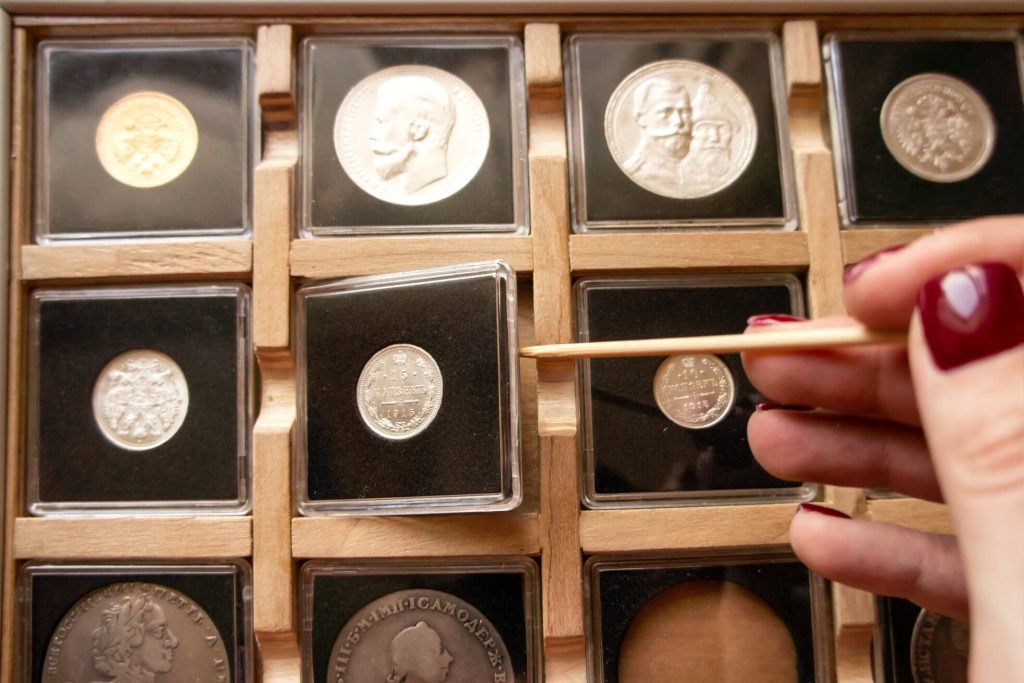
<p>A coin's grade only goes one way after minting, down. Good storage can slow that process to
near-zero; bad storage can wipe 30% off the value of a £500 coin in a year. The single most-common cause
of avoidable damage in UK collections is PVC contamination from cheap binder pages. Below is the practical
UK collector's storage guide.</p>
<h2>What to store coins in</h2>
<h3>Cardboard 2x2 flips with mylar windows, the default</h3>
<p>A folded card with a clear mylar (NOT PVC) window on each side. £0.08-£0.15 each in bulk.
Fill in grade, date and source on the card in pencil so it's visible without removing the coin.
Compatible with most UK denominations up to crown size (38mm); use larger 2x2.5 flips for anything bigger.
Brands worth buying: Saflip, Lighthouse Cardboard Holders, Trafford Coin Holders.</p>
<h3>Hard plastic capsules, for anything special</h3>
<p>Air-tight acrylic shells sized to specific coin diameters. £0.30-£0.80 each depending on
brand and size. Essential for: silver and gold coins (to prevent toning), high-value pieces (£50+),
and anything you want to handle frequently without surface contact. UK denominations:</p>
<ul>
<li>14p, 5p (post-2012): 18mm</li>
<li>10p (post-2012): 24.5mm</li>
<li>1p, 2p, 5p, 10p (older / pre-2012): 20.3-25mm</li>
<li>20p: 21.4mm</li>
<li>50p (post-1997): 27.3mm</li>
<li>50p (pre-1997, larger): 30mm</li>
<li>£1 (12-sided, post-2017): 23.43mm</li>
<li>£1 (round, pre-2017): 22.5mm</li>
<li>£2 (bimetallic): 28.4mm</li>
<li>Crown / £5: 38.6mm</li>
<li>Sovereign: 22.05mm</li>
<li>Half sovereign: 19.30mm</li>
</ul>
<p>Brands: Lighthouse Quadrum, AirTite Direct Fit, Quickslab self-encapsulators. The Quadrum holders include
a small foam ring that locks the coin in place; AirTite is a tighter pure-plastic fit.</p>
<h3>PCGS / NGC / CGS UK slabs, for £200+ coins</h3>
<p>Professionally graded coins arrive in tamper-evident plastic slabs. Don't crack them out, the
grade certification is part of the resale value, the slab is tamper-evident in a way no DIY storage can
match, and the £25-50 grading fee is already paid. Slabbed coins stack vertically in dedicated coin
storage boxes (slab boxes hold 20-30 slabs at £15-25 per box).</p>
<p>For coins genuinely worth £200+: consider grading rather than self-encapsulation. A Lighthouse
QuickSlab (DIY tamper-evident slab, no grading) doesn't carry the authentication value of a real
PCGS / NGC / CGS UK slab; for sale purposes it's seen as an enthusiast holder rather than a numismatic
slab.</p>
<h3>Coin albums, for date runs and themed sets</h3>
<p>Albums with mylar pocket pages organise large quantities of circulated material affordably. Lighthouse,
Westminster, Hartberger and Schaubek all make album systems with archival-grade pocket pages. Per-coin
storage cost is £0.20-£0.50 for the album slot. Best for collecting Olympic 50p sets, Beatrix
Potter 50p sets, date runs of pre-decimal copper, and similar circulating-grade thematic collections.</p>
<h2>What NOT to use</h2>
<ul>
<li><strong>PVC-lined sleeves and binder pages.</strong> Cheap "coin books" with clear plastic pages,
plus much of the cheap-direct-from-Asia eBay coin storage, often uses PVC. PVC plasticisers slowly
release acids and bond with coin surfaces, producing green corrosion that's irreversible. Look
for "PVC-free", "archival", "mylar" or "polyethylene" / "polypropylene" on every product description.
The damage takes 6-24 months to appear so a coin in a contaminated sleeve LOOKS fine for years before
starting to corrode.</li>
<li><strong>Direct skin contact.</strong> Skin oils and salt etch silver and copper within weeks.
Handle coins by the edge only. Cotton coin gloves are £3-5 a pair on eBay; not strictly required
but make handling easier without contamination.</li>
<li><strong>Damp environments.</strong> Bathrooms, kitchens, garages, conservatories, cellars, attics.
Silver tones blue-black in high humidity; copper turns red-brown then green; even gold develops
surface haze under prolonged damp. Aim for under 50% relative humidity.</li>
<li><strong>Stacking coins loose in tins or jars.</strong> Coin-on-coin contact creates
contact marks that permanently reduce grade. Even "junk silver" pre-1947 sterling florins
deserve individual flips at £0.10 each because the silver value alone is £5-10 per coin.</li>
<li><strong>Original Royal Mint card boxes for damp storage.</strong> The cardboard wicks moisture into
the coin capsule. Original packaging IS the gold standard for storage but only when the storage
environment is dry <50% RH.</li>
</ul>
<h2>Humidity and temperature targets</h2>
<table>
<thead><tr><th align="left">Variable</th><th align="left">Target</th><th align="left">Acceptable</th></tr></thead>
<tbody>
<tr><td>Relative humidity</td><td>40-50% RH</td><td>30-55% RH</td></tr>
<tr><td>Temperature</td><td>15-22°C</td><td>10-25°C, stable</td></tr>
<tr><td>Light exposure</td><td>Dark (cabinet, drawer)</td><td>Indirect daylight, no UV</td></tr>
<tr><td>Air movement</td><td>Sealed enclosure</td><td>Slow air exchange</td></tr>
</tbody>
</table>
<p>A cheap digital hygrometer tells you if your storage area meets the target.
Replace silica-gel sachets in your coin box every 6-12 months, they don't last forever and a
saturated sachet actually adds humidity rather than removing it. Rechargeable silica-gel desiccant tubs are a
good compromise; bake them in a low oven every 6 months.</p>
<h2>Where in your house?</h2>
<p>The ideal location is an interior wardrobe or under-bed drawer in the warmest, driest room (typically a
ground-floor or first-floor bedroom). Avoid:</p>
<ul>
<li><strong>Attic:</strong> 20+ degree temperature swings between summer and winter; condensation in
spring/autumn.</li>
<li><strong>Basement / cellar:</strong> persistent damp, 60-80% RH typical, mould risk.</li>
<li><strong>External walls and chimney breasts:</strong> cold spots cause condensation when moist
interior air contacts cooler surfaces.</li>
<li><strong>Near radiators:</strong> the dry-out / re-humidify cycle as heating switches on/off
accelerates surface oxidation.</li>
<li><strong>Bathrooms and kitchens:</strong> chronically high humidity.</li>
</ul>
<h2>Home safe vs bank safe deposit box</h2>
<p>For collections worth under £5,000, a small home safe (Burton, Phoenix, Yale brands at
£100-300) is the practical option. Look for fire rating (60+ minutes) and water rating (the LIPS
designation). The safe environment is typically slightly damper than the surrounding room because of the
sealed steel construction, so include silica gel inside.</p>
<p>For collections worth £5,000+, an external safe deposit box at an independent UK provider
(Metropolitan Safe Deposits in London, Mersey Safe Deposits in Liverpool, regional vaults) at
£200-800 per year. Insurance is generally separate and the box owner's responsibility. UK
high-street banks (Lloyds, Barclays, NatWest) all withdrew safe deposit services between 2010 and 2018, so
the bank-branch option no longer exists.</p>
<h2>Insurance, the often-skipped bit</h2>
<p>Most UK home contents policies cover coins up to £1,500-2,500 total under "general valuables"
without specific listing. Above that:</p>
<ul>
<li>Specify individual high-value coins on the policy with the insurer; they'll want professional
valuations (BNTA dealer or auction-house pre-sale estimate).</li>
<li>Consider specialist <a href="/guides/coin-collection-insurance-uk">coin collection insurance</a>, Hiscox, T H March, A-Plan all cover collectors above the standard household-cover threshold.</li>
<li>Off-site storage (safe deposit box, vault facility) usually requires the box provider's
insurance plus your own contents policy, clarify the chain of cover before signing.</li>
<li>Photograph and document EVERY coin worth £50+ for insurance purposes. The
<a href="/account/insurance-report.php">MyCoinage insurance PDF report</a> (Pro feature) produces a
formatted valuation document in the format insurers prefer.</li>
</ul>
<div style="background:rgba(224,156,38,.08);border-left:3px solid #E09C26;padding:.85rem 1.1rem;border-radius:8px;margin:1.5rem 0">
<strong>Quick PVC-damage test:</strong> look at any older-stored coin under a 10x loupe. If the surface
shows tiny green specks, hazy white residue, or a slight oily film, that's PVC damage. Move the coin
out of whatever sleeve it's in immediately and consult a dealer or grading service. Early-stage PVC
damage can sometimes be reversed with a brief acetone soak (NOT water, NOT silver dip); late-stage damage
is permanent.
</div>
<h2>The pragmatic summary</h2>
<p>Cardboard 2x2 flips with mylar for the bulk of a collection. Hard plastic capsules for anything
£50+. PCGS / NGC / CGS UK slabs for £200+ coins. Album pages for date-run sets. Silica gel for
humidity. Cool, dry, dark, stable. Avoid PVC at all costs. Photograph everything for insurance.</p>
<p>Storage is the cheapest single improvement most collectors can make. The price difference between a
properly-stored collection and a contaminated one over 10 years is enormous, a £5,000 collection
properly stored stays at £5,000+; the same collection in PVC sleeves can drop to £1,500-2,500 by
year 10 with no other change in the underlying coins.</p>
How to Store Coins Properly: A UK Collector's Guide
👤
Editor, MyCoinage
·
Published 2 May 2026
·
Updated 17 August 2026